 Warble


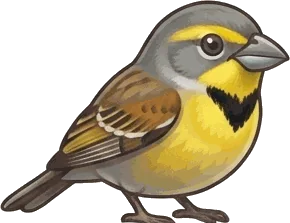
A Dickcissel sounds like it is announcing itself: dick-dick-cissel, two sharp, clipped notes followed by a buzzy, almost hissed cissel, repeated over and over by a male on a fence, a weed stalk or a shrub in prairie, hay and alfalfa fields across the middle of the country. The tone is harsh and insistent rather than sweet. Overhead, migrants give a distinctive buzzy flight call that sounds like a tiny electric buzzer, bzzzzt.
The birder's mnemonic
“dick-dick-cissel” The bird's name comes from this song, so once you have the rhythm, two sharp notes and a buzz, you have the identification.
What the song sounds like: it says its name
The song is short and easy to remember. The first two notes are sharp and clipped, dick, dick, and the last part is a buzzy, slightly hissed cissel. Some guides write it with an extra syllable, dick-dick-dickcissel, but the shape is the same: a couple of hard notes, then a buzz. The Missouri Department of Conservation calls it harsh, which is fair. It will not be mistaken for a thrush.
What makes it so noticeable is persistence. A male picks a conspicuous perch, a fencepost, a bush or the top of a tall weed, and repeats the song again and again, defending a territory in the grass below. In a good year, a single hay field can hold several singing males, and the whole field seems to be saying the bird's name.
The song is woven into the literature of the plains. Willa Cather and Laura Ingalls Wilder both wrote passages that call up its sound, and the Dickcissel remains one of the signature voices of the Great Plains and the tallgrass prairie.
The call: an electric bzzzt
The flight call is a single buzzy, electric note, written bzzzt, like a small buzzer going off. Dickcissels give it often in flight, and away from their core breeding range, migrants passing overhead are often detected by this sound alone. In late summer, when flocks start to form, it is the call to listen for over open fields.
When and where you hear it
Dickcissels breed across most of the central United States, with the core of the range in the Midwest and the prairie and farm country of the mid-continent. They originally nested in native prairies and meadows; today many nest in alfalfa, clover, timothy and other crop and hay fields, as well as weedy fields. In Missouri they arrive in late April and May, males about a week ahead of females, and they are common across the state and abundant in its plains and lowlands.
In August and September the birds gather in large flocks, and in Missouri most have left by mid-October. They winter in Central America and northern South America. Fall migrants gather in flocks of thousands, and winter roosts can hold millions. A few stay north and turn up at feeders, often with House Sparrows.
One quirk makes the Dickcissel hard to predict: its numbers jump around. A field can be full of singing males one year and silent the next, apparently in response to rainfall and changes in habitat. In the East it once nested commonly along the Atlantic seaboard, vanished in the late 1800s, and has returned only in small numbers since the 1920s. In Warble it is an uncommon card in Iowa, Kansas and Nebraska, and a legendary one in Illinois.
What it looks like
A sparrow-sized bird about 6 inches long. The breeding male looks like a miniature meadowlark: a yellow breast with a black bib at the throat, a yellow eyebrow, a gray cheek and rich chestnut shoulders. The female is plainer and resembles a House Sparrow, but with a hint of yellow on the chest and eyebrow and some reddish color on the shoulder. Meadowlarks share the colors and the fields but are larger and chunkier, with longer legs and longer, pointier bills.
Nests are bulky cups of grass and weeds hidden on or near the ground in dense grass or crops, sometimes a few feet up in a shrub. The female builds alone, lays usually four pale blue eggs and raises the young herself, and one male may have more than one mate. Early summer food is mostly insects, especially grasshoppers; the rest of the year it is mainly seeds and grain. Mowing hay before the young can leave is a real hazard, and populations have recently been declining again.
Birds that sound similar
- ?Grasshopper Sparrow
Sings from low perches in the same hay fields and prairies: sip-sip, tuhzeeeeee, two short notes and a long, thin buzz. The Dickcissel opens with sharp notes and ends in a short, harsh cissel rather than a long, drawn-out buzz.
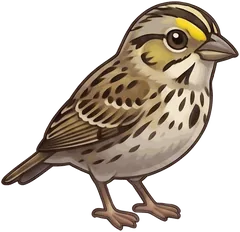 Savannah Sparrow
Also chips and then buzzes, tsip-tsip-tsip-se-e-e-srr, from fence wires in fields and alfalfa. Its song is high-pitched, with three thin chips before the buzz. The Dickcissel gives two sharp notes and a harsh, hissed cissel.
Where the Dickcissel card lives
In Warble the same bird can be an easy card in one state and a prized one in another, because each album ranks its birds by how often people really report them there. The Dickcissel appears in 8 state albums:
 Heard one? Open Warble, tap the green button while it sings, and the Dickcissel card flips into your album. Get the app free.
Questions people ask
What bird says its name in a field?
In the prairie and farm country of the central United States, it is very likely a Dickcissel. Males repeat dick-dick-cissel from fences and weed tops in hay, alfalfa and grassy fields after they arrive in spring.
What bird makes a buzzing sound when it flies over?
A buzzy, electric bzzzt from a small bird passing overhead in late summer or fall is often a migrating Dickcissel. Away from its breeding range, the flight call is often how birders detect it.
Why are there Dickcissels in my field some years and not others?
Their numbers swing widely from year to year. A site can hold many nesting pairs one season and none the next, apparently in response to rainfall and changes in the grass and crops.
Is a female Dickcissel a House Sparrow?
No, but the two look alike. A female Dickcissel has a hint of yellow on the chest and eyebrow and reddish shoulders, which a House Sparrow lacks. A few Dickcissels winter at northern feeders alongside House Sparrows, which makes the mix-up easy.
Sources
- National Audubon Society, Guide to North American Birds: Dickcissel. www.audubon.org/field-guide/bird/dickcissel
- Missouri Department of Conservation, Field Guide: Dickcissel. mdc.mo.gov/discover-nature/field-guide/dickcissel
- Missouri Department of Conservation, Field Guide: Grasshopper Sparrow. mdc.mo.gov/discover-nature/field-guide/grasshopper-sparrow
- National Audubon Society, Guide to North American Birds: Savannah Sparrow. www.audubon.org/field-guide/bird/savannah-sparrow