 Warble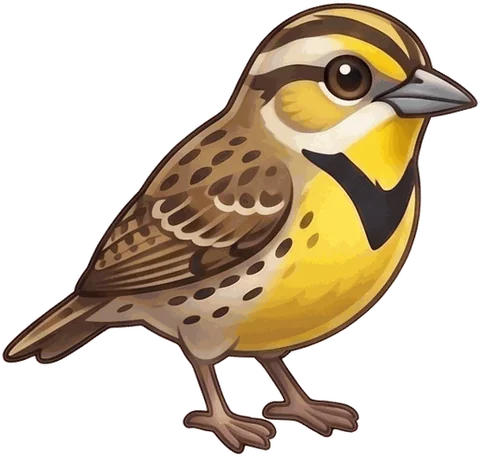
A Western Meadowlark sounds like a flute being played fast and a little drunk: one or two clear whistles, then a rich, bubbling, gurgling jumble of notes that runs down the scale and fades at the end. The whole thing takes a second or two and rings across open prairie from a fence post or power line. The call is a low, throaty chuck, and a dry rattle when the bird flushes. It is the state bird of six western states, and its liquid, complicated song is the easy way to separate it from the Eastern Meadowlark, which sings plain whistles.
What the song sounds like
The song opens like an Eastern Meadowlark's, with a clear, descending whistle or two, and then does something the Eastern never does: it breaks into a fast, flute-like gurgle, a watery tumble of notes that drops down the scale and fades out near the end. People reach for words like liquid, bubbling and bell-like. The tone is rich rather than thin, and the phrase has an obvious beginning, middle and end, all inside about two seconds.
Males sing from the highest thing available on flat ground: a fence post, a utility pole, a shrub, the top of a small tree. They are back and singing early in spring, before most other prairie birds have returned. Where the two meadowlarks overlap on the Plains they defend territories against each other and rarely interbreed, and the songs stay distinct even when the birds are side by side, which is why ear beats eye for this pair.
The call: a low chuck and a rattle
The common call is a dull, throaty chuck or chup, lower and rounder than the buzzy dzert of the Eastern Meadowlark. Flushed birds give a dry rattle as they fly off, flashing white outer tail feathers. In winter, when flocks work through stubble fields and no one is singing, these chucks and rattles are all you get, and they are still enough to separate the two species.
When and where you hear it
The Western Meadowlark is the meadowlark of the Great Plains, the Rockies, the Southwest, California and western Canada, roughly everything west of the Great Lakes. Northern birds move south for the winter and the winter range reaches central Mexico and stretches east across the southern states to western Florida, but across much of the West the birds simply stay. They migrate late in fall and early in spring. In the Midwest the two meadowlarks overlap, and the Western takes the shorter, drier, higher grass while the Eastern keeps the lusher ground.
Look for open country with nothing tall in it: native prairie, pastures, hayfields, shrub-steppe, cultivated fields, the grass beside rural airports. They avoid woods and dense brush. In dry regions the numbers rise and fall with spring rain. The birds walk rather than hop, probing the soil with the long bill for beetles, grasshoppers and crickets, and turn to seeds and waste grain in fall and winter, when seeds make up about a third of the diet.
Six states claim it: Kansas, Montana, Nebraska, North Dakota, Oregon and Wyoming. Only the Northern Cardinal is the state bird of more. On the Plains it is usually among the first grassland voices Warble players catch, since the song carries across a whole section of pasture. The species is still common, with a population estimated around 100 million, but it has lost roughly 40 percent of its numbers in 50 years to habitat loss and pesticides.
What it looks like
A stocky, short-tailed, long-billed bird 7.5 to 10 inches long with a 16-inch wingspan, weighing 3 to 4 ounces. Yellow below with a black V on the chest, streaked brown above, white outer tail feathers that show on takeoff and landing. Next to an Eastern Meadowlark it is paler on the back, and the stripe under the cheek is yellow rather than white, but these are hard marks in the field. In fall the black V is partly veiled by pale feather tips. Despite the name it is a blackbird relative, not a lark. John James Audubon named it neglecta, the overlooked one, in 1844, because Lewis and Clark had noted these western meadowlarks decades earlier and nobody had described them since.
Birds that sound similar
 Eastern Meadowlark
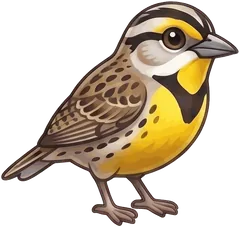
The Eastern Meadowlark gives two to four plain, slurred, descending whistles and stops. The Western starts the same way and then tumbles into a flute-like gurgle. Eastern call: a buzzy dzert. Western call: a low chuck.
- ?Chihuahuan Meadowlark
In the desert grasslands of Arizona, New Mexico and west Texas. Its song is three to five descending whistles, closer to an Eastern than to the Western's watery jumble.
 Bobolink
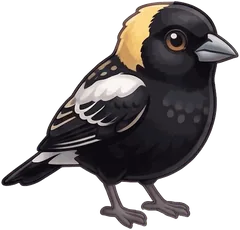
A Bobolink's song is also bubbling and tumbling, but it is a long, rambling flight song with notes jumping in every direction, often from a bird fluttering over a hayfield. The Western Meadowlark's gurgle is short, descends and ends cleanly.
Where the Western Meadowlark card lives
In Warble the same bird can be an easy card in one state and a prized one in another, because each album ranks its birds by how often people really report them there. The Western Meadowlark appears in 16 state albums:
 Heard one? Open Warble, tap the green button while it sings, and the Western Meadowlark card flips into your album. Get the app free.
Questions people ask
What is the difference between a Western and an Eastern Meadowlark song?
The Western's song is complex: a whistle or two followed by a fast, flute-like, gurgling jumble that runs down the scale. The Eastern's is simple: a few clear, plaintive whistles and nothing more. The birds look nearly identical, so voice is the practical way to tell them apart.
Which states have the Western Meadowlark as state bird?
Six: Kansas, Montana, Nebraska, North Dakota, Oregon and Wyoming. Oregon and Wyoming adopted it in 1927, Nebraska in 1929, Kansas in 1933, Montana in 1941 and North Dakota in 1947. Only the Northern Cardinal represents more states.
Is a meadowlark a lark?
No. Both meadowlarks belong to the New World blackbird family, alongside orioles and grackles. The long pointed bill, the walking gait and the habit of probing the ground are blackbird traits.
When do Western Meadowlarks start singing?
Early. Males are back on their posts and singing in early spring, well before the grass greens up, and they keep singing through early summer. Winter flocks are nearly silent apart from chucks and rattles.
Sources
- National Audubon Society, Guide to North American Birds: Western Meadowlark. www.audubon.org/field-guide/bird/western-meadowlark
- Missouri Department of Conservation field guide: Western Meadowlark. mdc.mo.gov/discover-nature/field-guide/western-meadowlark
- Wikipedia: Western meadowlark (range, naming, hybridization, state bird status). en.wikipedia.org/wiki/Western_meadowlark
- Wikipedia: List of U.S. state birds (adoption years). en.wikipedia.org/wiki/List_of_U.S._state_birds