 Warble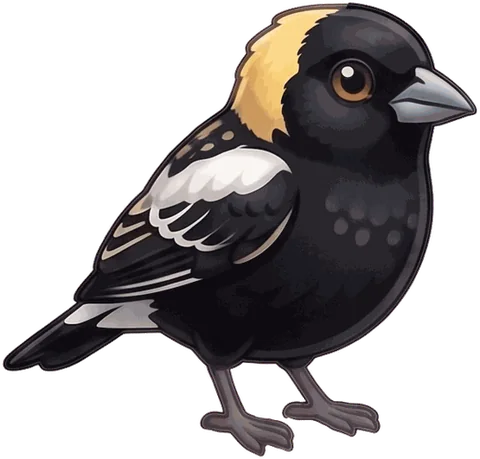
A Bobolink sounds like a music box tipped over in a hayfield: a long, fast, bubbling run of gurgling, twanging notes that jump up and down in pitch and volume with no two in a row alike. The name itself is an attempt to spell the song, bob-o-link. Males sing it while fluttering low over tall grass on stiff, shallow wingbeats, and from fence posts and weed stalks. The call is a short, soft pink, which is what you hear from flocks passing overhead on migration in late summer and fall.
The birder's mnemonic
“bob-o-link” The name is the mnemonic. Listen for that three-syllable bounce buried inside the longer bubbling song, with the last note higher.
What the song sounds like
The song is a long, rambling tumble of notes: bubbling, gurgling, twanging, some metallic like plucked wire, some clear whistles, each on a different pitch from the one before. It cascades up and down in pitch and loudness for several seconds. Males have two basic song types and often string them together into longer compound songs, especially in flight, which is why a display song can seem to go on forever.
The flight display is the thing to watch for in late May and June. The male rises a few yards over a meadow and flutters along on shallow, stiff wingbeats, singing the whole time, then drops back into the grass. On perches he spreads his tail, droops his wings and points his bill down to show off the straw-yellow patch on the back of his head.
The song belongs to the breeding grounds. By July it is mostly over, and by the time the birds gather to move south they are silent apart from calls.
The call: pink
The common call is a short, soft, slightly metallic pink. It matters more than you might expect, because for most of the country the Bobolink is a migrant heard overhead rather than a nesting bird seen in a field. In late summer and fall, flocks moving south give a steady scatter of pink notes from the sky, and that call is the only way to know they are passing. Birders also write it as spink or spank.
When and where you hear it
Bobolinks nest across southern Canada and the northern United States, most densely in the upper Midwest and from the Great Lakes east to New England and the Maritimes. The original habitat was damp meadow and tallgrass prairie; today it is mostly hayfields and pastures left uncut into July. Males arrive in late April and early May, a little ahead of the females, and the display flights run through June.
The migration is one of the longest of any American songbird. Bobolinks winter in the grasslands of Paraguay, Argentina and Bolivia, a round trip of roughly 12,000 miles a year, and tracked birds have covered more than 1,000 miles in a single day. They travel through Florida and the West Indies rather than Mexico, and they are the only land bird known to pass regularly through the Galapagos. Migrants gather in marshes and rice fields, which earned them the old southern name of ricebird and, in the 1800s, a place on the dinner table. Spring migrants pass through Tennessee and Missouri from mid-April to mid-May; fall birds return from late August into early October.
Numbers have fallen by more than 1.5 percent a year since the 1960s, and the species is listed as Near Threatened. Hay is now cut earlier and more often, and a mower in early June destroys the nests on the ground. Delaying the first cut by a week and a half has been shown to lift survival of the young by about 20 percent. In Vermont the population dropped by three quarters between 1966 and 2007.
What it looks like
A sparrow-sized blackbird relative, 6 to 7 inches long with a short, pointed tail. The spring male is black below and pale above: black face and belly, a white rump and white patches on the back, and that buff-yellow nape, a pattern often described as a tuxedo worn backwards. The female is a streaky buff sparrow with a striped crown. By August the males molt into the same buffy plumage, and the whole fall flock looks like big pale sparrows. Bobolinks molt completely twice a year, which is unusual among songbirds.
Birds that sound similar
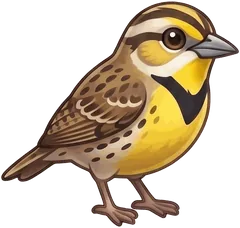 Western Meadowlark
The Western Meadowlark's song is also flute-like and gurgling, but it is short, starts with clear whistles, runs downward and ends cleanly. The Bobolink's rambles on for seconds, jumps in every direction and is usually sung in flight.
- ?Dickcissel
The other small bird singing over Midwestern hayfields. Its song is a stiff dick-dick followed by a buzzy cissel, repeated from a weed stalk over and over. No bubbling and no flight song.
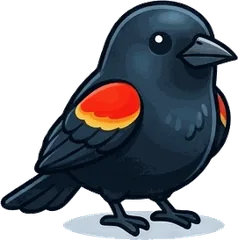 Red-winged Blackbird
Red-winged Blackbirds share wet meadows and also sing on the wing, but the song is one short gurgling conk-la-ree with a trilled end, not a long jangling run that goes on for seconds.
Where the Bobolink card lives
In Warble the same bird can be an easy card in one state and a prized one in another, because each album ranks its birds by how often people really report them there. The Bobolink appears in 3 state albums:
 Heard one? Open Warble, tap the green button while it sings, and the Bobolink card flips into your album. Get the app free.
Questions people ask
Why is it called a Bobolink?
The name is an imitation of the song. Early settlers heard it as Bob o' Lincoln, and William Cullen Bryant built a poem, Robert of Lincoln, on the same idea. Say bob-o-link quickly with the last syllable higher and you have the core of the phrase.
How far do Bobolinks migrate?
About 12,000 miles a year round trip, from the northern United States and Canada to the grasslands of Paraguay, Argentina and Bolivia. Tracked birds have flown more than 1,000 miles in a day, then rested for days or weeks. The route runs through Florida and the Caribbean.
Why are Bobolinks disappearing?
Mainly because hayfields are mowed earlier and more often than they used to be, which destroys ground nests before the young can fly. Native prairie has been lost too. The species is listed as Near Threatened.
What bird looks like a sparrow but sounds like a music box?
Probably a Bobolink. The female and the fall male are streaky, buff sparrow lookalikes, but the spring male is black below with a white back and a yellow nape, and his long bubbling song, poured out in fluttering flight over a meadow, is unlike any sparrow's.
Sources
- National Audubon Society, Guide to North American Birds: Bobolink. www.audubon.org/field-guide/bird/bobolink
- Wikipedia: Bobolink (song types, migration distances, decline, historical names). en.wikipedia.org/wiki/Bobolink
- Missouri Department of Conservation field guide: Bobolink. mdc.mo.gov/discover-nature/field-guide/bobolink
- Tennessee Wildlife Resources Agency: Bobolink (migration dates, molt). www.tn.gov/twra/wildlife/birds/grassland-and-shrub-birds/bobolink.html