 Warble
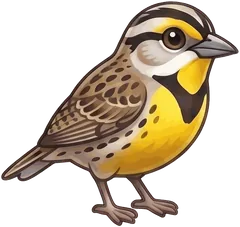
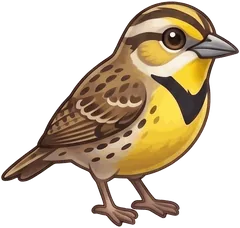
Listen to the song, because the birds themselves look almost identical. An Eastern Meadowlark sings a few clear, mellow whistles, see-you, see-yeeer, and stops. A Western Meadowlark starts with a clear whistle or two, then tumbles into a rich, flute-like gurgle that runs down the scale and fades at the end. The calls back it up: a short, buzzy dzzhrrt from the Eastern, a low, throaty chuck from the Western. One caution where the two meet: each species has been known to sing the other's song, so let the call settle a doubtful bird.
Side by side
| Eastern Meadowlark | Western Meadowlark | |
|---|---|---|
| Song | A few clear, mellow, plaintive whistles, see-you, see-yeeer; simple and unhurried | One or two clear whistles, then a rich, flute-like, gurgling jumble that descends and fades |
| Call | A short, buzzy dzzhrrt; a loud rattle in alarm | A dull, throaty chuck or chup; a dry rattle |
| Stripe below the cheek | Mostly white | Mostly yellow in breeding season |
| Back and wings | Darker, with thicker black barring | Paler brown, thinner barring |
| Flanks | Dark marks look streaked | Dark marks look spotted |
| Habitat where both live | Taller, lusher grass | Shorter, drier, higher grassland |
| Range | East of the Rockies; stays all year in most of its range | Western two-thirds of the continent; migrates late in fall and early in spring |
By ear: plain whistles or a gurgle
Male meadowlarks sing to hold a territory, Westerns typically from fence posts, treetops and power lines. The Eastern Meadowlark keeps it simple. Its song is a short series of clear, mellow whistles that fall in pitch: see-you, see-yeeer. The Missouri Department of Conservation describes it as two clear, descending whistles. It is plaintive and unhurried, and when the phrase is over, it is over. No trill, no bubbling.
The Western Meadowlark begins the same way, with a well-spaced clear note or two, and then does what the Eastern never does: it breaks into a rapid, flute-like gurgle, a jumble of rich, liquid notes that usually runs down the scale and fades out at the end. Audubon calls it very different from the plaintive whistles of the Eastern. In most places, the gurgle alone means a Western.
The calls are the backup, and they matter most outside the breeding season, when the Western's song is seldom heard. An Eastern gives a short, sharp, buzzy dzzhrrt and a loud rattle when alarmed. A Western gives a dull, throaty chuck or chup, sometimes written took, plus a dry rattle of its own. The buzz and the chuck sound nothing alike, which helps with a winter flock walking through a stubble field.
The one catch
The Tennessee Wildlife Resources Agency notes that both species have been known to sing each other's song. Song still works for most birds, but in the zone where the two overlap, an odd-sounding singer is worth a second listen for its call note before you name it.
By sight: small marks, hard to see
Both are stocky, short-tailed, robin-sized birds with a long, pointed bill, a brown-streaked back, a bright yellow breast crossed by a black V, and white outer tail feathers that flash on takeoff and landing. Audubon calls them remarkably similar and names voice and range as the main ways to separate them, which tells you how much the plumage helps.
There are differences for a close, patient look. The Eastern is darker above, because its back feathers have dark centers, and its wings and tail carry thicker black bars. The stripe running down beside the yellow throat is mostly white on an Eastern and mostly yellow on a Western in breeding plumage, February through August. On the flanks, the Eastern's dark marks look like streaks, the Western's more like spots. In fall the Western's black V is partly veiled, and nonbreeding Westerns are duller overall, so winter birds are harder still.
Where you will meet each one
The Eastern Meadowlark lives only east of the Rockies in North America, with other populations in Cuba and from eastern Mexico to northern South America. It stays all year across most of its range; only small numbers winter in the North. It breeds in native grassland, weedy pastures and hayfields. The Western Meadowlark covers the western two-thirds of the continent, in grassland, rangeland, cultivated fields and pastures, and it migrates late in fall and early in spring.
The two meet in the Midwest and split the habitat between them: the Eastern takes taller, lusher grass, the Western shorter, drier fields. They defend territories against each other and very rarely interbreed. Missouri shows the pattern well. Westerns are common year-round only in the northwest corner of Missouri, with a few breeding in the Osage Plains of the west-central part and wintering in the west and southwest. In Tennessee, the Western is a very rare winter visitor to farm fields in the west of the state, from late October to early May.
In the Southwest there is a third bird to consider. The Chihuahuan Meadowlark, recognized as a separate species in 2022, also sings plaintive whistles and gives a buzzy call like the Eastern's, but it shows more white in the tail than a Western.
 Still not sure which one is outside? Warble listens while it sings and tells you, then adds the card to your album. Get the app free.
Questions people ask
What is the difference between an Eastern and a Western Meadowlark song?
The Eastern sings a few clear, plaintive whistles and stops. The Western starts with a whistle or two and breaks into a rich, flute-like gurgle that runs down the scale. Voice is the main way to tell these near-identical birds apart.
Can meadowlarks sing the other species' song?
Yes, occasionally. Both Eastern and Western Meadowlarks have been known to sing each other's song. In the overlap zone, listen for the call: a buzzy dzzhrrt is Eastern, a low chuck is Western.
Do Eastern and Western Meadowlarks interbreed?
Very rarely. Where they overlap, in the Midwest, they defend territories against each other and prefer different grass, and hybrids turn up mainly at the edges of the ranges. Captive hybrids were fertile but produced few viable eggs.
Sources
- National Audubon Society, Guide to North American Birds: Eastern Meadowlark. www.audubon.org/field-guide/bird/eastern-meadowlark
- National Audubon Society, Guide to North American Birds: Western Meadowlark. www.audubon.org/field-guide/bird/western-meadowlark
- Missouri Department of Conservation field guide: Western Meadowlark (telling it from the Eastern, Missouri range). mdc.mo.gov/discover-nature/field-guide/western-meadowlark
- Tennessee Wildlife Resources Agency: Western Meadowlark (song, plumage, singing each other's song, hybrids). www.tn.gov/twra/wildlife/birds/grassland-and-shrub-birds/western-meadowlark.html