 Warble


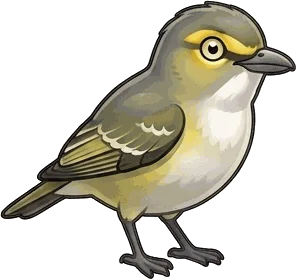
A White-eyed Vireo sounds like a short, emphatic sentence shouted from a thicket. The song is a quick burst of loud, explosive notes that usually begins and ends with a sharp chick, with a slurred whistle in the middle, and birders often hear it as quick, give me a rain check! The male sings it almost constantly from early spring to late summer, from brambles, briars and overgrown fields, and he often works imitations of other birds into it. You will nearly always hear this bird long before you see it.
The birder's mnemonic
“Quick, give me a rain check!” The song varies a lot from bird to bird, so focus on the frame: a crisp chick at the start, another at the end, and a jumble of quick notes between.
What the song sounds like: a snappy, bracketed phrase
The White-eyed Vireo's song is short, loud and almost rude in its emphasis. A typical version runs chick, peer-wheeo, chick: a sharp opening note, a slurred whistled phrase in the middle, and a sharp closing note. Audubon's field guide writes it chip-a-wheeoo-chip or quick, give me a rain check!, and the Missouri Department of Conservation offers two more: pic, pic up the beeeer check and sit, sit-behind-a-white-oak, sit. In Bermuda, where the bird is common, people call it the chick-of-the-village, which matches the rhythm nicely.
No two of those spellings agree because no two vireos do. The song is highly variable, and each bird delivers it with a different arrangement of quick notes between the sharp bookends. To make things harder, the White-eyed Vireo often slips imitations of other species nearby into its song, so a phrase can suddenly sound like someone else entirely. The snap at the start and finish is what gives it away.
Males are tireless. One will sing nearly nonstop from early spring until late summer, defending his patch of brush. If you stand near the bushes and make squeaking sounds, he may come out to inspect you and scold.
The call: a falling veeer
Away from the song, listen for a descending veeer. A White-eyed Vireo that is disturbed, for example by a birder squeaking at the edge of its thicket, will also scold.
When and where you hear it
This is a bird of the Southeast that spreads north in summer. It breeds from New England west to northern Missouri and south to Texas and Florida, and many birds along the Gulf Coast and farther south stay all year. Northern birds migrate, but compared with most vireos they arrive early in spring and leave late in fall. In Missouri, for example, White-eyed Vireos are present from April into early October, most numerous from May through early September, and much more common in the south of the state than the north.
The northern edge of the range has moved over the years. The species disappeared from Massachusetts and later came back, and it spread into Michigan in the 1960s. A separate island subspecies lives in Bermuda, where it was threatened after about eight million Bermuda cedars were lost in the 1940s. Today it numbers around 2,000 birds and is considered stable.
Wherever you are, look for dense, low growth: briar tangles on swampy ground, thickets of young shrubs and saplings in old pastures, brushy streamsides and scrubby woodland edges. The nest is a deep, hanging cup slung from a low fork and bound with spider silk. An old nickname for the bird, "the politician," may come from its habit of weaving bits of newspaper into that nest.
What it looks like
A small, compact vireo about 5 inches long, olive-gray above and whitish below with yellow on the sides. It has two white wing bars, yellow spectacles around the eyes and a fairly thick bill with a small hook at the tip. The namesake white iris is visible only at close range. Young birds have dark gray or brown eyes, and the change in iris color with age may help White-eyed Vireos judge each other's age when choosing mates. It forages slowly and deliberately, hopping from twig to twig and peering at leaves for caterpillars and other insects.
Birds that sound similar
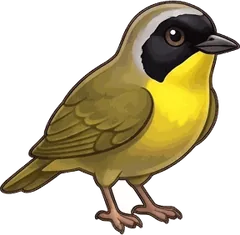 Common Yellowthroat
The yellowthroat shares the same thickets, but its loud song is a fast phrase repeated several times, witchity-witchity-witchity. The vireo sings one short, varied phrase with a sharp chick at each end.
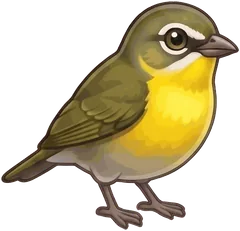 Yellow-breasted Chat
The chat is another thicket mimic, but it scatters whistles, mews and stutters with about a full second of silence between them. The vireo packs everything into one crisp, quick phrase.
Where the White-eyed Vireo card lives
In Warble the same bird can be an easy card in one state and a prized one in another, because each album ranks its birds by how often people really report them there. The White-eyed Vireo appears in 18 state albums:
 Heard one? Open Warble, tap the green button while it sings, and the White-eyed Vireo card flips into your album. Get the app free.
Questions people ask
What bird says quick, give me a rain check?
The White-eyed Vireo. Its loud, snappy song usually starts and ends with a sharp chick, and Audubon's field guide renders it quick, give me a rain check! You hear it from brambles and overgrown fields across the eastern and southern United States from spring through late summer.
Does the White-eyed Vireo imitate other birds?
Yes. It often slips imitations of other nearby species into its song, which is one reason individual songs vary so much. The sharp opening and closing notes usually stay, so listen for those.
Why does the White-eyed Vireo have white eyes?
Adults have white irises, while young birds have dark gray or brown eyes. Because the color changes with age, it may help the birds judge how old a potential mate is. You need a close look to see it.
Why is the White-eyed Vireo called the politician?
It is an old nickname, possibly earned because the bird sometimes weaves bits of newspaper into its hanging nest.
Sources
- National Audubon Society, Guide to North American Birds: White-eyed Vireo. www.audubon.org/field-guide/bird/white-eyed-vireo
- Wikipedia: White-eyed vireo (range, migration, Bermuda subspecies). en.wikipedia.org/wiki/White-eyed_vireo
- Missouri Department of Conservation, Field Guide: White-eyed Vireo. mdc.mo.gov/discover-nature/field-guide/white-eyed-vireo
- National Audubon Society, Guide to North American Birds: Common Yellowthroat. www.audubon.org/field-guide/bird/common-yellowthroat
- Missouri Department of Conservation, Field Guide: Yellow-breasted Chat. mdc.mo.gov/discover-nature/field-guide/yellow-breasted-chat