 Warble

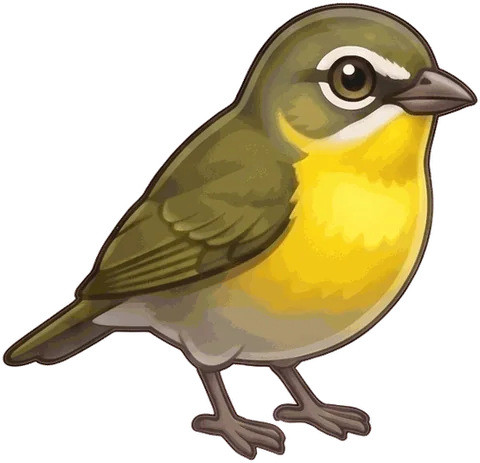
A Yellow-breasted Chat sounds like several different birds taking turns inside one bush. The song is a jumble of whistles, cackles, clucks, mews, croaks and hoots, each short phrase followed by a pause of about a second, in an order nobody can predict. Males sing from deep in a thicket or from a high perch in late spring and summer, and they often keep going after dark. The everyday call is a harsh, nasal chak.
What the song sounds like: a one-bird variety show
A singing chat strings together whistles, rattles, gurgles, clucks, hoots and catlike mews, one short burst at a time, with a gap after each. The Missouri Department of Conservation says the order of the phrases seems completely random, and that is about the best description anyone has managed. A clear whistle may be followed by a dry croak, then a chuckle, then nothing at all. Audubon's field guide stresses the same spacing: croaks and whistles with room between them, plus short phrases repeated a few times.
According to Animal Diversity Web, a male carries anywhere from 41 to 100 song types, and its breeding songs tend to be low-pitched. Males are also strong mimics. They copy the calls of other birds, and they have been recorded imitating melodies, car alarms and other human-made sounds. Neighboring males sometimes counter-sing, one delivering a song type and the next answering with the same one.
Put together, a chat in full voice sounds like a Northern Mockingbird that stops to think between every phrase.
The calls: chak, cheow and rattles
The call you hear most is a harsh chak, which the Missouri guide spells chat or tschat. Chirps, rattles and whistles also work as calls, and both parents give a sharper cheow when something threatens the young. Outside the breeding season chats go quiet and rarely sing in the open.
When and where you hear it
Chats breed across much of the United States, from the southern Canadian prairies south into central Mexico, and they winter from Mexico to western Panama. Singing belongs to the breeding season, which runs from about May into July. In Missouri, for example, they show up in late April, leave by mid-September, and are common in summer across the southern part of the state.
Look for brushy tangles: blackberry patches, briars, willow thickets along streams, overgrown pastures, regrowing burns and the shrubby edges of ponds. The bird is secretive and much easier to hear than to see. You may first notice one at night, because males often sing after dark, and a string of whistles and cackles coming out of a black hedge on a June night is hard to forget.
In fall many chats turn up along the northeastern coast, and a few stay through the winter as far north as New England, where they sometimes visit feeders for suet and peanut butter. In Missouri, numbers grew with early twentieth century logging and farming and fell again as the woods grew back.
The song flight
In spring a male will sometimes launch out of the thicket in the middle of a song, climb into the air, hover, and then come back down with slow wingbeats held high over his back and his legs dangling. It looks clumsy and sounds wonderful. Males use the flight in territorial disputes, and it is the best chance most people get to see a chat in the open. During courtship the male also points his bill straight up and sways from side to side.
What it looks like
A chunky songbird about 7.5 inches long, roughly bluebird size, with a long tail and a thick bill. It is olive above with a bright yellow throat and breast that can look almost orange, a white belly, and bold white spectacles around the eye on a dark face. Males have black between the eye and bill, females gray. The much smaller Common Yellowthroat has a black mask instead of spectacles.
The chat was long counted as the largest North American warbler. Since 2017 it has had a family of its own, Icteriidae, and genetic work places it close to the New World blackbirds.
Birds that sound similar
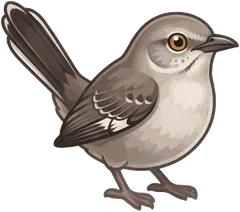 Northern Mockingbird
A mockingbird also strings together borrowed phrases, but it usually repeats each one three or four times and moves straight on. A chat leaves about a full second of silence between phrases.
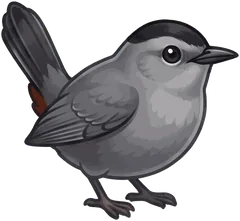 Gray Catbird
A catbird rambles through squeaks and mews with fewer repeats and much shorter gaps, so its song sounds nearly continuous. The chat's is choppy, with long pauses.
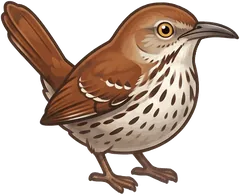 Brown Thrasher
A Brown Thrasher usually sings each phrase twice before moving on, in a steady stream from a treetop. The chat's phrases are spaced out with a pause after each.
Where the Yellow-breasted Chat card lives
In Warble the same bird can be an easy card in one state and a prized one in another, because each album ranks its birds by how often people really report them there. The Yellow-breasted Chat appears in 7 state albums:
 Heard one? Open Warble, tap the green button while it sings, and the Yellow-breasted Chat card flips into your album. Get the app free.
Questions people ask
What bird whistles and cackles at night from the bushes?
In summer it is often a Yellow-breasted Chat. Males frequently sing after dark, and their song is a jumble of whistles, clucks, cackles and croaks with a pause after each phrase. If each phrase is repeated three or four times in a quick run, think mockingbird instead.
Is the Yellow-breasted Chat a warbler?
Not anymore. It was long classed as the largest New World warbler, but in 2017 it was moved into a family of its own, Icteriidae, where it is the only species. Genetic studies put its closest relatives among the New World blackbirds.
Can a Yellow-breasted Chat imitate a car alarm?
Yes. Males are capable mimics, and Animal Diversity Web lists car alarms, melodies and other human-made sounds among the things they copy, along with the calls of other birds.
Why can I hear a chat but never see it?
Chats are secretive and spend most of their time inside dense thickets and brambles. Your best chance is in spring, when males sing from higher perches and sometimes rise into the open in a song flight.
Sources
- National Audubon Society, Guide to North American Birds: Yellow-breasted Chat. www.audubon.org/field-guide/bird/yellow-breasted-chat
- Wikipedia: Yellow-breasted chat (song, mimicry, taxonomy, range). en.wikipedia.org/wiki/Yellow-breasted_chat
- Missouri Department of Conservation, Field Guide: Yellow-breasted Chat. mdc.mo.gov/discover-nature/field-guide/yellow-breasted-chat
- Animal Diversity Web: Icteria virens, yellow-breasted chat (repertoire, mimicry, night singing). animaldiversity.org/accounts/Icteria_virens/