 Warble


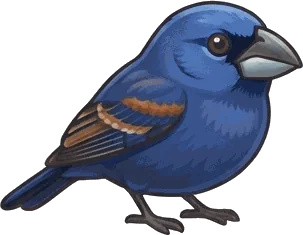
A Blue Grosbeak sounds like a rich, run-on warble: a sweet, jumbled, slightly buzzy string of notes that lasts about two and a half seconds, sung by the male from a shrub or other low perch at the edge of a brushy field. It resembles an Indigo Bunting's song but is buzzier and does not pair its phrases. The call is a loud, metallic chink, stronger than a bunting's, and the bird often flicks and spreads its tail.
What the song sounds like: a rich warble
Only the male sings, and his song is a long, rich warble of about two and a half seconds, delivered in a steady, rolling rhythm. Audubon calls it sweet and jumbled, and that is the right word for it: the notes run together and carry a slight buzz, so the phrase sounds burry rather than clean and whistled. It has a warbling, rhythmic pattern that you learn to recognize even when the details change.
The details do change. The opening of the song is similar from one male to the next, but the endings vary, and researchers counting the building blocks of these songs have found roughly 11 to 19 distinct elements per bird. Older males sing longer songs, and a male makes his singing more complex during the days when his mate is fertile, which suggests females are listening closely.
Males sing to hold a nesting territory, usually from a small shrub or another low perch near open ground. Larger, more brightly colored males tend to hold bigger territories.
The call: a metallic chink
The common call is a loud, sharp, metallic note, written chink, klink or tink depending on the guide. It is stronger and harder than the call of an Indigo Bunting, which makes it one of the best clues when you are standing at a brushy field edge and cannot see which blue bird is in the hedge. Blue Grosbeaks also give a low buzz, and in flight a distinctive series of syllables.
Watch the tail when you hear the call. Both sexes flick and spread their tails often, in a nervous-looking motion that nobody has fully explained.
When and where you hear it
Blue Grosbeaks are summer birds across most of the southern two-thirds of the United States, from southern California, Nevada and Utah east through much of the central and eastern states. They are common in summer in the South. They head north in early April, males arriving and flocking together before females show up, and they return south by mid-October to winter in Mexico and the Caribbean. Eastern birds probably cross the Gulf of Mexico, while western birds travel overland. The breeding range has been moving northward for decades, and strays turn up north of it in spring and fall.
Listen in dense, low growth in semi-open country: brushy fields, overgrown pastures, young second-growth woods, hedgerows, thickets, orchards and woodland edges. In the Southwest they are most common near water, in streamside thickets and mesquite groves. They tend to avoid suburbs and are shy around people.
Breeding runs from April into August. Pairs commonly raise two broods, with the first nest usually built in May and the second in August, so in some areas nesting, and the singing that defends it, runs late into summer. In Warble it is an uncommon card in Delaware and New Mexico, rare in most southern albums, and legendary in Kentucky, Oklahoma and South Carolina.
What it looks like
A bird about 6 to 7.5 inches long with a very thick bill. The adult male is deep, dark blue with wide cinnamon or buff wing bars; the female is warm brown with the same broad wing bars. Perched, a male looks like an oversized Indigo Bunting, but the bunting is slimmer, has a much smaller bill and lacks the obvious wing bars.
Food is mostly insects in summer, including grasshoppers, beetles, caterpillars, cicadas, praying mantises, spiders and snails, plus weed seeds, grass seeds and waste grain, and in fall they gather in big flocks in grain fields. Adults pull the head, legs and wings off insects before feeding them to the chicks. The female builds a compact cup in a shrub, tree or vine, usually 3 to 10 feet up, and often decorates it with odd scraps such as snakeskin, paper, string or rags. She lays three to five pale blue eggs, and cowbirds often add their own.
Birds that sound similar
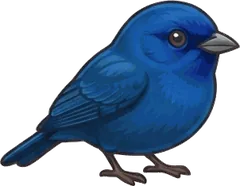 Indigo Bunting
An Indigo Bunting builds its song from paired phrases. The Blue Grosbeak's song is similar but buzzier and more rolling, with no pairs, and its chink call is louder and more metallic than a bunting's.
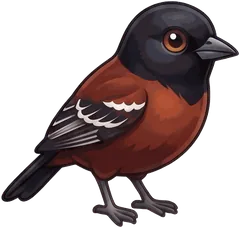 Orchard Oriole
The Orchard Oriole sings a rapid, musical warble from shade trees and orchards along the same field edges. The grosbeak's song is buzzier and usually comes from a low shrub rather than a treetop.
Where the Blue Grosbeak card lives
In Warble the same bird can be an easy card in one state and a prized one in another, because each album ranks its birds by how often people really report them there. The Blue Grosbeak appears in 14 state albums:
 Heard one? Open Warble, tap the green button while it sings, and the Blue Grosbeak card flips into your album. Get the app free.
Questions people ask
How do you tell a Blue Grosbeak from an Indigo Bunting by sound?
Listen for pairs. The Indigo Bunting's song is built from paired phrases. The Blue Grosbeak's warble is buzzier and runs on without pairs, and its chink call is louder and more metallic than a bunting's.
Do female Blue Grosbeaks sing?
No. Only males sing. Females are warm brown with broad wing bars, and they share the male's habit of flicking and spreading the tail, which helps you spot them in a hedge.
Why does a Blue Grosbeak flick its tail?
Nobody knows for sure. Tail flicking and spreading is common in both males and females and looks nervous, but its purpose has not been worked out. It is a handy clue when a dark bird pops up in a hedgerow.
Is the Blue Grosbeak expanding north?
Yes. Its breeding range has moved northward in recent decades, and surveys suggest the overall population is stable or slightly increasing. Strays show up north of the regular range in spring and fall.
Sources
- National Audubon Society, Guide to North American Birds: Blue Grosbeak. www.audubon.org/field-guide/bird/blue-grosbeak
- Animal Diversity Web (University of Michigan): Passerina caerulea. animaldiversity.org/accounts/Passerina_caerulea/
- BWD Magazine (Bird Watcher's Digest): Blue Grosbeak. bwdmagazine.com/learn/blue-grosbeak
- National Audubon Society, Guide to North American Birds: Orchard Oriole. www.audubon.org/field-guide/bird/orchard-oriole