 Warble


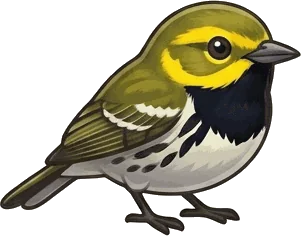
A Black-throated Green Warbler sounds like a sleepy insect that has learned a tune. The song is a short run of thin, buzzy notes with a lower one tucked in near the end, written zee-zee-zee-zoo-zee, and males also sing a second version, zoo-zee-zoo-zoo-zee. You hear it from high in spruce, hemlock and pine forests across the North and down the Appalachians in late spring and summer, and from woods and edges across the East during migration. The call is a sharp tsip.
The birder's mnemonic
“zee-zee-zee-zoo-zee” The Missouri Department of Conservation offers a memory aid built on the word trees: trees, trees, trees, trees, love-TREES! Either way, listen for the buzz and the dip near the end.
What the song sounds like: lazy buzzes with a dip
Every note in this song is a buzz rather than a whistle, thin and a little drowsy, as if the bird were humming through a comb. Audubon describes it as a lazy zeer repeated, or a faster zee-zee-zee-zoo-zee. The lower zoo near the end is the hook: the song climbs along on high buzzes, dips once, and pops back up for the last note. The Missouri guide writes it ZEE-ZEE-ZEE-ZEE-zooZEE! and notes that people usually hear this warbler before they see it.
Males have two song types, and they use them for different jobs. The zoo-zee-zoo-zoo-zee pattern announces and defends the nesting territory. The zee-zee-zee-zoo-zee pattern is for courtship and for keeping in touch with a mate. Once you know both, you can tell what kind of morning a male is having.
Singers often pick an exposed perch, such as the top twig of a tall spruce. Because males also forage higher in the canopy than females during the breeding season, the song usually seems to float down from somewhere well over your head.
The calls: tsip, chip and see
The common call is a sharp tsip, and you will also hear a variety of high, sharp see notes and chip notes. In late summer, when Black-throated Greens often travel with chickadee flocks, listen for these notes mixed into the chickadees' chatter.
When and where you hear it
The main breeding range covers Canada, the Great Lakes region, the northeastern United States and the Appalachians south to northeastern Alabama, with a small isolated population in northwest Arkansas. Breeding birds favor dense conifers, especially spruce, but also white pine, hemlock, red cedar and jack pine, and they use mixed forest too. An isolated race on the southern Atlantic Coast breeds in cypress swamps and builds its nests much higher, sometimes 50 feet or more up, while most Black-throated Greens nest in a fork beside a conifer trunk, often only a few feet off the ground.
Migration happens mostly at night, and during passage the birds turn up in all kinds of woods, edges and thickets. In Missouri, where they only pass through, spring migrants appear from early April through May, peaking in late April and early May, and fall birds come through from early September to mid-October, peaking in mid-September. Fall migration can run well into October even in the north. Missouri's fall migrants fuel up on red cedar cones and the fruit of poison ivy and sumac.
Winter is spent in Mexico, Central America and the Caribbean, with some reaching southern Florida, usually among oaks and pines in foothills and mountains. In parts of the Rockies, where its range meets that of Townsend's Warbler, the two species sometimes hybridize.
What it looks like
A small warbler, 4 to 5 inches long, with a bright yellow face, a moss-green back and crown, two white wing bars and black streaks along pale flanks. The adult male has a solid black throat and upper breast. Females and young birds show less black, with the throat partly or mostly white. It forages quickly, moving from twig to twig and often hovering to pick insects, mostly smooth caterpillars, from the undersides of leaves. The nest is shared work: both sexes build it, and after the young leave, each parent takes charge of half the brood for up to a month.
Birds that sound similar
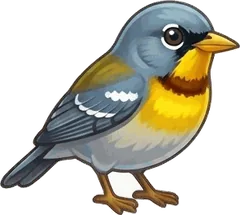 Northern Parula
A parula's song is a rising buzz that snaps off with a short dropped note at the end, bzzzzz-zip. The Black-throated Green's buzzes are separate, lazy notes with a lower zoo tucked in near the end.
- ?Black-throated Blue Warbler
Its song is a husky, rising zwee-zwee-zwee from the interior of hardwood and mixed forest. It keeps climbing, while the Black-throated Green's song dips on a lower note before the finish.
Where the Black-throated Green Warbler card lives
In Warble the same bird can be an easy card in one state and a prized one in another, because each album ranks its birds by how often people really report them there. The Black-throated Green Warbler appears in 16 state albums:
 Heard one? Open Warble, tap the green button while it sings, and the Black-throated Green Warbler card flips into your album. Get the app free.
Questions people ask
What bird sings zee zee zee zoo zee?
The Black-throated Green Warbler. Its thin, buzzy courtship song, zee-zee-zee-zoo-zee, comes from high in conifer and mixed forests across the North and the Appalachians in late spring and summer, and from woods and edges across the East during migration.
Why does the Black-throated Green Warbler have two songs?
Each song has a job. Males use zoo-zee-zoo-zoo-zee to proclaim and defend their territory, and zee-zee-zee-zoo-zee for courtship and for communicating with their mate.
Do Black-throated Green Warblers nest in the South?
Some do. They breed down the Appalachians to northeastern Alabama, there is a small isolated population in northwest Arkansas, and a separate race breeds in cypress swamps on the southern Atlantic Coast.
When do Black-throated Green Warblers migrate?
Mostly at night, in April and May and again from September into October. In Missouri, for example, spring passage peaks in late April and early May and fall passage peaks in mid-September.
Sources
- National Audubon Society, Guide to North American Birds: Black-throated Green Warbler. www.audubon.org/field-guide/bird/black-throated-green-warbler
- Wikipedia: Black-throated green warbler (song, call, range, hybridization). en.wikipedia.org/wiki/Black-throated_green_warbler
- Missouri Department of Conservation, Field Guide: Black-throated Green Warbler. mdc.mo.gov/discover-nature/field-guide/black-throated-green-warbler
- National Audubon Society, Guide to North American Birds: Northern Parula. www.audubon.org/field-guide/bird/northern-parula
- National Audubon Society, Guide to North American Birds: Black-throated Blue Warbler. www.audubon.org/field-guide/bird/black-throated-blue-warbler