 Warble


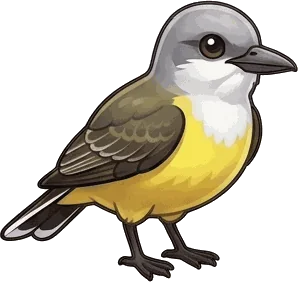
A Western Kingbird sounds like an argument on a fence wire. The everyday call is a loud, sharp kit, and when birds get worked up they run their notes into a high, squeaky, rising chatter, something like widik pik widi pik pik. Neighbors bicker this way around their nests all summer and turn the noise on any hawk or raven that comes close. At first light males add a dawn song. Listen in open country with scattered trees, ranch yards and roadsides across the West from late spring through August.
What the song sounds like: squeaky and sputtering
Kingbirds are flycatchers, and flycatchers do not learn their songs. They are born with them, and they sing through a simpler voice box than true songbirds have, so do not expect a melody. The Western Kingbird's song is high and squeaky, written pidik pik pidik PEEKado, with the stress near the end. It sounds less like singing than like a rubber toy squeezed in a hurry.
Males give a dawn song at the first hint of daylight to hold their territory, so the best performance is before sunrise. Courtship adds a show in the air. The male rises in rapid vertical zigzags, twisting and flipping while he sputters out fast calls, or flutters nearly in place with his feathers vibrating and a trilling song pouring out.
The calls: kit and the bickering chatter
The call you hear most is a loud, sharp, hard kit, given from a wire, a post or a treetop. Excited birds string their notes into a rapid, rising, shrill series, widik pik widi pik pik, and add assorted chattering notes. That squeaky, quarrelsome chatter is the sound of summer in the open West: two kingbirds settling a boundary, or a family scolding a hawk.
The chatter often turns into a chase. Western Kingbirds fly at ravens, hawks, crows and owls that come near the nest, and where many pairs nest close together, as many as ten have been seen attacking a predator as a group. One kingbird even teamed up with a Scissor-tailed Flycatcher to drive a grackle out of their shared nest tree. Not every threat is vocal: they also raise their crown feathers, flick their wings and crouch.
When and where you hear it
Western Kingbirds breed across western North America, from southern Canada to just past the Mexican border, and east to about the Mississippi River. They need open ground with something to perch on: dry savanna, farmland, prairie with streamside trees, semi-desert scrub, ranch yards and corrals, and towns. They avoid true desert. Where they overlap with Eastern and Cassin's Kingbirds, the Western takes the most open country.
In Washington they arrive in late April or early May and are common in the eastern lowlands, especially on farmland, from May to August. Across the range, nest building starts in early May in the south and in late May or early June elsewhere. Birds begin to scatter in mid-August and travel alone or in small flocks to southern Mexico and Central America. A few stray to the Atlantic Coast every fall, and some spend the winter in Florida.
The nest is a cup of grass, twigs and plant fibers lined with feathers, down and hair, usually in a tree but very often on a utility pole where the wires attach, even along busy city streets. In Washington a favorite spot is beside a transformer. Food is mostly large insects such as bees, wasps, beetles, grasshoppers and robber flies, caught in midair or picked off the ground after a short hover, plus some berries. The species spread east during the 20th century and grew more common, and it now numbers around 30 million. For Warble players in farm country, a June morning along a fence line is the time to catch this card.
What it looks like
About the size of a robin, 7.9 to 9.4 inches long, sitting upright on a wire. The head and chest are pale gray with a darker mask, the belly bright yellow, the back gray-green and the wings darker. The best mark is the tail: black and square-ended, with narrow white outer edges. An orange-red crown patch stays hidden except during displays. Males and females look alike, and young birds are paler.
Birds that sound similar
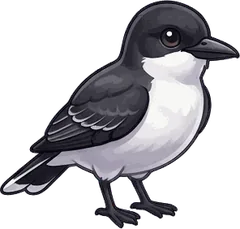 Eastern Kingbird
The Eastern Kingbird also chatters in harsh, rapid kit and kitter notes, so the two can sound alike. Its main call, though, is a sharp dzee or dzeet rather than a clean kit, and it needs water near its nest.
- ?Cassin's Kingbird
Looks nearly identical, but its call is a loud chi-beer!, often run into a rapid ch-beer-beer-beer-r-r. Where both live, Cassin's usually sits higher, in pine-oak, pinyon-juniper and other more wooded country.
Where the Western Kingbird card lives
In Warble the same bird can be an easy card in one state and a prized one in another, because each album ranks its birds by how often people really report them there. The Western Kingbird appears in 14 state albums:
 Heard one? Open Warble, tap the green button while it sings, and the Western Kingbird card flips into your album. Get the app free.
Questions people ask
Why do Western Kingbirds chatter so much?
Mostly to defend their nests. Males sing a dawn song at first light, and the sharp kit calls and squeaky chatter rise whenever a rival, a hawk or a raven gets close. Neighboring kingbirds sometimes gang up on a predator together.
What does a Western Kingbird's call sound like?
A loud, sharp kit. Excited birds run their notes into a high, squeaky, rising series written widik pik widi pik pik, with extra chattering notes mixed in.
Why do Western Kingbirds nest on power poles?
They are adaptable. In open country and in towns where trees are scarce, they often build on utility poles, usually where the wires attach, even along busy streets. In Washington a spot next to a transformer is a common choice.
When do Western Kingbirds migrate?
They arrive in late April or early May in the north and start leaving in mid-August, alone or in small flocks, for southern Mexico and Central America. A few spend the winter in Florida.
Sources
- National Audubon Society, Guide to North American Birds: Western Kingbird. www.audubon.org/field-guide/bird/western-kingbird
- Animal Diversity Web: Tyrannus verticalis (song, calls, behavior). animaldiversity.org/accounts/Tyrannus_verticalis/
- Seattle Audubon BirdWeb: Western Kingbird. www.birdweb.org/birdweb/bird/western_kingbird
- National Audubon Society, Guide to North American Birds: Eastern Kingbird. www.audubon.org/field-guide/bird/eastern-kingbird
- National Audubon Society, Guide to North American Birds: Cassin's Kingbird. www.audubon.org/field-guide/bird/cassins-kingbird