 Warble


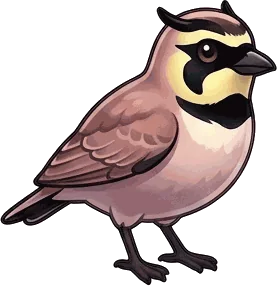
A Horned Lark sounds like faint, high wind chimes: a soft, twittering, tinkling series of notes, usually sung by a male circling high over a bare field, often so high that the song reaches you before you find the bird. On the ground, Horned Larks give thin, lisping calls written tsee or tzee-te-te, and a soft ti-ti as a flock lifts off. They live in the most open places around: plowed fields, short grass, airports and beaches.
What the song sounds like: tinkling from the sky
The song is a high-pitched string of tinkling, twittering notes, with nothing loud or whistled about it. It sounds less like a melody than like tiny bells shaken together, and because it is soft and often comes from far overhead, it can seem to drift down out of an empty sky.
Most singing happens in flight, but not all of it. Males also sing from the ground to defend their territory. Listen for the song early in the year: in Missouri, courtship singing starts in January and February.
The call: a thin, lisping tsee
Horned Larks keep in contact with soft, high, lisping notes, written tsee, tzee-te-te or ti-ti. You hear them most from winter flocks, especially when a group is flushed from a field and takes off in a swift, twisting flight. The notes are soft, so watch for the flock and then listen as it passes.
When and where you hear it
Horned Larks are birds of bare, open ground, and they avoid places with trees or bushes. Look and listen in short-grass prairie, plowed and stubble fields, large lawns at airports and golf courses, beaches, lake flats, and dry tundra in the far north and high mountains. Anywhere the ground is wide, flat and nearly empty is worth a pause.
From southern Canada southward they can be found year-round in most areas, although the birds you see in winter may not be the ones that nested there. Far-northern birds are strictly migratory and are among the earliest spring migrants. In winter, flocks walk across open fields picking seeds from the soil and stubble. In Warble it is an uncommon card in Plains and Rocky Mountain albums such as Kansas, Nebraska and Colorado, and a legendary one in Michigan and Minnesota.
East of the plains, the Horned Lark was originally a bird of the midwestern prairie and spread east as people plowed prairie and cleared forest. In Tennessee the first known nest was found in 1925. Farm fields suit it so well that its numbers probably rose as farmland spread, though they have declined in recent decades.
The sky display
The show that goes with the song is worth waiting for. A male rises steeply to a height of several hundred feet, then hovers and circles for several minutes, singing all the while. When he is done he folds up and drops toward the ground like a dart, opening his wings only at the last moment. If you hear tinkling and cannot find the bird, look much higher than seems reasonable.
What it looks like
A sandy-brown ground bird about 7 inches long, and the only lark native to North America. The face is the giveaway: a black mask that sweeps down the cheek, a black band across the chest, a white to yellow face and throat, and, at close range, two tiny black feather tufts on the crown that give the bird its name. Females are duller with smaller horns. In flight it looks pale, with a black tail edged in white. It walks and runs rather than hops.
Nesting starts remarkably early, as soon as February in Missouri and with eggs by early to mid-March in Tennessee. The female scrapes a shallow hollow in bare ground, often beside a grass clump or a dried cow pat, lines it with grass, and often adds a flat doorstep of pebbles on one side. She lays about four spotted eggs and incubates them for around 11 days. Southern pairs can raise two or three broods a year. Many nests are lost when fields are worked in spring, and raccoons, skunks and weasels take others; if a predator gets close, the female may fake an injury, like a Killdeer.
Birds that sound similar
- ?American Pipit
Tennessee's wildlife agency warns that pipit and lark calls can be confusing in winter fields. If the caller has no black face markings and no horns, think pipit.
- ?Lapland Longspur
Longspurs share plowed and stubble fields with larks in winter. Their call is a husky, whistled tleew, unlike the lark's thin, lisping tsee.
Where the Horned Lark card lives
In Warble the same bird can be an easy card in one state and a prized one in another, because each album ranks its birds by how often people really report them there. The Horned Lark appears in 15 state albums:
 Heard one? Open Warble, tap the green button while it sings, and the Horned Lark card flips into your album. Get the app free.
Questions people ask
What bird sings high in the sky over a field?
Over bare fields, short grass or airports, it is very often a Horned Lark. Males climb several hundred feet, circle and sing a soft, tinkling song for minutes at a time, then dive steeply. The song is soft and comes from high up, so you may hear it long before you spot the bird.
Do Horned Larks really have horns?
No. The horns are two small tufts of black feathers on the crown. They are visible only at close range and are less obvious on females.
When do Horned Larks start singing?
Very early. In Missouri courtship songs and display flights begin in January and February, and nesting can start in February. That makes it one of the earliest nesting songbirds.
Where do Horned Larks go in winter?
Some stay put. From southern Canada south they can be found all year in most areas, while far-northern birds migrate south. In winter they form flocks on open fields, often joined by migrants from farther north.
Sources
- National Audubon Society, Guide to North American Birds: Horned Lark. www.audubon.org/field-guide/bird/horned-lark
- Missouri Department of Conservation, Field Guide: Horned Lark. mdc.mo.gov/discover-nature/field-guide/horned-lark
- Tennessee Wildlife Resources Agency: Horned Lark. www.tn.gov/twra/wildlife/birds/grassland-and-shrub-birds/horned-lark.html
- Tennessee Wildlife Resources Agency: Lapland Longspur. www.tn.gov/twra/wildlife/birds/grassland-and-shrub-birds/lapland-longspur.html