 Warble


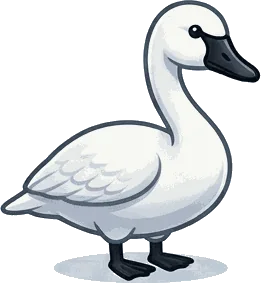
A Trumpeter Swan sounds like its name: a loud, low, bugling ko-hoh with a brassy, horn-like tone. It is deeper than the call of the Tundra Swan, the other native swan, and pairs often call together in a duet that starts as two separate voices and ends almost in unison. Young birds sound higher and more nasal. You hear trumpeters on marshes, lakes and slow rivers in the northern states and Alaska in summer, and on open water farther south in winter.
What it sounds like: a low, bugling horn
Swans do not sing, but the trumpeter has the best voice of the lot. Audubon writes the call as a bugling ko-hoh, and its tags describe it as a honk that is mostly flat but can rise and fall. The Missouri Department of Conservation calls it a low, trumpet-like sound, and Wikipedia describes it as loud and somewhat musical. The bird was named for it twice over: the common name is obvious, and the scientific name buccinator comes from bucina, a kind of military trumpet.
Imagine a child's toy horn with real lungs behind it, pitched low, and you are in the neighborhood. The written ko-hoh catches the shape: two syllables run together and delivered loudly.
Young trumpeters have not grown into the voice yet. Their calls are higher and more nasal than the adults', so a family on the water mixes deep horns with thinner, nasal notes.
Duets, family calls and hissing
Trumpeter pairs often stay together for life, and they talk to each other in duets. A duet can begin as two separate solo calls and build until the pair is calling almost at the same moment. Pairs keep their young with them through the first winter, and family groups usually return to the same wintering site year after year, so a winter flock is really a gathering of families.
The other sound worth knowing is a warning. Adults defend the nest by hissing, bobbing their heads and beating intruders with their wings, and they have driven off animals as heavy as themselves. If a trumpeter hisses at you, you are too close.
When and where you hear it
North America has three populations of Trumpeter Swans: Pacific Coast, Rocky Mountain and Interior, with the largest breeding numbers in Alaska. They nest on large, shallow freshwater ponds and wide, slow rivers with plenty of plants, mostly in forested country now, though they were once common on the northern prairies. Northern birds move south in late fall as the water freezes, flying by day in V-shaped flocks, often low, and they head north so early in spring that they often reach their nesting ponds before the ice is gone. Southern and reintroduced birds mostly stay put.
Winter brings trumpeters to southern Canada, the northwestern states, including Red Rock Lakes in Montana and Puget Sound in Washington, and south to southern Colorado. In Missouri a small number winter from late November to late March on marshes, lakes, rivers and corn stubble near water; most come from captive breeding programs farther north. A winter swan flock in full voice is one of the more satisfying cards to add in Warble.
Back from fewer than a hundred
Trumpeters once nested across most of North America, and people hunted them for meat, for skins used in powder puffs and for quill feathers. The Hudson's Bay Company alone killed 17,671 swans between 1853 and 1877. By the 1930s fewer than 100 were left south of Canada.
Protection let the Northwest population recover, and in the 1950s an aerial survey found several thousand trumpeters along Alaska's Copper River, which later supplied birds for reintroduction. Reintroductions followed in Minnesota, Wisconsin, Michigan, Ohio and Ontario, and in Missouri, where no surviving swans knew the way, some efforts even taught birds the migration route. The count rose from 3,722 in 1968 to tens of thousands today. Lead from old shot and fishing weights, power lines and habitat loss are still threats.
What it looks like
The heaviest bird native to North America and the largest waterfowl in the world: 4.5 to 5.4 feet long, with a wingspan of 6.5 to 8 feet and a weight of 15 to 30 pounds. Adults are pure white with a massive, all-black bill whose profile runs straight from the forehead; the black skin at the base reaches the eye, so the eye seems to sit in the bill. Young birds are light gray with pinkish legs and turn white after about a year. Trumpeters feed on pondweed, wild celery, sedges and other water plants, tipping tail-up to reach the bottom, and in winter graze grasses and waste grain in fields.
Birds that sound similar
- ?Tundra Swan
Its call is higher-pitched than the trumpeter's deep ko-hoh, and the difference is clear when both are together. It is smaller, with a slightly dished bill and often a small yellow spot in front of the eye.
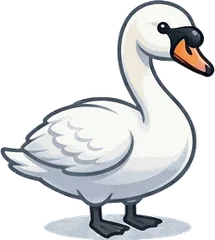 Mute Swan
The Mute Swan is usually silent, giving hoarse hisses and barks much quieter than a native swan's call, though its wings whir loudly in flight. Look for an orange bill with a black knob and an S-curved neck.
Where the Trumpeter Swan card lives
In Warble the same bird can be an easy card in one state and a prized one in another, because each album ranks its birds by how often people really report them there. The Trumpeter Swan appears in 7 state albums:
 Heard one? Open Warble, tap the green button while it sings, and the Trumpeter Swan card flips into your album. Get the app free.
Questions people ask
Why is it called a trumpeter swan?
Because its loud, low call sounds like a trumpet. Even the scientific name, Cygnus buccinator, comes from bucina, a kind of military trumpet.
How can you tell a trumpeter swan from a tundra swan by sound?
Listen for pitch. The trumpeter's bugling ko-hoh is lower than the Tundra Swan's call. Side by side the trumpeter is also clearly bigger, with an all-black bill and no yellow spot before the eye.
Are trumpeter swans endangered?
Not globally anymore, but they came close. Fewer than 100 remained south of Canada by the 1930s. Protection and reintroductions brought them back to tens of thousands, though they are still rare in places such as Missouri.
Do trumpeter swans mate for life?
Usually. Pairs often stay together for life, though divorces do happen, and mates keep in touch with duets, calling together until their voices nearly overlap.
Sources
- National Audubon Society, Guide to North American Birds: Trumpeter Swan. www.audubon.org/field-guide/bird/trumpeter-swan
- Wikipedia: Trumpeter swan (voice, size, populations, history, breeding). en.wikipedia.org/wiki/Trumpeter_swan
- Missouri Department of Conservation, Field Guide: Trumpeter Swan. mdc.mo.gov/discover-nature/field-guide/trumpeter-swan
- National Audubon Society, Guide to North American Birds: Mute Swan (voice). www.audubon.org/field-guide/bird/mute-swan