 Warble

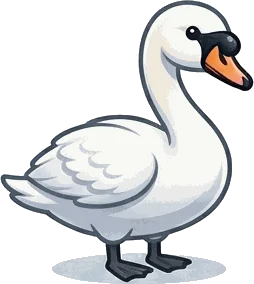
A Mute Swan is quiet for a swan, not silent. Up close it hisses, grunts, snorts and gives hoarse whistling and barking notes, and the hiss is a warning to back off. The sound most people notice, though, comes from the wings: a loud, rhythmic throbbing or whirring in flight that Audubon says can carry up to a mile. You hear it year-round on ponds, lakes, rivers and coastal bays in the Northeast and Great Lakes, where this European swan was introduced and is now widespread.
What a Mute Swan sounds like
The name comes from comparison: the Mute Swan is less vocal than other swans, and its voice is hoarse and much quieter than those of the native swans. But it has a small vocabulary. Adults grunt, snort and make hoarse whistles, and Audubon adds hissing and barking notes. A loud trumpeting call exists but is rarely heard.
Two softer sounds are worth knowing. Courting pairs have a rhythmic duet that keeps their head and neck movements in time as they face each other and turn their heads side to side together. And cygnets are surprisingly chatty: they whistle and chirp when content and switch to a harsher chirp when they are lost or distressed.
The hiss: a warning, not a greeting
A hiss from a Mute Swan is the first step in a defense routine. The swan hisses at rivals or intruders, then may raise its wings in a threat posture called busking, with the neck drawn back and the wings half lifted over the back. Audubon describes a nesting bird that arches its wings, lays its head back with the neck feathers fluffed and surges forward through the water in jerks. If that does not work, it strikes with the bony spurs on its wings and bites. Other water birds that intrude can be drowned.
Both sexes are aggressive while nesting, and the male gets bolder when defending his mate or cygnets. Connecticut's wildlife agency says attacks on people are commonly reported, especially on small children and on kayakers, canoeists and jet skiers. Cobs will go after small boats. If a swan hisses and starts busking toward you, give the nest a wide berth.
When and where you hear it
Mute Swans were brought from Europe as ornamental birds for parks and estates, and the Atlantic Flyway population descends from a few hundred birds released in the lower Hudson Valley and on Long Island between 1910 and 1912. They have spread across the Northeast and the Great Lakes; on the lower Great Lakes, numbers doubled every seven to eight years between 1971 and 2000. Connecticut alone holds 1,000 to 1,400 breeding birds. Look for them on ponds, lakes, slow rivers, tidal marshes and coastal bays, often close to people.
They are basically homebodies. Pairs stay on inland water into winter as long as it stays open, then move to the coast or big rivers after freeze-up, usually in early or mid-December. Courtship starts in late February and nests go up in late March or early April, so spring is when the hissing is most likely to be aimed at you. In Warble the swan is a card in the New York, Connecticut and Michigan albums, among others, and one of the quieter catches.
The sound of the wings
For many people the defining Mute Swan sound has nothing to do with its voice. In flight the big wings make a loud, pulsing throb that is unique to this species. Wikipedia reports that it carries one to two kilometers, and Audubon puts it at up to a mile. Because the swans are otherwise so quiet, the wing noise works as a contact call, letting flying birds keep track of each other. If a rhythmic humming passes overhead near water, look up.
What it looks like
A huge, all-white swan, about four and a half to five feet long, with a wingspan of seven to eight feet and an average weight around 25 pounds. The bill is orange with black at the base and a black knob on top, bigger in males. On the water it holds its neck in a graceful S with the bill pointed down, often with the wings arched over its back. Feathers on the head and neck are often stained orange-brown by iron in the water. Cygnets are gray or white with a grayish bill for their first year.
Birds that sound similar
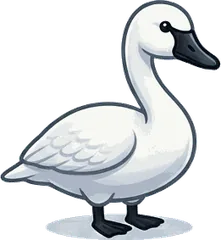 Trumpeter Swan
The Trumpeter Swan earns its name with a loud, bugling ko-hoh, and it has an all-black bill. A white swan that only hisses, grunts and throbs its wings in flight is a Mute Swan.
- ?Tundra Swan
Tundra Swans are far more vocal, with calls higher than a Trumpeter's bugle. A flock calling as it passes over is not Mute Swans, which fly in near-silence except for the wings.
Where the Mute Swan card lives
In Warble the same bird can be an easy card in one state and a prized one in another, because each album ranks its birds by how often people really report them there. The Mute Swan appears in 8 state albums:
 Heard one? Open Warble, tap the green button while it sings, and the Mute Swan card flips into your album. Get the app free.
Questions people ask
Are mute swans really mute?
No. They are just quieter than other swans. Mute Swans hiss, grunt, snort, bark and make hoarse whistles, and cygnets chirp. What they lack is the loud, bugling call of Trumpeter and Tundra Swans, though Audubon notes a rarely heard trumpeting note.
Why do mute swans hiss?
To warn you off. Hissing is the opening move of a defense that can escalate to a wing-raised threat display, a charge across the water, wing strikes and bites. It is most common in spring and early summer, when pairs guard nests and cygnets.
Why do swan wings make so much noise?
It is the Mute Swan's wingbeat: a rhythmic throbbing, unique to the species, that carries up to about a mile and helps flying swans keep in contact.
Are mute swans invasive in the US?
They are an introduced species, and many biologists consider them ecologically damaging. A swan can eat up to eight pounds of underwater plants a day and uproot more, crowding out native waterfowl. In 2005 the Department of the Interior declared them non-native and unprotected, so states can manage them.
Sources
- National Audubon Society, Guide to North American Birds: Mute Swan. www.audubon.org/field-guide/bird/mute-swan
- Wikipedia: Mute swan (vocalizations, wing sound, aggression, North American population). en.wikipedia.org/wiki/Mute_swan
- Connecticut Department of Energy and Environmental Protection: Mute Swan fact sheet. portal.ct.gov/deep/wildlife/fact-sheets/mute-swan
- National Audubon Society, Guide to North American Birds: Trumpeter Swan. www.audubon.org/field-guide/bird/trumpeter-swan