 Warble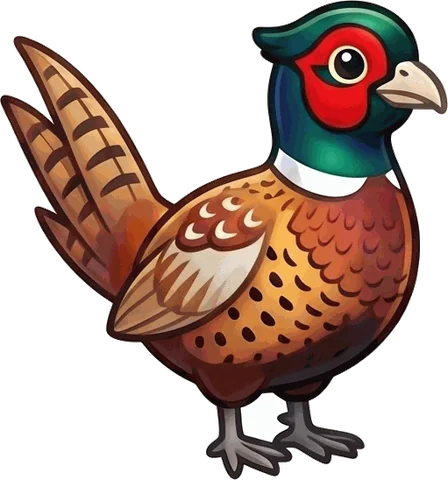
A Ring-necked Pheasant sounds like a rooster with a sore throat. The male's crow is a loud, harsh, two-syllable caw-cawk or SCAA-konk, followed at once by a short, rapid beating of the wings that you can hear from a distance. He crows from the ground or a low rise, mostly at dawn and dusk in spring, and it carries across open farmland. A flushed bird takes off with a loud, hoarse cackle, kok kok kok, and a heavy whir of wings. Hens are quieter, with soft keea, keea notes.
The crow and the wing whir
The rooster's crow is short and unmusical. Audubon writes it as a loud crowing caw-cawk!, Missouri's field guide as a harsh two-syllable SCAA-konk. Both agree on what comes next: a resonant, rapid drumming of the wings that lasts a second or two, as if the bird were applauding itself. The crow is a territorial call, given, in Audubon's words, from a raised perch while the male briefly drums with his wings.
Missouri's guide notes that a cock may crow at any time of year, but the sound peaks in spring, when males stake out territories and gather harems. Wikipedia describes the mating system plainly: males are polygynous and are often followed by several females. A crowing male in April is advertising to all of them at once.
The courtship display itself is quiet. Audubon describes the male strutting in a half circle around the hen, tilting his back and tail toward her, drooping the near wing and swelling his red wattles.
The cackle when it flushes
Most people meet the pheasant by accident, when one erupts from the grass at their feet. Audubon says an alarmed bird flies off with a loud cackle; Wikipedia gives it as kok kok kok and adds the distinctive whirring of the wings. The bird would rather run, but when startled it can burst almost straight up and power away low, at roughly 27 to 38 miles an hour and up to 56 when chased.
Hens make softer sounds. Missouri's field guide transcribes them as keea, keea.
When and where you hear it
The pheasant is not a native bird. It comes from Asia, from the Black Sea and Caspian region east to China, Korea and Taiwan. The introduction that took was in 1881, in Oregon's Willamette Valley, credited to Owen Nickerson Denny, followed by Washington in 1883 and California in 1889. Today it is a permanent resident across the northern United States and southern Canada, thriving most, in Audubon's words, on the northern prairies.
Look for farmland with a mix of crops, hayfields, brushy meadows, hedgerows, marsh edges and grassland set aside under the Conservation Reserve Program. Missouri's guide says the birds want dense cover 9 to 17 inches tall within a quarter mile of grain, and Audubon notes they need water and avoid very dry country. The diet is grain, seeds, shoots, berries and, in the breeding season, more insects, earthworms and snails. Most hens start laying in mid to late April, with the peak of hatching in June, so the crowing you hear in April and May is the season's main event.
Pheasant country is South Dakota above all. The state made the Ring-necked Pheasant its state bird in 1943, and Wikipedia notes it is one of only two state birds not native to the United States. The state's own figures for 2025 put the harvest above 1.35 million birds. Audubon adds a caveat: in many places pheasant populations are not self-sustaining and are kept going by releases of game-farm birds. For Warble players in the Plains, the crow and wing whir is an easy card on a spring morning drive.
What it looks like
A large, long-tailed, chicken-like bird, 30 to 36 inches long with the tail making up nearly half of that. The rooster is unmistakable: an iridescent bottle-green head, a bright red face wattle, a white neck ring on most birds, and a body barred in gold, copper and chestnut with a bronze sheen. The hen is mottled brown with a long, pointed tail, which Missouri's guide notes is the quick way to tell her from a grouse or prairie-chicken, whose tails are rounded. Males average about 2 pounds 10 ounces and females about 2 pounds.
The nest is a shallow depression lined with grass and leaves, holding 10 to 12 olive-buff eggs, sometimes 6 to 15 or more, which hatch after about 23 days. The chicks leave within hours.
Birds that sound similar
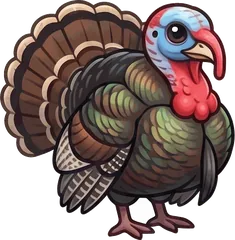 Wild Turkey
A turkey's gobble is a long, rattling gurgle from woodland edges. The pheasant's crow is two harsh notes over in a second, followed by a wing whir, and it comes from open fields.
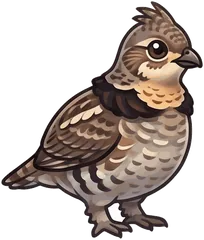 Ruffed Grouse
A Ruffed Grouse makes its spring sound with wings alone, a deep accelerating thump with no voice. The pheasant crows first and then whirs its wings briefly.
Where the Ring-necked Pheasant card lives
In Warble the same bird can be an easy card in one state and a prized one in another, because each album ranks its birds by how often people really report them there. The Ring-necked Pheasant appears in 10 state albums:
 Heard one? Open Warble, tap the green button while it sings, and the Ring-necked Pheasant card flips into your album. Get the app free.
Questions people ask
What does a pheasant crow sound like?
A loud, harsh, two-syllable caw-cawk, like a hoarse rooster, followed immediately by a short rapid beating of the wings. Males crow most at dawn and dusk in spring, and they can be heard across open farmland.
Why do pheasants cackle when they fly?
It is an alarm. A startled pheasant bursts up with a loud kok kok kok cackle and a heavy whir of wings, then flies low and fast, up to about 56 miles an hour when chased.
Is the pheasant native to the United States?
No. It is an Asian bird, introduced as a game bird. The first successful introduction was in Oregon's Willamette Valley in 1881, and it spread across the northern states from there. It is one of only two non-native state birds.
Which state has the pheasant as its state bird?
South Dakota, since 1943. The state is the center of American pheasant hunting, with more than 1.35 million birds harvested in 2025.
Sources
- National Audubon Society, Guide to North American Birds: Ring-necked Pheasant. www.audubon.org/field-guide/bird/ring-necked-pheasant
- Wikipedia: Common pheasant (native range, introduction history, size, calls, flight speed, state bird). en.wikipedia.org/wiki/Common_pheasant
- Missouri Department of Conservation, Field Guide: Ring-necked Pheasant. mdc.mo.gov/discover-nature/field-guide/ring-necked-pheasant
- South Dakota Game, Fish and Parks: Pheasant hunting. gfp.sd.gov/pheasant/