 Warble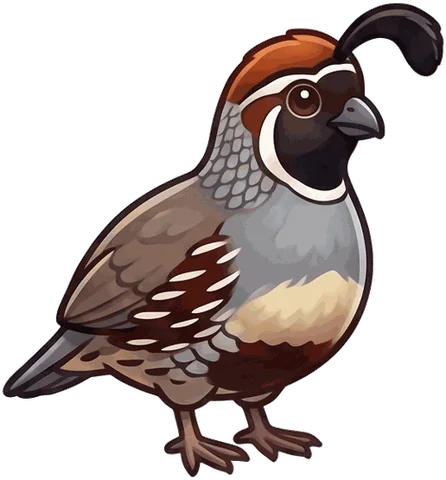
A Gambel's Quail sounds like a small, hoarse crowd in a mesquite thicket. Its signature call is a ringing three or four-note puk-KWAW-cah, with the second syllable highest, used to gather a scattered covey. Around it you hear a steady stream of clucks and crowing notes as the birds feed and move. In spring an unpaired male sits on a high perch and gives a single clear, descending note over and over. You hear all of it in the Sonoran Desert and nearby brushy country of Arizona, southern Nevada, Utah, New Mexico, west Texas and southeastern California.
What the call sounds like
Audubon writes the assembly call as a ringing puk-kwaw-cah with the second syllable highest in pitch. It has the same shape as the California Quail's chi-CA-go, up to a loud middle note and down again, and the two species are close relatives, sister taxa that Wikipedia says split one to two million years ago. To most ears Gambel's is a little harsher and more ringing. It is given when a covey has been scattered by a hawk or a hiker, or when a bird has simply lost the group in the brush, and it goes on until everyone is back together.
The spring song is different and easy to miss. Audubon describes a breeding male giving a clear, descending note from a high perch, the top of a mesquite or a fence post, often for long stretches in the morning. It is the sound of a male without a mate.
Covey chatter
Beyond the assembly call, Audubon notes a variety of clucking and crowing notes. These are the working sounds of a covey: soft clucks between birds feeding a few feet apart, and louder notes when the group moves. Animal Diversity Web says the birds keep contact with calls constantly, which makes sense for a flock that spends its day walking through thorny cover where nobody can see anybody.
When a covey is pressed it runs first. Animal Diversity Web calls Gambel's Quail fast runners that fly only to escape a predator, cross an obstacle or reach a roost. When they do flush, it is a sudden whir of short rounded wings, low and brief.
When and where you hear it
Gambel's Quail are year-round residents, and Animal Diversity Web says their annual movements are under two kilometers. The covey season runs from late summer through winter and early spring, when, according to Audubon, the birds forage in flocks and walk to water together in the morning and evening. A covey usually consists of an adult pair and up to sixteen young. Roosting is communal, in bushes or low trees. In the heat of the day the birds rest in shade, so the best listening is early and late.
The habitat is brushy desert: canyons, washes and mesquite-lined river valleys with open ground between a mix of shrubs, low trees and cactus, usually near water. Audubon notes the birds have adapted to suburbs where some ground is left wild, and Animal Diversity Web lists desert hackberry, mesquite, sumac, catclaw acacia and scrub oak as typical cover. The diet is about 90 percent plant material, seeds, leaves, cactus fruit and the berries of mistletoe and hackberry, with insects making up the rest, mostly in spring when chicks need protein. Little or no drinking water is required, though the birds prefer to live near it.
Breeding follows the rain. Audubon says Gambel's Quail reproduce poorly in very dry years and may raise two broods in a good one. The nest is a shallow scrape lined with grass and leaves, hidden under a shrub, with 10 to 12 heavily marked eggs incubated 21 to 24 days, mostly by the female. Chicks walk out within hours. Audubon puts the population at 5.8 million and calls it stable, though Animal Diversity Web notes that 1.2 million were taken by hunters in Arizona in a single season in the mid-1990s. In Arizona the covey call is an everyday Warble card; the descending single note of a lonely spring male is the one that takes some patience.
What it looks like
A plump, round quail about 11 inches long and 5.6 to 7 ounces, blue-gray above with chestnut-red flanks streaked in white and a curving black topknot that leans forward over the bill. The male has a black face edged in white, a chestnut cap and a cream-yellow belly with a black patch in the center. The female is plainer, without the black face or belly patch, and her plume is thinner. Both sexes have long bare legs built for running. The name honors William Gambel, a 19th-century naturalist who explored the Southwest.
Where the range meets the California Quail, look at the belly: Gambel's is plain with the black patch, California's is heavily scaled. Gambel's also has a longer plume and redder flanks.
Birds that sound similar
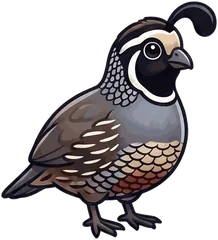 California Quail
The sister species, with a very similar three-note chi-CA-go that also peaks on the middle syllable. California Quail lives on the Pacific slope and Gambel's in the desert Southwest, and they overlap in only a few places.
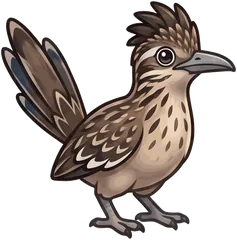 Greater Roadrunner
The roadrunner shares the same desert washes and hunts quail, but its song is a slow, soft, descending series of dove-like coos with no ringing quality. A quail's call is short, sharp and three or four notes.
Where the Gambel's Quail card lives
In Warble the same bird can be an easy card in one state and a prized one in another, because each album ranks its birds by how often people really report them there. The Gambel's Quail appears in 3 state albums:
 Heard one? Open Warble, tap the green button while it sings, and the Gambel's Quail card flips into your album. Get the app free.
Questions people ask
What does a Gambel's Quail call sound like?
A ringing three or four-note puk-KWAW-cah, loudest and highest on the second syllable, given to reassemble a scattered covey. Around it you hear clucks and crowing notes, and in spring a lone male gives a single clear, descending note from a high perch.
Are Gambel's Quail and California Quail the same bird?
No, but they are sister species that split one to two million years ago and sound much alike. Gambel's lives in the desert Southwest, has a longer plume, redder flanks and an unscaled belly with a black patch in the male. California Quail lives on the Pacific slope and has a scaled belly.
Do Gambel's Quail need water?
Very little. Animal Diversity Web says they require little or no free water, getting moisture from leaves, fruit and insects, but they prefer to live near a source and coveys will walk to it morning and evening.
Why are there so many quail some years and few in others?
Rain. Audubon notes the species reproduces poorly in very dry years and can raise two broods in good ones, and Animal Diversity Web says population swings are driven mainly by temperature and rainfall rather than predators.
Sources
- National Audubon Society, Guide to North American Birds: Gambel's Quail. www.audubon.org/field-guide/bird/gambels-quail
- Wikipedia: Gambel's quail (appearance, range, relation to California quail, name). en.wikipedia.org/wiki/Gambel%27s_quail
- Animal Diversity Web: Callipepla gambelii (coveys, habitat, diet, water, hunting). animaldiversity.org/accounts/Callipepla_gambelii/