 Warble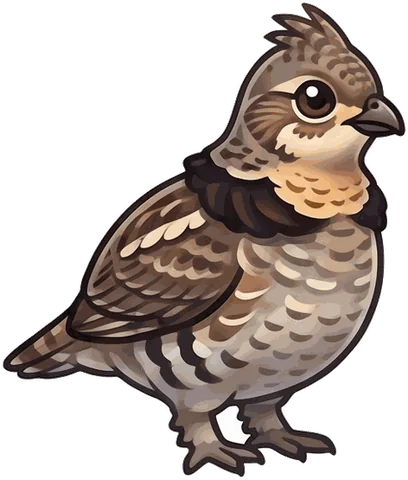
A Ruffed Grouse sounds like a distant engine trying to start. The male's spring display is not a song but a drumming: he stands on a fallen log, braces his tail and beats his wings against the air, and the thumps begin slowly, thump, thump, thump, then speed up until they blur into a fast, steady whir. The whole thing lasts a few seconds, is pitched so low you feel it in your chest, and carries a quarter mile or more through dense woods. Hens give soft, hen-like clucks.
The drumming: a sound made with wings
Wikipedia writes the rhythm as thump, thump, thump, thump-thump-thump-thump: single slow beats that accelerate into a roll. The Pennsylvania Game Commission describes the individual thudding beats merging into a fast, steady whir. The pitch is so low that many people feel the first beats before they hear them, and a first-time listener often looks for a tractor or a generator.
The mechanism surprises people. The grouse is not hitting the log. Wikipedia explains that he beats his wings against the air to create a vacuum, and the log, stone or mound he stands on is only a stage. The Pennsylvania Game Commission adds that the same displaying male also hisses and drags his wingtips along the ground when a hen is near.
Audubon describes the visual side: on his perch the male fans his tail, raises his crest and the black neck ruff that gives the bird its name, and struts from side to side.
The other sounds: clucks, hisses and a burst of wings
Away from the log, grouse are mostly quiet. Audubon notes the female's soft, hen-like clucks. The sound most hikers actually know is the flush: an explosion of whirring wings from the leaf litter a few feet away. In winter, Wikipedia notes, a grouse may burst straight out of the snow it has burrowed into.
When and where you hear it
Drumming peaks in spring. The Pennsylvania Game Commission gives March and April as the mating season, and Missouri's guide says males display at dawn and dusk in April, usually on a fallen log. A male returns to the same log, so if you hear drumming one morning you can come back the next.
The habitat is young forest. Audubon lists deciduous and mixed woods with clearings and dense undergrowth; the Pennsylvania Game Commission specifies brushy stands less than 20 years old; Wikipedia adds that the best woods are rich in aspen. Grouse eat buds, catkins, leaves, berries and seeds, with aspen, birch and cherry buds carrying them through northern winters. Chicks eat insects. On cold nights a grouse will fly straight into a soft snowbank and spend the night in a snow roost under the surface.
The range runs from Alaska across Canada and down the Appalachians to Georgia, and Audubon puts the population around 18 million. Numbers rise and fall on a roughly ten-year cycle that Wikipedia says still puzzles scientists. Pennsylvania, which adopted the Ruffed Grouse as its state bird in 1931, reports steady declines since the 1980s and sharp ones since the early 2000s, with West Nile virus now identified as a major cause. In Missouri the bird is rare and local, with restoration under way in the eastern Ozarks. In Pennsylvania, Minnesota and northern New England the drum is a spring Warble card; hold the phone still and let the whole roll play out.
Why the drum is so low
Two things make grouse drumming easy to miss. It is very low in pitch, so the first slow beats register as a vibration and the sound passes through trees that would swallow a whistle. And it starts slowly, about one thump a second, and only becomes recognizable once it accelerates. Give any suspicious engine noise in April woods five seconds before you decide what it is.
What it looks like
A chicken-like bird about the size of a crow, 16 to 19 inches long and about a pound and a half, with a short crest, a black ruff on the neck and a long, fan-shaped tail with a wide dark band near the tip. It comes in two color morphs, gray and reddish brown, most obvious in the tail. The barred, streaked plumage makes a sitting grouse almost invisible on the forest floor. In a hen the dark tail band is usually broken in the center; in a male it runs unbroken. Wikipedia notes that partridge, the northern nickname, properly belongs to unrelated birds.
The nest is a leaf-lined depression at the base of a tree or under a log, with 9 to 12 eggs, incubated 23 to 25 days by the hen alone.
Birds that sound similar
 Downy Woodpecker
A woodpecker's drum is a fast, even roll on wood, higher and sharper, and it does not speed up. Grouse drumming is much lower, starts slowly and accelerates into a whir.
 Wild Turkey
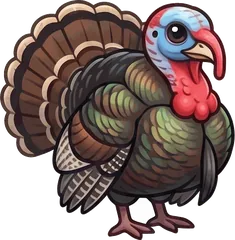
A strutting tom turkey also drums, a low hum from his chest, but you hear it only within a few dozen yards and it comes with a gobble. Grouse drumming carries a quarter mile and is never followed by a voice.
Where the Ruffed Grouse card lives
In Warble the same bird can be an easy card in one state and a prized one in another, because each album ranks its birds by how often people really report them there. The Ruffed Grouse appears in 1 state albums:
 Heard one? Open Warble, tap the green button while it sings, and the Ruffed Grouse card flips into your album. Get the app free.
Questions people ask
What is the thumping sound in the woods in spring?
Probably a male Ruffed Grouse drumming. He stands on a log and beats his wings against the air, producing very low thumps that start slowly and accelerate into a whir. It peaks at dawn and dusk in March and April and carries a quarter mile or more.
Does a grouse drum by hitting a log?
No. The log is only a platform. The sound is made by the wings striking the air, which Wikipedia describes as creating a vacuum with each beat. A grouse can drum on a stone or a mound of earth just as well.
Is the Ruffed Grouse the state bird of Pennsylvania?
Yes. Pennsylvania adopted it in 1931, by an act that names it the state game bird; the Game Commission calls it the official state bird. The state's grouse have declined sharply since the early 2000s, with West Nile virus a major factor.
Why do grouse populations go up and down?
Nobody fully knows. Ruffed Grouse numbers follow a cycle of roughly ten years that has puzzled biologists for decades, and Wikipedia notes that it happens whether or not the birds are hunted.
Sources
- National Audubon Society, Guide to North American Birds: Ruffed Grouse. www.audubon.org/field-guide/bird/ruffed-grouse
- Wikipedia: Ruffed grouse (drumming mechanism, distance, population cycle, snow burrowing). en.wikipedia.org/wiki/Ruffed_grouse
- Pennsylvania Game Commission: Ruffed Grouse. www.pa.gov/agencies/pgc/wildlife/discover-pa-wildlife/ruffed-grouse.html
- Missouri Department of Conservation, Field Guide: Ruffed Grouse. mdc.mo.gov/discover-nature/field-guide/ruffed-grouse