 Warble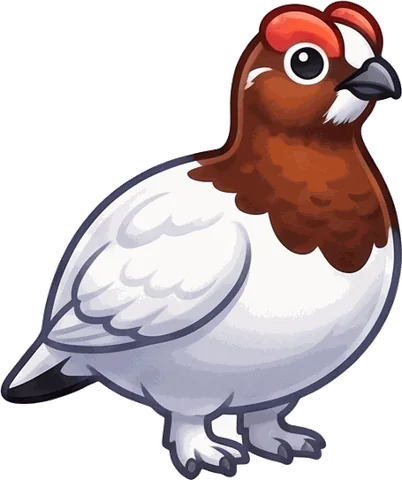
A Willow Ptarmigan sounds like a laughing, scolding chicken on the tundra. The courting male flies up and gives a loud, staccato go-back, go-back, go-back, low-pitched and guttural, along with rattles, barks and cackles that carry across the willow flats. Both sexes cluck and chuckle, the female purrs and moans to her chicks, and either parent will hiss at anything that comes near the brood. It is the state bird of Alaska, where it has the widest range of any upland game bird.
The birder's mnemonic
“go-back, go-back, go-back” Audubon's rendering of the male's flight call; the notes are fast, low and guttural, more like a bark than a whistle.
What the song sounds like
Ptarmigan do not sing, but the male's spring display call does the same job and is a lot funnier. He launches into the air and gives a loud, staccato go-back, go-back, go-back, with other guttural calls mixed in. The voice is low-pitched and throaty, a string of chuckles and repeated clucks, and during display he adds rattles and barking noises. The whole performance sounds like an outraged farmyard bird arguing with the sky, and on still mornings in April and May it carries a long way over the tundra.
Researchers count at least eleven distinct calls. Both sexes have similar territorial calls, but the flight song, the rattle and calls written kohwa and aroo come only from males, as do the koks, ko-ko-ko and krrow notes used in threats and courtship. A male guarding his hen will also dive at intruders, including people, with a guttural cackle.
The call: clucks, purrs and hisses
Away from the display, the everyday sounds are quieter. Females purr or moan to keep chicks close, and both parents hiss or moan when defending the brood. Winter flocks feed and roost close together and keep up soft clucking. Flush a bird from a willow thicket and you may get a burst of the same guttural cackling as it rockets away on white wings.
When and where you hear it
The Willow Ptarmigan rings the top of the world: Alaska, Canada from the Arctic islands to Newfoundland and Labrador, Scandinavia, Siberia and northern Asia, with the Red Grouse of Britain as a dark subspecies. In Alaska it has the widest range of any upland game bird, missing only from the broad forested interior valleys, the thick woods of the Southeast and the Aleutians west of Unimak Island. It wants low, wet tundra with dwarf willow and birch thickets and willow-lined streams, lusher ground than the Rock Ptarmigan uses above it.
Spring is the season to hear it. Males arrive about two weeks before females, set up territories in April and May and defend them hard, which is when the go-back calls and barking displays are constant. Hens lay six to ten eggs in a shallow scrape and incubate for about three weeks, and most chicks hatch in late June or early July. In winter the birds turn nomadic, moving in flocks into sheltered valleys and denser willows and burrowing into snow to roost; in Alaska the females often travel farther south than the males. Numbers swing widely, with peaks thought to come every nine or ten years. For Warble players the Alaska album is where this card lives, and the comic display call is the easiest way to get it.
This is the one grouse in which the male stays with the family. He guards the nest and the hen through incubation, defends the chicks until they are independent, and if the hen dies he raises the brood himself. Unpaired males have even been recorded adopting orphaned chicks. Adults eat willow almost exclusively in winter, buds, twigs and catkins making up as much as 94 percent of the diet; chicks start on insects.
What it looks like
A plump, chicken-like bird about 14 to 17 inches long with a wingspan around two feet and a weight of one to nearly two pounds. In winter it is pure white except for black outer tail feathers, with feet feathered to the toes that act as snowshoes. In spring the male grows a cape of chestnut-red on the head and neck over a still-white body, with red combs over the eyes, and by summer he is mottled reddish brown with white wings. The female is a duller mottled brown through summer, which hides her on the nest. It is larger and heavier-billed than the Rock Ptarmigan.
Birds that sound similar
- ?Rock Ptarmigan
The courting male Rock Ptarmigan gives a snoring kurr-kurr rather than a barking go-back, and the female clucks and purrs. It lives on higher, barer, rockier tundra and is smaller with a smaller bill.
- ?White-tailed Ptarmigan
The White-tailed gives high-pitched creaking notes and soft low clucks, thinner than the Willow's throaty calls, and it keeps to rocky alpine ground above timberline from Alaska down the Rockies.
- ?Spruce Grouse
The Spruce Grouse male's low krrrrk, krrrk, krrk is said to be the lowest vocal sound of any North American bird, and it comes from inside conifer forest, not from a bird in the air over tundra.
Where the Willow Ptarmigan card lives
In Warble the same bird can be an easy card in one state and a prized one in another, because each album ranks its birds by how often people really report them there. The Willow Ptarmigan appears in 1 state albums:
 Heard one? Open Warble, tap the green button while it sings, and the Willow Ptarmigan card flips into your album. Get the app free.
Questions people ask
What bird says go-back, go-back?
The male Willow Ptarmigan, during his spring display flight. Audubon writes the loud, staccato call as go-back, go-back, go-back. It is low and guttural, closer to a bark or a laugh than to a whistle, and it is given from the air over tundra and willow thickets.
Is the Willow Ptarmigan the state bird of Alaska?
Yes. Alaska adopted the Willow Ptarmigan as its state bird in 1955. It is the only state with a ptarmigan as its official bird.
Why do ptarmigan turn white in winter?
For camouflage on snow. The Willow Ptarmigan molts twice a year, trading mottled brown summer feathers for an all-white winter coat with black outer tail feathers. Its feet also grow dense feathers to the toes that work like snowshoes.
Do male ptarmigan help raise the chicks?
Willow Ptarmigan males do, which is unusual among grouse. The male guards the hen and nest during incubation, defends the chicks until they are independent, and takes over the brood if the female dies.
Sources
- National Audubon Society, Guide to North American Birds: Willow Ptarmigan. www.audubon.org/field-guide/bird/willow-ptarmigan
- Wikipedia: Willow ptarmigan (vocalizations, plumage, range, male parental care, state bird of Alaska). en.wikipedia.org/wiki/Willow_ptarmigan
- Animal Diversity Web: Lagopus lagopus. animaldiversity.org/accounts/Lagopus_lagopus/
- Alaska Department of Fish and Game: Willow Ptarmigan species profile. www.adfg.alaska.gov/index.cfm?adfg=willowptarmigan.main