 Warble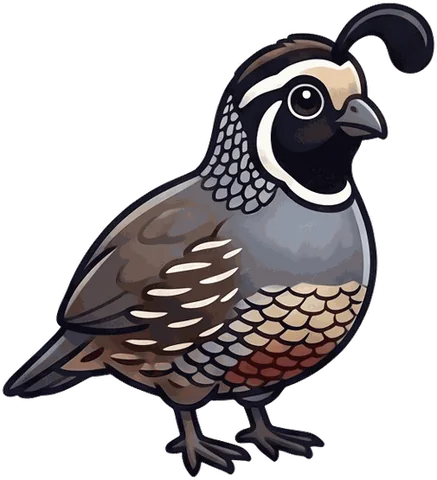
A California Quail sounds like a bird calling out the name of a city. Its best-known call is a loud, three-syllable chi-CA-go, also written ka-KAH-ko, with the middle note highest. It is an assembly call, given when a covey has been scattered or when a bird has lost track of the group, and you hear it from brushy hillsides, oak woodland edges and suburban yards across California and the Pacific Northwest. Up close, a feeding covey keeps up a steady chatter of soft pip notes.
The birder's mnemonic
“chi-CA-go” Stress the middle syllable; a bird calling the whole word slowly from a fence post is usually asking where everyone went.
What the call sounds like
Audubon writes it as a loud, distinctive ka-kah-ko or Chi-ca-go, the second note highest, and Wikipedia calls it simply the chicago call. It is three clear, slightly hoarse notes with an undulating shape: up to the middle syllable, then down. The pace is unhurried, and a single bird may repeat it every few seconds from a low perch until the covey answers.
The call is social. Wikipedia lists it alongside contact pips, warning pips and a harsher note it calls a squill, given in disputes during the breeding season. There is a nice detail in the same account: a male will often cut in on his mate's chicago call with a squill, so the pair calls back and forth in a pattern. Listen for that duet in spring.
The covey sounds
Most of what a quail says is quiet. A covey moving through brush keeps up soft pip notes that let each bird know where the others are, and a sharper pip warns of a hawk or a cat. Audubon describes the birds strutting across clearings, nodding their heads with each step, and then, when disturbed, bursting into fast, low flight on whirring wings. That wing noise is often the first sign a covey was there at all.
Coveys are large. Animal Diversity Web gives a typical fall and winter group of 25 to 40 birds, with gatherings of more than a thousand on record. In spring the coveys break up, males stake out territories and defend a mate, and families later merge again into what Wikipedia calls communal broods, with several hens and males tending a crowd of chicks together.
When and where you hear it
California Quail are permanent residents and call year-round, most insistently in spring, when pairs are forming, and in late summer and fall, when coveys are regrouping. They are most active in the morning and late afternoon. Animal Diversity Web gives a breeding season of May through July, with a single large clutch, usually around 14 eggs, incubated 22 to 23 days by the female. Chicks are running within an hour of hatching.
The native range runs along the Pacific side of the continent from Baja California north through California and western Nevada into southern Oregon, and introduced birds now live in Washington, British Columbia, Utah, Hawaii, New Zealand, Chile, Argentina and South Africa. Audubon lists the habitat as broken chaparral, woodland edges, coastal scrub, parks and farms, especially open oak woodland and streamside growth, and the birds are at home in suburbs. They avoid high mountains. The diet is mostly seeds and leaves, with berries and insects when available.
The species has been California's state bird since 1931. Audubon says the population is increasing overall while declining in heavily built coastal areas, and Wikipedia notes that by 2017 a single quail, nicknamed Ishi, was left in San Francisco. For Warble players in the West it is one of the first ground birds to land in the album, often from a backyard fence.
What it looks like
A plump, robin-sized quail, 9.4 to 10.6 inches long and 5 to 8 ounces, gray and brown with a curving black topknot, a teardrop-shaped plume that bobs forward over the bill. The male has a black face outlined in white and a chestnut crown; the female is plainer brown with a smaller plume. Both have white stripes on gray-brown flanks and a heavily scaled pattern on the belly. Animal Diversity Web records flight speeds of 38 to 58 miles an hour over short bursts and a running speed of about 12, which is how the birds usually get around.
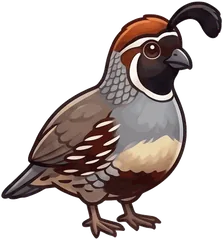
The closest relative is Gambel's Quail, which has a longer plume, brighter head colors and an unscaled belly, and lives in the deserts to the east. Wikipedia says the two species split one to two million years ago.
Birds that sound similar
 Gambel's Quail
The sister species. Its assembly call is a similar three or four-note puk-KWAW-cah, also with the second note highest, but Gambel's lives in the desert Southwest and California Quail on the Pacific slope, so location settles most cases.
 Northern Bobwhite
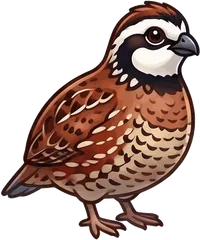
The bobwhite is an eastern bird with a two or three-note whistle whose last syllable rises steeply. The California Quail's chi-CA-go peaks in the middle and falls at the end.
Where the California Quail card lives
In Warble the same bird can be an easy card in one state and a prized one in another, because each album ranks its birds by how often people really report them there. The California Quail appears in 7 state albums:
 Heard one? Open Warble, tap the green button while it sings, and the California Quail card flips into your album. Get the app free.
Questions people ask
What bird says Chicago?
The California Quail. Its loud three-note assembly call, chi-CA-go with the middle note highest, is given when a covey is scattered or a bird has lost the group. Gambel's Quail in the desert Southwest has a similar call.
Is the California Quail the state bird of California?
Yes, since 1931. It lives in chaparral, oak woodland, coastal scrub, parks and suburbs across the state, and its range extends from Baja California north to Oregon, with introduced populations far beyond.
What is the difference between California Quail and Gambel's Quail?
Range first: California Quail lives on the Pacific slope, Gambel's in the Sonoran and other southwestern deserts. Gambel's has a longer plume, a brighter chestnut cap, unscaled underparts and, in the male, a black patch on the belly. Their calls are similar.
Why do quail travel in big groups?
Safety and shared parenting. Fall and winter coveys of 25 to 40 birds mean many eyes watching for hawks, and in summer several families merge into communal broods, with more than one hen and several males guarding the chicks.
Sources
- National Audubon Society, Guide to North American Birds: California Quail. www.audubon.org/field-guide/bird/california-quail
- Wikipedia: California quail (calls, communal broods, state bird, relation to Gambel's quail). en.wikipedia.org/wiki/California_quail
- Animal Diversity Web: Callipepla californica (range, covey size, breeding, speeds). animaldiversity.org/accounts/Callipepla_californica/