 Warble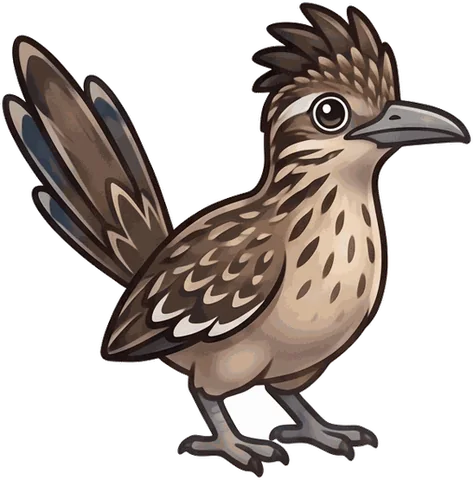
A Greater Roadrunner does not say beep beep. Its song is a slow, descending series of about six low, soft, dove-like coos, given by the male from a raised perch, most often at dawn in spring. The other common sound is a dry, rapid clatter made by snapping the bill together, a rattle used in alarm and in courtship. Females give a run of short, low whining shrills that Wikipedia compares to coyote squeals. You hear all of this in deserts and brushy open country of the Southwest, from California to Texas.
The coo: a dove that is not a dove
Missouri's field guide says it in six words: the call is a descending series of coos. Animal Diversity Web fills in the count, a series of six slow, low coos dropping in pitch, and Wikipedia adds who and when: males give it from an elevated perch, typically at dawn, and it can be heard about 820 feet away. Each note is soft and rounded, and the whole phrase steps downward like someone sighing in stages. Most people who hear it for the first time assume a dove.
Audubon's summary of the roadrunner's voice is wider: clucks, crows, dove-like coos, dog-like whines and hoarse guttural notes. Wikipedia counts seven distinct call types. It is a member of the cuckoo family, and it sounds like one, low and unmusical, rather than like the songbirds around it.
The bill clatter and the whine
The second sound to learn is mechanical. Animal Diversity Web describes an alarm call produced by clicking the mandibles together sharply and rapidly, a hollow wooden rattle that carries surprisingly well. Animal Diversity Web also records a whirring sound during the male's tail-wagging courtship display, along with coos, just before mating.
Females have a call of their own. Wikipedia describes up to 22 short, low-frequency shrills, resembling coyote squeals, audible about 1,000 feet away. During incubation and chick rearing both sexes give five or six chatters mixed with groaning, and chicks beg with a buzzing note.
When and where you hear it
Spring dawns are best. Wikipedia gives a breeding season of mid-March to early September, and the male's cooing is concentrated at first light, often from a fence post, a rooftop or the top of a cactus. In hot weather roadrunners are active from sunrise to mid-morning and again in the late afternoon, resting in shade through the middle of the day, so that is your listening window too. In the cool of early morning you may also see one sunbathing with its back to the sun and its back feathers raised to expose dark skin, warming up after a night in which, Wikipedia says, it lets its body temperature drop from 104 to 93 degrees to save energy.
The range covers the arid Southwest: California, Nevada, Utah, Colorado, Arizona, New Mexico, Oklahoma and Texas, thinning out into Kansas, Louisiana, Arkansas and Missouri, and south through much of Mexico. Audubon lists deserts and open country with scattered brush, the Sonoran Desert, chaparral and the Texas brushlands, plus dry grassland and juniper hills at the edges. Missouri's guide says the bird was first recorded there in 1956 near Branson and lives on Ozark glades, where numbers rise and fall with the severity of the winters.
Roadrunners hunt on foot. Audubon puts the running speed around 15 miles an hour with faster spurts; Wikipedia says 18 to 20 sustained. The menu is anything that moves and fits: large insects, scorpions, tarantulas, centipedes, lizards, snakes including young rattlesnakes, mice, small birds and even hummingbirds, plus some cactus fruit. Animal Diversity Web describes the bird killing small prey by smashing it against a rock and swallowing it whole. Flight is a last resort, a few seconds at a time. The Greater Roadrunner has been the state bird of New Mexico since 1949. For Warble players in Arizona and Texas the dawn coo is the card; the bill clatter is a bonus.
What it looks like
A long, lean, streaky bird, 20 to 24 inches from bill to tail tip and 8 to 19 ounces, brown above with black and white streaks, pale below, with a shaggy crest it can raise or lower, a heavy slightly hooked bill and a very long tail edged in white. Behind each eye is a patch of bare skin, blue and orange. The feet are zygodactyl, two toes forward and two back, so the track in desert sand is an X that gives no hint which way the bird went. Pairs are monogamous, likely for life, and defend a territory year-round. The nest is a platform of sticks a few feet up in a cactus, bush or low tree, often lined with snakeskin, holding three to five white eggs that hatch in about 20 days.
Birds that sound similar
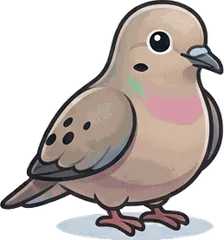 Mourning Dove
The Mourning Dove's coo-OO-oo, oo, oo is the sound people confuse with a roadrunner. The dove's second note rises before the rest fall; the roadrunner's six coos step steadily downward and are lower and softer.
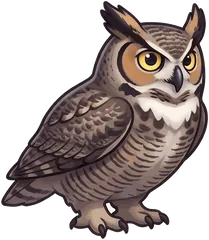 Great Horned Owl
A Great Horned Owl's hoots are also low and soft, but they are given in a fixed rhythm of four or five notes on one pitch, mostly after dark. The roadrunner coos at dawn and every note drops.
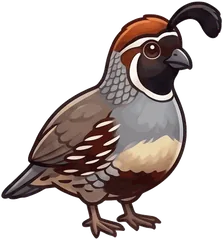 Gambel's Quail
Gambel's Quail shares the same washes and is on the roadrunner's menu. Its calls are short, sharp and ringing; nothing a quail says is as slow or as low as a roadrunner's coo.
Where the Greater Roadrunner card lives
In Warble the same bird can be an easy card in one state and a prized one in another, because each album ranks its birds by how often people really report them there. The Greater Roadrunner appears in 3 state albums:
 Heard one? Open Warble, tap the green button while it sings, and the Greater Roadrunner card flips into your album. Get the app free.
Questions people ask
Do roadrunners really say beep beep?
No. That is the cartoon, running since 1949. A real roadrunner's song is a slow, soft, descending series of about six dove-like coos, and its other common sound is a rapid clatter made by snapping the bill.
What is the clicking or rattling sound a roadrunner makes?
It is the bill. The bird claps its mandibles together sharply and rapidly to make a dry, wooden clatter. Animal Diversity Web describes it as an alarm call, and it also turns up in courtship.
How fast can a roadrunner run?
Audubon gives about 15 miles an hour with faster spurts; Wikipedia says 18 to 20 sustained, with reports up to 26. It runs with head and tail level with the ground and steers with the tail, and it flies only for a few seconds when it must.
Is the roadrunner the state bird of New Mexico?
Yes, since 1949. Some Pueblo peoples, including the Hopi, regarded the bird as protection against evil spirits, and it appeared on a 1982 United States stamp series of state birds and flowers.
Sources
- National Audubon Society, Guide to North American Birds: Greater Roadrunner. www.audubon.org/field-guide/bird/greater-roadrunner
- Wikipedia: Greater roadrunner (calls and distances, speed, range, thermoregulation, state bird). en.wikipedia.org/wiki/Greater_roadrunner
- Animal Diversity Web: Geococcyx californianus (song, bill clatter, hunting, breeding). animaldiversity.org/accounts/Geococcyx_californianus/
- Missouri Department of Conservation, Field Guide: Greater Roadrunner. mdc.mo.gov/discover-nature/field-guide/greater-roadrunner