 Warble
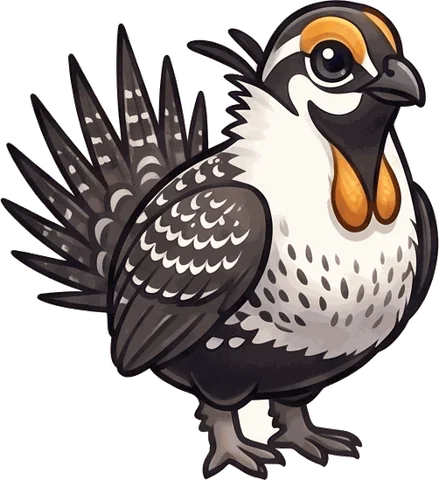
A Greater Sage-Grouse sounds like nothing else in the sagebrush. On spring leks at dawn, each male struts through a two-second sequence: two soft swishes as his breast feathers brush his wings, three low coos, then a whistle sandwiched between two sharp pops as his yellow air sacs collapse. Dozens of males strutting at once make a bubbling, popping chorus. Away from the lek, a flushed bird gives a chicken-like cackle. Listen from March into May in sagebrush country across the interior West.
What the strut sounds like: swish, coo, pop
Sage-grouse do not sing the way songbirds do. The sound people come to hear is the male's strut, and each one lasts about two seconds. It opens with two soft swishes, made by stiff, pointed breast feathers rubbing against the insides of his wings. Then, with his beak closed, he produces three low coos, and the display ends with an up-down-up whistle sandwiched between two sharp, staccato pops.
To the ear the whole thing has a bubbling, watery quality. Meanwhile the male puffs out his white chest, raises and fans his spiky tail, droops his wings and inflates two bare yellow air sacs, then throws his head back as the sacs deflate with a loud pop. The sacs are part of his digestive system, shaped during the display by muscles under the skin, and his syrinx can produce two tones at the same time.
The call: a cackle when flushed
Away from the lek, the call you are most likely to hear is a chicken-like cackle from a bird flushed out of the sagebrush. In flight the blackish belly contrasts with white underwings, and females tend to dip from side to side. Males also make a bubbling sound during courtship.
When and where you hear it
Greater Sage-Grouse live only where sagebrush grows, from southeastern Alberta and southwestern Saskatchewan south to California, Nevada, Utah and Colorado. Look on sagebrush plains, high valleys, rocky mesas and foothill slopes. They are mostly permanent residents, but some shift between breeding and wintering areas, and in Montana a few have traveled around 100 miles to escape deep snow.
Sagebrush is their lifeline. In fall and winter they eat almost nothing but sagebrush leaves and shoots, and since they lack the muscular gizzard other grouse use to grind seeds, they depend on soft plant food year-round. The nest is a shallow scrape on the ground, usually under sagebrush. The female incubates alone for 25 to 27 days, and the downy young leave the nest soon after hatching and feed themselves.
The species has vanished from much of its former range, pushed out by farmland clearing, overgrazing, energy development, invasive plants and West Nile virus. Audubon puts the population at about 430,000. In September 2015 the U.S. Fish and Wildlife Service decided it did not warrant listing under the Endangered Species Act. For Warble players in sagebrush country, an April dawn near a lek is the time to catch this card.
On the lek: the dawn strut
Each spring, males gather on traditional display grounds called leks: open clearings ringed by sagebrush on broad ridgetops, grassy swales, dry lakebeds or even crop fields. The same site can be used for years. In central Montana males occupy leks from early March to early June, peaking in late April and early May, while females visit most in early to mid-April. The strutting happens mostly in the early morning. Montana leks have averaged about 30 males, though one central Montana lek drew 80 or more, and as many as 115 females have been counted on a single lek at once.
The oldest, most experienced males compete for the center of the lek, and females usually choose them, so a few males do most of the mating. What tips a female's choice may be tiny details of sound: researchers comparing successful and unsuccessful males found differences in the timing of the two pops, and possibly the loudness of the whistle, of less than a tenth of a second. Disturbance at leks is a real concern for this declining bird, so keep your distance and keep quiet.
What it looks like
North America's largest grouse, 23 to 30 inches long, with males larger than females. The male is mottled gray-brown above with a white breast, a dark throat and bib, a black belly, a small yellow comb over the eye and a long, spiky tail. Females are mottled gray-brown with a dark belly patch. Females and young can be mistaken for a female Ring-necked Pheasant, which has a brown belly and bare legs.
Birds that sound similar
- ?Gunnison Sage-Grouse
Its display sounds very different: 9 or 10 hooting gobbles on one low pitch, broken up by three wing noises. It lives only in southwestern Colorado and a small part of Utah, and the two ranges do not overlap.
- ?Sharp-tailed Grouse
Also dances on leks and deflates neck sacs, but the sound is a hollow, low single or double coo, with rattling tail feathers and rapid foot stamping instead of swishes and pops. It prefers grassland with groves of trees or shrubs.
Where the Greater Sage-Grouse card lives
The Greater Sage-Grouse is not in the top 100 of any single state album, so it lives in the national album of all 800 birds, where it counts as rare. Catching one anywhere in the country adds it there.
 Heard one? Open Warble, tap the green button while it sings, and the Greater Sage-Grouse card flips into your album. Get the app free.
Questions people ask
What sound does a sage grouse make?
On the lek, the male's two-second strut: two soft swishes, three low coos, then a whistle between two sharp pops. A flushed bird gives a chicken-like cackle.
When do sage grouse strut?
In spring, mostly in the early morning. In central Montana males hold leks from early March to early June, peaking in late April and early May, and females visit most in early to mid-April.
How do sage grouse make the popping sound?
The pops come at the climax of the strut, as the male throws his head back and his two yellow air sacs deflate. The coos, whistle and pops are all produced with his beak closed.
Is the Greater Sage-Grouse endangered?
It was not listed when the U.S. Fish and Wildlife Service reviewed it in September 2015. It has still disappeared from much of its former range, and Montana ranks it a Species of Concern.
Sources
- National Audubon Society, Guide to North American Birds: Greater Sage-Grouse. www.audubon.org/field-guide/bird/greater-sage-grouse
- Montana Field Guide: Greater Sage-Grouse (lek timing, range, status). fieldguide.mt.gov/speciesDetail.aspx?elcode=ABNLC12010
- Golden Gate Bird Alliance, Alan Krakauer: Sage-Grouse leks, one of the greatest shows on Earth. goldengatebirdalliance.org/?p=22655
- National Audubon Society, Guide to North American Birds: Gunnison Sage-Grouse. www.audubon.org/field-guide/bird/gunnison-sage-grouse
- National Audubon Society, Guide to North American Birds: Sharp-tailed Grouse. www.audubon.org/field-guide/bird/sharp-tailed-grouse