 Warble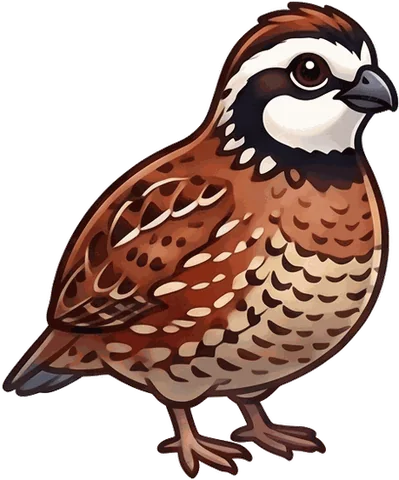
A Northern Bobwhite sounds exactly like its name. The male's summer call is a clear, loud whistle, bob-WHITE or poor-bob-WHITE, with the syllables slow and widely spaced and the last one jumping sharply upward. It comes from a fence post or a weedy field edge on late spring and summer mornings across the eastern and central United States. In fall and winter the birds gather in coveys and switch to softer whistled contact calls, a koi-lee that scattered birds use to find each other again.
The birder's mnemonic
“bob-WHITE” The name is the call: two or three slow notes with the last one rising a full octave, so the WHITE sounds almost like a question.
What the whistle sounds like
Audubon writes it as a clear, whistled bob-WHITE or poor-bob-WHITE, and Wikipedia adds the detail that makes it easy to recognize: the notes are slow and widely spaced, and the pitch rises a full octave across the call. The first syllable is low and short, almost swallowed, and the second is a long, emphatic upward slur. Once you have heard it you cannot unhear the word.
It is a male's breeding call, given from a low perch or the ground in spring and summer, and Missouri's field guide notes it is loud enough and simple enough that several other birds imitate it. In good habitat you may hear two or three males answering each other across a pasture.
Covey calls and the whir of wings
From fall through winter bobwhites live in coveys, on average about a dozen birds according to Audubon. Missouri's field guide describes a koi-lee call given in autumn, and Wikipedia lists lisps, peeps and rapid whistled warning calls. These are the sounds of a group keeping together in tall grass, and of scattered birds regathering after a hawk has broken the covey up. At night the covey roosts on the ground in a circle, tails in and heads out, so every bird watches a different direction. Animal Diversity Web adds that the famous whistle is only a small part of what bobwhites say; most calls are quiet ones for moving the group and warning of danger.
The other bobwhite sound is a sudden explosion of whirring wings from underfoot. Animal Diversity Web puts the average flight at about five seconds, just long enough to get out of sight.
When and where you hear it
The whistle season runs from spring into late summer. Animal Diversity Web notes courtship as early as February in south Texas, with nesting concentrated from May to August, and Missouri's guide says it can continue until around October. Listen in the early morning and late afternoon, when the birds are feeding.
Bobwhites are permanent residents of farms, brushy open country, roadsides and wood edges from southeastern Ontario south through the eastern and central states to Mexico and Guatemala. They want a patchwork: shrubby cover to hide in, open weedy ground with bare soil to walk on, and green, growing plants with the insects that chicks depend on. The diet is about 85 percent plant material, mostly seeds of ragweed, foxtail, legumes and waste grain in winter, and about a quarter insects from spring to fall.
The hard news is the decline. Audubon says the bobwhite has disappeared from much of the northern part of its range and dropped seriously even in the South, and Wikipedia puts the loss in eastern North America at roughly 85 percent between 1966 and 2014. The main cause named by Animal Diversity Web is habitat: large-scale farming and the removal of fencerows. Where land is managed for quail, Missouri's guide says numbers hold steady. In Texas, Kansas and much of the Southeast it is still a Warble card you can catch from a country road with the window down.
What it looks like
A small, round quail, 8 to 11 inches long, reddish brown and mottled with a very short gray tail. The male has a bright white throat and eyebrow bordered in black; on the female the same pattern is buff. Northern birds weigh around 6 ounces.
The nest is a shallow scrape lined with grass, with living vegetation woven into an arch over the top. Audubon gives 12 to 16 white to pale buff eggs and 23 to 24 days of incubation shared by both parents. Chicks are the size of bumblebees, in Missouri's phrase, and leave the nest within a day. Life is short: Animal Diversity Web says about 80 percent of bobwhites do not reach their first birthday.
Birds that sound similar
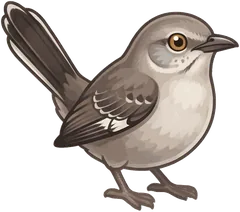 Northern Mockingbird
Missouri's field guide notes that other birds imitate the bobwhite, and the mockingbird is the usual culprit. A real bobwhite repeats the same two or three notes with long pauses; a mockingbird runs through it a few times and moves on to something else.
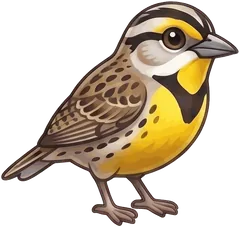 Eastern Meadowlark
The Eastern Meadowlark whistles from the same fence posts, but its song is a slow, sliding phrase of two to four notes that falls in pitch. The bobwhite gives two or three notes, and the last one rises.
Where the Northern Bobwhite card lives
In Warble the same bird can be an easy card in one state and a prized one in another, because each album ranks its birds by how often people really report them there. The Northern Bobwhite appears in 3 state albums:
 Heard one? Open Warble, tap the green button while it sings, and the Northern Bobwhite card flips into your album. Get the app free.
Questions people ask
What bird says bob-white?
The Northern Bobwhite, a small quail of fields and brushy edges in the eastern and central United States. The male whistles a clear bob-WHITE with the second note rising sharply, mostly in late spring and summer.
Why don't I hear bobwhites anymore?
Because there are far fewer of them. Populations in eastern North America fell by about 85 percent between 1966 and 2014, and the bird has vanished from much of the northern part of its range, mainly as farms grew larger and weedy edges were removed.
Is the bobwhite a state bird?
It is a state game bird rather than a state bird: Georgia named it in 1970, Tennessee in 1987 and Missouri in 2007. Georgia's state bird is the Brown Thrasher, Tennessee's the Northern Mockingbird and Missouri's the Eastern Bluebird.
Why do quail roost in a circle?
Safety. A covey settles on the ground with tails pointed in and heads out, so eyes cover every direction, and if a predator comes close the whole group flushes at once.
Sources
- National Audubon Society, Guide to North American Birds: Northern Bobwhite. www.audubon.org/field-guide/bird/northern-bobwhite
- Wikipedia: Northern bobwhite (call, size, range, decline figures). en.wikipedia.org/wiki/Northern_bobwhite
- Missouri Department of Conservation, Field Guide: Northern Bobwhite. mdc.mo.gov/discover-nature/field-guide/northern-bobwhite
- Animal Diversity Web: Colinus virginianus (calls, coveys, diet, lifespan). animaldiversity.org/accounts/Colinus_virginianus/