 Warble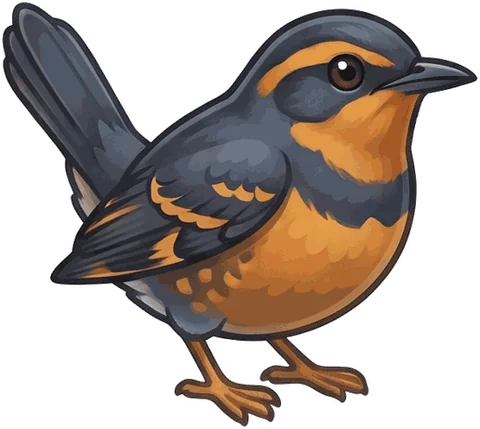
A Varied Thrush sounds like a single long whistle with a buzz inside it, held for about two seconds until it fades, followed by silence, then another whistle on a different pitch. There is no melody and no flourish, just one fuzzy, metallic tone at a time, three to twenty seconds apart. It sounds eerie and far away even when the bird is close, and it carries through dense, dripping conifer forest from Alaska to northern California. The everyday call is a low, soft took.
What the song sounds like
Most thrush songs are built from phrases. The Varied Thrush sings a single note. Each one is a drawn-out whistle with a buzzy, metallic edge, as if someone were blowing across a reed and a tuning fork at once, and it holds for roughly two seconds before trailing off. Then the bird waits, anywhere from three to twenty seconds, and sings again on a clearly different pitch. Audubon describes two or three buzzy whistles, each fading away, separated by short silences. The Montana Field Guide puts the tone at about two seconds with a pause of three to twenty seconds between tones.
The effect is unlike anything else in a western forest. The notes seem to come from nowhere in particular, and the bird is usually sitting still in a hemlock or fir where you cannot see it. Montana's account calls the song ventriloquial, and many people hear it for years in the Cascades before they see the singer.
If you want a handle on the sound, think of a referee's whistle slowed down, softened and given a slight rasp, played once, with a long patient gap before the next.
The call: a low took
Away from the song, Varied Thrushes are quiet birds. The call to listen for is a low, soft took, given by a bird on the ground under cover or by one flushing up into a tree. You hear it in winter when the birds have come down to lowland parks, ravines and stream-side thickets to turn over leaf litter under shrubs.
Timing helps. BirdWeb notes that males sing most at dawn, at dusk and right after rain, which in the Northwest covers a lot of the day.
When and where you hear it
This is a bird of dense, wet conifer forest. It breeds from Alaska down the coast through British Columbia, Washington and Oregon to northern California, and inland into Idaho, western Montana and Alberta. The best habitat is old, mossy forest of fir, hemlock, spruce and cedar with thick understory. BirdWeb notes that in Washington the bird is common west of the Cascades all year and fairly common east of them.
Singing starts when males return to breeding territory, mid to late April in Montana, and runs through nesting. The nest goes in a conifer close to the trunk, five to fifteen feet up, with three or four pale blue eggs dotted with brown. Pairs often raise two broods, so there is a second round of song in early summer.
In winter the birds drop to lower elevations and spread out into city parks, orchards and backyards with apples or berries, and they wander. Audubon notes that a few stray far east every fall and winter, some reaching New England. The diet swings with the season: insects, earthworms and spiders in summer, berries, seeds and acorns in winter. If you play Warble in Seattle or Portland, the song is the catch to go for on a wet April morning.
What it looks like
Robin-sized but stockier, about 8 to 10 inches long. The male is slate blue-gray above with an orange throat, an orange eyebrow, a black mask through the eye and a bold black band across an orange breast. Orange wing bars and orange edges on the flight feathers are the quickest way to pick one out of a robin flock. Females show the same pattern in duller, browner tones. Juveniles are mottled on the chest but already have the adult wing pattern.
It is the only member of its genus, Ixoreus. If the song sounds familiar and you have never been to the Northwest, you may have heard it in the opening of the television series Twin Peaks.
Birds that sound similar
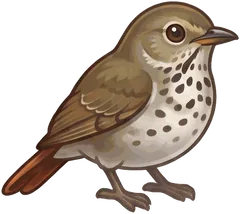 Hermit Thrush
A Hermit Thrush also opens with a long clear note, but it follows it with a soft, rising flourish of flute-like phrases. The Varied Thrush stops after the one buzzy note and waits.
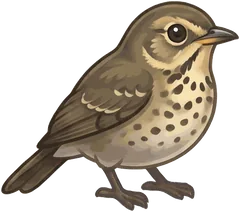 Swainson's Thrush
A Swainson's Thrush song spirals upward in a quick series of fluty notes and lives in the same wet western forests. There is no spiral in a Varied Thrush, only single held tones.
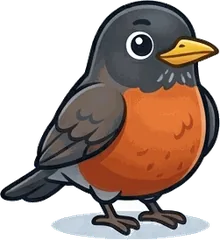 American Robin
Robins feed beside Varied Thrushes on winter lawns and give a similar soft call, but a robin's song is a run of short rising and falling phrases, never one long buzzy whistle.
Where the Varied Thrush card lives
In Warble the same bird can be an easy card in one state and a prized one in another, because each album ranks its birds by how often people really report them there. The Varied Thrush appears in 3 state albums:
 Heard one? Open Warble, tap the green button while it sings, and the Varied Thrush card flips into your album. Get the app free.
Questions people ask
What bird makes a single long eerie whistle in the forest?
In wet conifer forest from Alaska to northern California, that is very likely a Varied Thrush: one long, buzzy, metallic whistle about two seconds long, a pause, then another on a different pitch. It sounds far away even when the bird is near.
Why is a Varied Thrush so hard to see when it is singing?
The note is ventriloquial, so it is hard to tell which direction it comes from, and the male sings from inside dense fir and hemlock while sitting still. Wait for the next note to narrow down the tree, then look for the orange wing bars.
Do Varied Thrushes come to feeders?
Yes, in winter. When they come down from the mountains they visit yards with fruit, apples and seed on the ground, and they turn over leaf litter under shrubs. They are shyer than robins and usually stay close to cover.
When do Varied Thrushes sing?
From the return to breeding territory in spring, mid to late April in Montana, through early summer, with peaks at dawn, at dusk and after rain. In winter you mostly hear the quiet took call instead.
Sources
- National Audubon Society, Guide to North American Birds: Varied Thrush. www.audubon.org/field-guide/bird/varied-thrush
- Wikipedia: Varied thrush (measurements, range, taxonomy, Twin Peaks). en.wikipedia.org/wiki/Varied_thrush
- Seattle Audubon, BirdWeb: Varied Thrush. birdweb.org/birdweb/bird/varied_thrush
- Montana Field Guide: Varied Thrush. fieldguide.mt.gov/speciesDetail.aspx?elcode=ABPBJ22010