 Warble


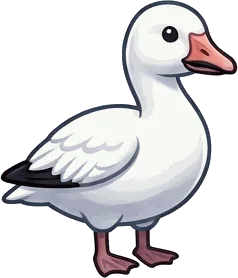
A Snow Goose sounds like a small dog barking in the sky. The call is a high-pitched, yelping howk-howk or bow-wow, higher and thinner than a Canada Goose's honk. One bird is easy enough to pick out, but Snow Geese travel in huge flocks and are very vocal, so what you usually hear is thousands of yelps overlapping into a constant clamor that can carry for more than a mile. Listen in winter and during spring and fall migration over farm fields, marshes and bays, often from flocks so high they look like specks.
What it sounds like: high, barking yelps
Geese do not sing, but Snow Geese more than make up for it. Audubon describes the call as a high-pitched, barking bow-wow! or howk-howk!, and its tags capture the shape: the note often falls in pitch, sometimes wavers, and has both a quacking edge and a squeaky, whistled quality. Up close, a single bird sounds a bit like a terrier that has learned to honk.
The real experience is the flock. Wikipedia calls the species very vocal, and Audubon notes that Snow Geese tend to show up in big numbers or not at all. Put those together and you get the classic sound of a winter marsh: thousands of birds yelping at once, a rolling roar that can drift down from flocks flying so high they are hard to see. The calls can often be heard from more than a mile away, so you may well hear Snow Geese before you see them.
Calls in flight and in the field
In migration, Snow Geese travel in large flocks that fly very high along fairly narrow corridors, stopping at the same traditional resting places year after year. Some trips between the wintering grounds and the tundra run more than 3,000 miles. Look up when you hear the yelping: the birds may be so high that the flock looks like a wavering white thread.
On the ground the noise continues. Outside the nesting season Snow Geese feed in flocks, walking through shallow water or across fields, often alongside Greater White-fronted Geese but usually keeping apart from Canada Geese. Mates court by facing each other and stretching their necks upward together, and pairs may stay together for life. Families stick together too, with young often traveling with their parents for two or three years, so a big flock is partly a crowd of families calling together.
When and where you hear it
Snow Geese nest on Arctic tundra north of the tree line, in Alaska, Canada, Greenland and northeastern Siberia, and they spend more than half of each year migrating to and from their wintering grounds. The Lesser Snow Goose uses the Central, Mississippi and Pacific Flyways and winters on grasslands and farmland across the United States and Mexico, especially on the Gulf coastal plain. The larger Greater Snow Goose nests in far northeastern Canada and Greenland, follows the Atlantic Flyway and winters along the Atlantic coastal plain.
Audubon's range covers regions from California and Texas to New England, though the flocks gather only in favored places. In migration and winter, look and listen over coastal and freshwater marshes, estuaries, bays, ponds and especially grain fields, where flocks glean leftover crops. If the yelping is loud enough to turn your head, it is loud enough for Warble to have a listen.
Too many geese
The Snow Goose is a rare conservation story run in reverse. The Greater Snow Goose fell to just 2,000 or 3,000 birds around 1900 and has since recovered. The Lesser Snow Goose has exploded: its breeding population tops 5 million, up more than 300 percent since the mid-1970s, and it is still growing. A shift from marsh-grass roots to waste grain on farmland is thought to have helped fuel the boom.
So many geese now graze the Arctic that they have badly damaged tundra breeding grounds and saltmarsh wintering areas, hurting other wildlife. Since 1997 the United States and Canada have tried to cut numbers with longer hunting seasons and larger bag limits under the Light Goose Conservation Order, without shrinking the overall population.
What it looks like
A medium-sized goose, about 25 to 30 inches long with a wingspan of roughly 4.5 to 5.5 feet. The white form is all white with black wingtips and a pink bill and legs. The bill's black cutting edges form a dark grin patch, and soil minerals sometimes stain the face rusty. The blue form, long thought to be a separate species called the Blue Goose, is gray-bodied with a white head. The two forms interbreed, and young birds are grayer than adults.
Birds that sound similar
- ?Ross's Goose
Its voice is soft cackling and grunting, gentler than the Snow Goose's high barking. The two often migrate in mixed flocks; Ross's is smaller, with a short, stubby bill that lacks the black grin patch.
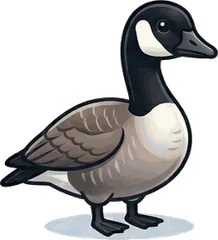 Canada Goose
A Canada Goose gives a rich, musical honk, rounder and lower than the Snow Goose's yelping howk. In flight, a black neck with a white chinstrap settles it.
Where the Snow Goose card lives
In Warble the same bird can be an easy card in one state and a prized one in another, because each album ranks its birds by how often people really report them there. The Snow Goose appears in 7 state albums:
 Heard one? Open Warble, tap the green button while it sings, and the Snow Goose card flips into your album. Get the app free.
Questions people ask
How far away can you hear snow geese?
Often more than a mile. Snow Geese are very vocal and travel in huge flocks, so the combined yelping of thousands of birds carries a long way, and you often hear a flock before you spot it high overhead.
What is a blue goose?
A dark form of the Snow Goose, gray-bodied with a white head. It was long treated as its own species, but the blue and white forms interbreed and their young can be either color.
Why are there so many snow geese now?
The Lesser Snow Goose breeding population has grown more than 300 percent since the mid-1970s, helped by a switch to feeding on waste grain in farm fields. The boom is now damaging Arctic tundra, and special hunting rules have not brought numbers down.
Sources
- National Audubon Society, Guide to North American Birds: Snow Goose. www.audubon.org/field-guide/bird/snow-goose
- Wikipedia: Snow goose (voice, morphs, migration, population and conservation order). en.wikipedia.org/wiki/Snow_goose
- National Audubon Society, Guide to North American Birds: Ross's Goose (voice and identification). www.audubon.org/field-guide/bird/rosss-goose
- National Audubon Society, Guide to North American Birds: Canada Goose (voice). www.audubon.org/field-guide/bird/canada-goose