 Warble


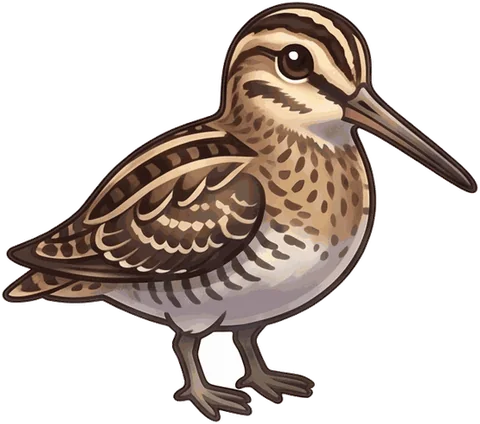
Wilson's Snipe makes two sounds people notice. The famous one is the winnow, a hollow, pulsing hoo-hoo-hoo-hoo that drifts down from the sky over northern marshes in the breeding season, often at night. It is not a voice at all but air rushing through the male's tail feathers as he dives. The other is a harsh, rasping scaip! given by a bird bursting out of the grass at your feet and zigzagging away.
The voice: chip, chipper and fencepost calls
Snipe do not really sing. Animal Diversity Web notes that their vocal sounds are limited to calls, and that males and females share most of them. In the breeding season, though, they get much easier to notice, and Audubon describes them calling from fenceposts and dead trees around the marsh.
ADW describes two calls tied to family life. The chipper is heard between birds of the same sex during the mating season and used to call chicks. The chip is a hard, sharp, repeated note given when a bird is excited or warning its chicks of danger. Males also call as they land to attract a female, and females call when a male flies over.
The call: a rasping scaip
The sound most people hear first is the alarm. Walk across a wet field in fall and a brown bird explodes from almost under your boot, zigzags off and gives a sudden, hoarse rasp: scaip! in Audubon's spelling, scraip, scraip in Missouri's.
Around the nest the repertoire gets stranger. A parent trying to lead a predator away may fake a broken wing, like a Killdeer, with grunts, squeals and wheezes to sell the act.
When and where you hear it
Snipe breed in fresh marshes, bogs, wet meadows, shrubby streamsides and northern tundra, mostly in Canada and Alaska, with the breeding season running from mid-April to August. That is winnowing country. In winter they spread across much of the continental United States and south through the Caribbean and Central America to northern South America, using fresh and salt marshes, muddy banks, wet pastures and flooded fields. In parts of the Northwest and the Great Lakes they can be found all year.
In Missouri the snipe is a common migrant in spring and fall but is not known to breed, so Missouri birds rarely put on the winnowing display. Snipe are most active at dawn and dusk and migrate at night. In Warble the snipe is a legendary card in the Wyoming album.
Audubon puts the population near 2 million and says it was probably far larger before market hunting in the late 1800s and the loss of wetlands. It is still hunted as a game bird.
The winnow: a sound made by feathers
Winnowing is a display flight. A male climbs high over his marsh, flies in circles and every so often tips into a shallow dive. As he drops, his spread outer tail feathers vibrate in the rushing air and produce the sound: a hollow, pulsing hoo-hoo-hoo-hoo that Audubon describes as a whinnying. Then he climbs and does it again, so the sound comes in separate bursts, one for each dive.
ADW adds the physics. The bird spreads and rapidly beats its tail feathers to set them vibrating, and the sound only becomes audible once it is moving at about 24 miles an hour. Wilson's Snipe winnows at a higher pitch, around 700 to 800 hertz, than the Common Snipe, which sounds at roughly half that. Males use the display mostly as an aggressive signal, and both sexes use it to put off predators.
Audubon says males perform it mainly at night in the breeding season. If soft hooting seems to circle overhead at a northern bog with no owl in sight, look up and wait for the next dive.
What it looks like
A plump, short-legged shorebird about 10 to 12 inches long with a very long, straight bill. The head is striped black and white, the back is mottled brown and black with long white stripes, the flanks are barred and the belly is white, with a rusty band near the tip of the tail. The bill tip is flexible and sensitive and can open underground to grab a worm, and a probing snipe bobs its head like a sewing machine.
Females build a well-hidden nest on the ground and incubate the usual four eggs alone. The chicks leave the nest soon after hatching, and the parents may split the brood between them.
Birds that sound similar
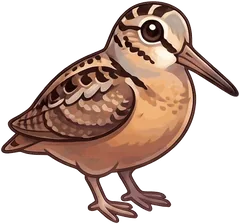 American Woodcock
The woodcock also performs a sky dance on spring nights, but its wings make a musical twittering, mixed with vocal chirps, and on the ground it gives a buzzy bzeep. It favors wet thickets and moist woods; the snipe winnows over open marsh.
- ?Common Snipe
Until 2003 North American snipe were lumped with this species, so older books may say Common Snipe. Its winnow has about half the frequency, roughly 350 to 400 hertz against Wilson's 700 to 800.
Where the Wilson's Snipe card lives
In Warble the same bird can be an easy card in one state and a prized one in another, because each album ranks its birds by how often people really report them there. The Wilson's Snipe appears in 4 state albums:
 Heard one? Open Warble, tap the green button while it sings, and the Wilson's Snipe card flips into your album. Get the app free.
Questions people ask
What is the hooting sound over a marsh at night in spring?
Often a winnowing Wilson's Snipe. A male circles high and dives, and air through his spread tail feathers makes a hollow, pulsing hoo-hoo-hoo. Audubon says the display happens mainly at night in the breeding season.
Does a snipe make the winnowing sound with its voice?
No. Winnowing is made by the outer tail feathers vibrating as the bird dives, and it only becomes audible at around 24 miles an hour. The snipe's actual voice is a set of calls: a rasping scaip, a sharp chip and a chipper.
Is the snipe a real bird?
Yes. Wilson's Snipe is a real and common shorebird of marshes and wet fields across North America, with a population of about 2 million. It is well camouflaged and shy, so many people only see one when they nearly step on it.
Does the word sniper come from snipe?
Yes. Missouri's field guide explains that a sniper was originally a snipe hunter skilled enough to hit such a difficult, zigzagging target. The word later came to mean a marksman shooting from a hidden position.
Sources
- National Audubon Society, Guide to North American Birds: Wilson's Snipe. www.audubon.org/field-guide/bird/wilsons-snipe
- Animal Diversity Web: Gallinago delicata (calls, winnowing, behavior, breeding). animaldiversity.org/accounts/Gallinago_delicata/
- Missouri Department of Conservation, Field Guide: Wilson's Snipe. mdc.mo.gov/discover-nature/field-guide/wilsons-snipe
- National Audubon Society, Guide to North American Birds: American Woodcock. www.audubon.org/field-guide/bird/american-woodcock