 Warble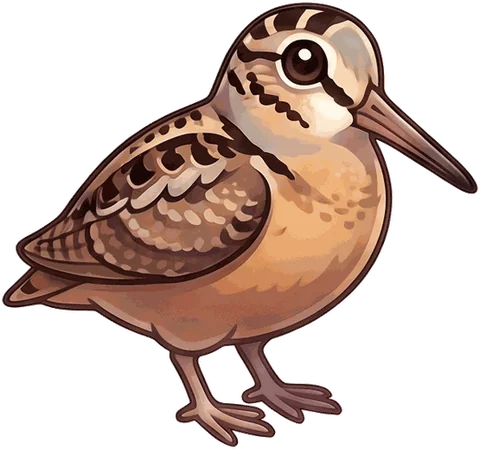
An American Woodcock sounds like two different birds. On the ground at dusk the male gives a loud, buzzy, nasal peent, close to a nighthawk's call, repeated about every two seconds. Then he launches into the sky dance: a high spiral climb during which his outer wing feathers make a musical twittering, followed by a zigzag drop with liquid chirping notes. You hear it in spring at dawn and dusk from brushy fields and wet woodland edges across the eastern United States and Canada.
The peent and the sky dance
The performance starts on the ground. A male walks out onto a clearing, an old field, a pasture or a swamp edge as the light fades and begins to peent: a short, buzzy, nasal note that Audubon compares to the call of a Common Nighthawk and writes as a loud bzeep. He repeats it roughly every two seconds, turning a little between notes so the sound seems to move.
Then he goes up. Wikipedia describes a high, spiraling climb of 50 to 100 yards. As he rises, air rushing through his outer primary feathers makes a melodious twittering that gets faster and higher. At the top he starts singing, a liquid chirping, and comes down in a zigzag, fluttering, in Animal Diversity Web's phrase, like a falling leaf. He lands close to where he started and peents again.
Several males may display in the same field within earshot of each other. Wikipedia notes that a male can keep this up for as long as four months.
Other sounds: whirring wings and a cackle
Outside the display, woodcocks are quiet birds, and most people meet the species by nearly stepping on one. When flushed, the short, rounded wings make a loud whirring that Missouri's field guide calls distinctive. Animal Diversity Web lists four vocalizations: the peent, a tuko, the chirping of the flight song, and a cackle.
When and where you hear it
The window is spring twilight. Displays happen at dawn, at dusk and on moonlit nights. Animal Diversity Web says breeding can begin as early as January in the South, peaking in April and May, and Missouri's field guide recommends February through April for watching the courtship. Spring migration starts very early: Audubon notes some males move north in January in warm years, and birds are back on territory by mid-March to mid-April.
Look for a mix of young woods and open ground. Woodcocks breed from Atlantic Canada west to southeastern Manitoba and south to northern Virginia, Kentucky, Missouri and eastern Kansas, and winter along the Gulf Coast and southeastern Atlantic states, with the core in Louisiana, Mississippi, Alabama and Georgia. They like wet thickets, moist woods, young alder and aspen stands and streamside brush, feeding on soft soil where they probe for earthworms, which make up 50 to 90 percent of the diet. While feeding they rock their bodies back and forth, a walk that made the bird a social media star in 2024.
Migration is at night and slow: Wikipedia gives a cruising speed of 16 to 28 miles per hour and credits the woodcock with the slowest recorded flight of any bird, 5 miles per hour. The population is put at around 3.5 to 5 million, the most common sandpiper in North America, but it has declined about 1.1 percent a year for four decades as young forest matures or is built over. For Warble players the peent is a card you earn by standing in a damp field at dusk in March, which is a fine way to spend an evening.
What it looks like
A plump, round-bodied bird about the size of a robin, 10 to 12 inches long, with a short neck, short legs, a stubby tail and an absurdly long straight bill of 2.5 to 2.8 inches. The upperparts are a dead-leaf mix of brown, gray and black, the underparts orange-buff, and the crown carries black bars running crosswise. The large dark eyes sit high and far back on the head, which Wikipedia says gives it probably the widest field of view of any bird, a full 360 degrees horizontally. Its nicknames, timberdoodle, bogsucker, mudbat and night partridge among them, tell you where and when people meet it.
The nest is a shallow scrape in dead leaves, usually within 150 yards of a singing ground, with about four pinkish-buff eggs blotched brown and gray. The female incubates alone for 20 to 22 days, the chicks walk within hours, and the male plays no part at all. He is busy peenting.
Birds that sound similar
 Common Nighthawk
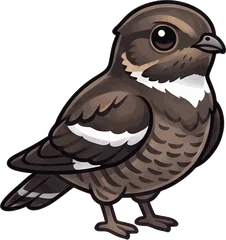
The nighthawk's nasal peent is very similar, but it comes from a bird flying high overhead, often over town rooftops. A woodcock peents from the ground in a field, then climbs and twitters.
- ?Wilson's Snipe
The snipe also displays at dusk with a feather sound, a hollow, pulsing winnow from its spread tail over marshes. The woodcock's wing twitter is higher, faster and more musical, and it ends in chirping.
Where the American Woodcock card lives
The American Woodcock is not in the top 100 of any single state album, so it lives in the national album of all 800 birds, where it counts as uncommon. Catching one anywhere in the country adds it there.
 Heard one? Open Warble, tap the green button while it sings, and the American Woodcock card flips into your album. Get the app free.
Questions people ask
What is the buzzing peent sound in a field at dusk?
In spring across the eastern United States, it is most likely a male American Woodcock. He gives a buzzy, nasal peent about every two seconds from open ground at dusk, then spirals up with twittering wings and drops back down chirping.
When do woodcocks do the sky dance?
From late winter through spring, at dawn, at dusk and on moonlit nights. Displays can start as early as January in the South and peak in April and May farther north. Missouri's field guide suggests February through April at twilight.
Why does a woodcock rock back and forth when it walks?
Nobody knows for certain. One idea is that the rocking sends vibrations into the soil that make earthworms move so the bird can find them. Another is that it signals to a watching predator that the woodcock has already noticed it.
Is the woodcock a shorebird?
Yes, oddly. It is a sandpiper that lives in damp woods and fields instead of on beaches, and it is the most common sandpiper in North America. It is the only woodcock species found in North America.
Sources
- National Audubon Society, Guide to North American Birds: American Woodcock. www.audubon.org/field-guide/bird/american-woodcock
- Wikipedia: American woodcock (display, nicknames, range, migration, population). en.wikipedia.org/wiki/American_woodcock
- Missouri Department of Conservation, Field Guide: American Woodcock. mdc.mo.gov/discover-nature/field-guide/american-woodcock
- Animal Diversity Web: Scolopax minor (vocalizations, display, diet, breeding). animaldiversity.org/accounts/Scolopax_minor/