 Warble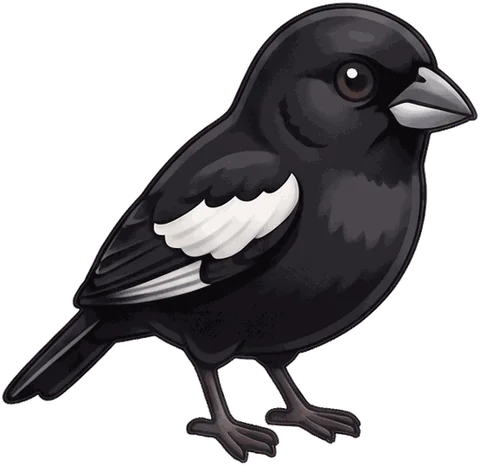
A Lark Bunting sounds like a canary let loose on the shortgrass prairie: loud bubbling runs and trills mixed with harsher buzzes, rattles and chirps, all strung together in a long, uneven sequence. The most memorable version is the flight song. A breeding male flutters up twenty or thirty feet, then floats back down to the grass on stiff, outstretched wings, singing the whole way. The call is a soft two-note whistle, often written as a gentle hoo. In winter the birds go quiet and travel in big flocks.
What the song sounds like
Audubon describes the song as canary-like, with loud bubbling sequences and trills broken up by harsher notes, and that is a fair summary of a sound that refuses to settle into a pattern. A single song can roll through a whistle, a buzz, a dry rattle, a quick chirp and a liquid trill in a few seconds. It is sweet and rough at the same time, which is unusual among the sparrows. No other prairie bird sounds so cheerfully disorganized.
The setting is part of the sound. On the open plains there is nothing to bounce an echo off, so the song arrives clean and carries a long way. Where Lark Buntings are common, which in a good year means much of eastern Colorado in June, several males sing at once and the prairie buzzes from every direction.
The song is a territorial announcement, and in this species it comes with choreography.
The flight song
Males sing from fence posts and shrub tops, but the full performance happens in the air. The bird launches from the grass, climbs twenty to thirty feet, then drifts back down on wings held out stiff, like a small black parachute, singing the whole descent. The white wing patches flash the entire way.
Away from the display, the everyday sound is a soft two-note whistle, heard from birds walking through the grass, from flocks lifting off a roadside and from migrants passing overhead. In a winter flock of a few hundred birds it becomes a quiet murmur.
When and where you hear it
This is a bird of native shortgrass prairie and sagebrush plains with a grassy, weedy understory. It breeds across the Great Plains, from the prairie provinces of Canada south through Montana, Wyoming, the Dakotas, Nebraska, Colorado and Kansas to the Texas Panhandle, and Wikipedia calls it the most numerous songbird of North America's grasslands. Birds nest in loose colonies. The nest is a grass cup sunk slightly into the ground beside a shrub or grass clump, with four or five pale blue to greenish eggs; the young leave around nine days after hatching.
The season is short. In Texas, spring migrants arrive from late March into early May, breeding runs through May and June, and southbound birds are moving by mid July, so the singing window on the plains is roughly late April to early July. After that the males molt out of their black plumage and the species goes quiet.
Winter birds gather in large flocks in open country from western Texas and southern Arizona into northern Mexico: prairies, farm fields, desert grassland and weedy lots. They forage by walking on the ground, eating grasshoppers and other insects in summer and weed seeds and waste grain in winter. Numbers swing wildly from year to year, and the species has lost ground as prairie has gone under the plow. For Warble players in Denver, the flight song is a late spring drive east, not a backyard catch.
What it looks like
A chunky, short-tailed, big-billed sparrow, five to seven inches long with a wingspan of nine to eleven inches. A breeding male is unmistakable: black all over with a large white patch on each wing and a thick, bluish bill. Females, young birds and males in winter are streaky gray-brown with the same pale wing patch and white tips on the short tail. By late summer the males have molted and look like the females again.
Colorado adopted the Lark Bunting as its state bird in 1931.
Birds that sound similar
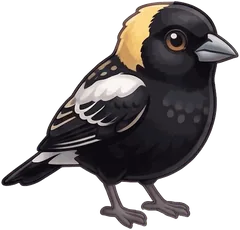 Bobolink
A Bobolink also sings a bubbling, tumbling song in flight over grassland, but it is a wetter, more metallic jumble and the bird is a tallgrass and hayfield species, farther east. Lark Buntings favor dry shortgrass and sagebrush.
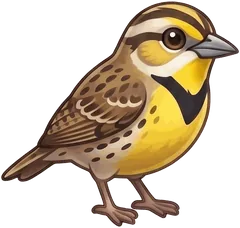 Western Meadowlark
The Western Meadowlark shares the same fence posts, but its song is a short, clear, flute-like phrase that ends in a gurgle, repeated the same way each time. A Lark Bunting rambles and never repeats itself in the same order.
- ?Chestnut-collared Longspur
Another prairie bird with a fluttering song flight, but its song is a short, sweet warble and the bird is smaller, with no big white wing patch. Lark Bunting songs run longer and include buzzes and rattles.
Where the Lark Bunting card lives
The Lark Bunting is not in the top 100 of any single state album, so it lives in the national album of all 800 birds, where it counts as uncommon. Catching one anywhere in the country adds it there.
 Heard one? Open Warble, tap the green button while it sings, and the Lark Bunting card flips into your album. Get the app free.
Questions people ask
Why is the Lark Bunting Colorado's state bird?
Colorado chose it in 1931. It is a bird of the eastern plains rather than the mountains, abundant in good years, with a striking black-and-white male and a song flight that anyone can enjoy from a county road.
Does the Lark Bunting sing in flight?
Yes, and that is its signature. A male flies up twenty to thirty feet, then floats down on outstretched wings while singing a long run of trills, whistles and buzzes. He also sings from fence posts, but the aerial version is the one to watch for.
Where do Lark Buntings go in winter?
South and a little west. They leave the breeding grounds early, some by late July, and winter in flocks in open country from western Texas and southern Arizona into northern Mexico, feeding on weed seeds and waste grain.
Is the Lark Bunting a bunting or a sparrow?
It is a New World sparrow despite the name. Audubon describes the females and winter birds as chunky, short-tailed, big-billed sparrows, and the thick bluish bill and ground-feeding habits fit that family, not the Indigo and Painted Buntings of the cardinal family.
Sources
- National Audubon Society, Guide to North American Birds: Lark Bunting. www.audubon.org/field-guide/bird/lark-bunting
- Wikipedia: Lark bunting (song, flight display, measurements, Colorado state bird). en.wikipedia.org/wiki/Lark_bunting
- Texas Breeding Bird Atlas (Texas A&M): Lark Bunting. txtbba.tamu.edu/species-accounts/lark-bunting/
- Wikipedia: List of Colorado state symbols. en.wikipedia.org/wiki/List_of_Colorado_state_symbols