 Warble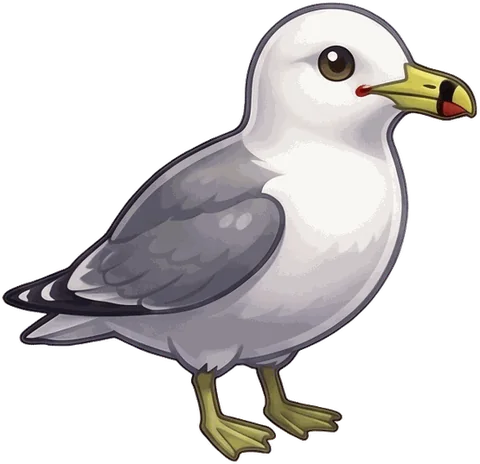
A California Gull sounds like a slightly hoarser, mid-pitched version of the classic seagull: a loud, repeated kee-yah, kee-yah, which Audubon describes as raucous and screaming, plus a long call of rising notes, a soft mew between mates, and sharp alarm notes when a predator nears the colony. It sits between a Ring-billed Gull and a Herring Gull in size and in pitch. You hear it in summer on lakes and marshes of the interior West, from the Great Salt Lake to Mono Lake, and in winter along the Pacific coast.
The long call: what stands in for a song
Gulls have no song, so the sound that fills that role is the long call, the rising, repeated series a gull gives to claim a spot or greet a mate. In the California Gull it comes out as a string of kee-yah notes, higher than a Herring Gull's bugle and lower than a Ring-billed Gull's, with the rough, screaming edge Audubon notes. On a nesting island in the Great Salt Lake or Mono Lake, where colonies run from a couple of thousand birds to tens of thousands, the long calls of hundreds of pairs blend into a continuous roar.
Animal Diversity Web breaks the repertoire down further. There is a warning call in which the bird drops the pitch and leans on the second syllable, a mew of soft, low notes used in courtship and courtship feeding, a charge call given while chasing a predator, and a hoarse, thin shrill waver when a bird is caught. Chicks beg with their own calls from the day they hatch.
The call: kee-yah and the alarm
The single kee-yah is what you hear from a bird overhead or on a beach, and it is repeated over and over when the gull is agitated. The alarm is several sharp notes in a row, given when a hawk, an owl or a person approaches the colony, and it brings neighbors into the air. Away from the colony, on a coastal parking lot or a plowed field, the voice can be hard to pick out of a mixed flock; the dark eye, yellow-green legs and the bill with both a red and a black spot settle it by sight.
When and where you hear it
This is a gull that spends its summers far from any ocean. It breeds on islands in lakes and marshes across the interior West, from the Northwest Territories south through the Great Basin to eastern California and Colorado. The nest is a shallow scrape lined with weeds, grass and feathers, usually with two or three eggs; incubation takes about 24 days and the chicks fly at roughly six to eight weeks. The breeding season, and the loud season, runs from May into July.
After nesting most birds head west or southwest to the Pacific coast, wintering from southern British Columbia to Mexico, so in California, Oregon and Washington it is a winter and migration bird of beaches, harbors, dumps and fields, and it rarely reaches the Atlantic or Gulf coasts. It eats almost anything: insects, worms and spiders in summer, fish, rodents, the eggs and ducklings of other birds, grain, cherries and garbage. A colony in south San Francisco Bay grew from under 1,000 birds in 1982 to more than 33,000 by 2006, enough that managers now work to move the gulls away from nesting Snowy Plovers and Least Terns.
Its fame rests on 1848. Swarms of Mormon crickets were attacking the first crops of the Salt Lake Valley when flocks of gulls arrived and ate them, an event remembered as the Miracle of the Gulls and commemorated by the Seagull Monument in Salt Lake City. The story stuck, and in 1955 Utah made the California Gull its state bird. Audubon puts the population at about 1.1 million and rising.
What it looks like
A medium-large gull, about 18 to 22 inches long with a wingspan around four feet, smaller than a Herring Gull and larger than a Ring-billed. The adult has a white head and body, a gray back slightly darker than either of those two, black wingtips with large white spots, greenish yellow legs and a dark brown eye. The yellow bill carries both a red spot and a black mark near the tip. Young birds start out all dark brown with a thin bill that is sharply pink at the base, and reach adult plumage in their fourth winter. Animal Diversity Web gives a typical lifespan of 20 years and a record of 30.
Birds that sound similar
- ?Ring-billed Gull
The smaller, commoner gull of parks and parking lots has a similar mewing cry but higher pitched. In a mixed flock the California Gull's call is lower and rougher, and its bill has a red spot and a black mark rather than a neat black ring.
 Herring Gull
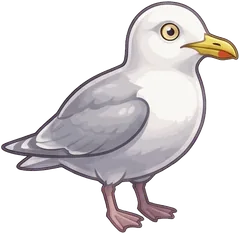
The Herring Gull is bigger and its long call is deeper and fuller, a rolling kuk-kuk-kuk, yucca-yucca with a clear keow. The California Gull is a notch higher and thinner, and it has pale greenish legs, not pink.
Where the California Gull card lives
In Warble the same bird can be an easy card in one state and a prized one in another, because each album ranks its birds by how often people really report them there. The California Gull appears in 8 state albums:
 Heard one? Open Warble, tap the green button while it sings, and the California Gull card flips into your album. Get the app free.
Questions people ask
Why is the California Gull the state bird of Utah?
Because of the Miracle of the Gulls. In 1848 gulls descended on the Mormon cricket swarms that were destroying the Salt Lake Valley's first crops and ate them. The Seagull Monument in Salt Lake City commemorates it, and Utah adopted the gull as state bird in 1955.
Where do California Gulls go in winter?
To the Pacific coast. After nesting on inland lakes, most birds move west or southwest and winter on beaches, harbors and fields from southern British Columbia to Mexico. They rarely reach the Atlantic or Gulf coasts.
How do you tell a California Gull from a Herring Gull?
By ear the California Gull is higher and thinner, the Herring Gull deeper and more bugling. By eye, the California Gull is smaller, has a dark eye, yellow-green legs instead of pink, and a bill with both a red spot and a black mark near the tip.
Do California Gulls eat ducklings?
Yes. Wikipedia and Animal Diversity Web both list the eggs and young of other birds, ducklings in particular, in the diet, along with insects, fish, rodents, grain, cherries and garbage. Large colonies can be a real problem for plovers and terns nesting nearby.
Sources
- National Audubon Society, Guide to North American Birds: California Gull. www.audubon.org/field-guide/bird/california-gull
- Wikipedia: California gull (measurements, plumage, range, subspecies, diet, San Francisco Bay colony, Miracle of the Gulls). en.wikipedia.org/wiki/California_gull
- Animal Diversity Web: Larus californicus, California gull (calls, colonies, nesting, lifespan). animaldiversity.org/accounts/Larus_californicus/
- Wikipedia: List of U.S. state birds (Utah, California gull, 1955). en.wikipedia.org/wiki/List_of_U.S._state_birds