 Warble


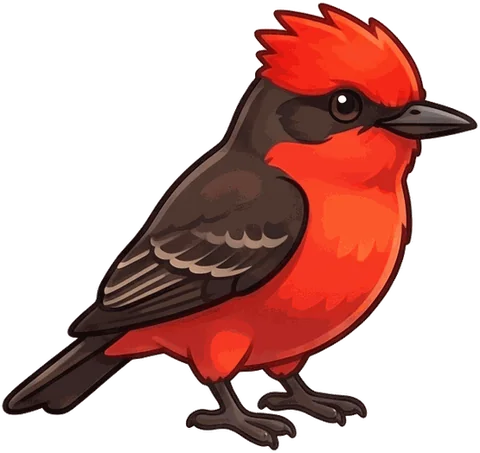
A Vermilion Flycatcher sounds like a quick, tinkling run of high notes that tumbles into a rolling finish, something like pit pit pit pidddrrrreedrr. The famous version is the flight song: the male puffs out his red feathers, flutters up as high as 50 feet or more over his territory, singing fast the whole way, then swoops back to a perch. The everyday call is a short peet or peet-a-weet, flat and then rising. Listen near water in the Southwest from late February through July.
What the song sounds like: a tinkle, not a tune
The song is short, high and bright: a few clipped notes that spill into a rolling, slightly buzzy ending. David Sibley writes it as pit pit pit pidddrrrreedrr, and the Cornell Lab hears ching-tink-a-le-tink, with the weight on the last syllable. It sounds less like a melody than a pocketful of tiny bells being shaken.
The song has a variable opening and a closing section of four elements. Males stretch the opening out before dawn and after the nest is built, and rivals seem to use it to size each other up. Females rarely sing. In Mexico City, males in noisier spots sang longer and louder, a problem familiar to anyone who has talked over traffic.
The call: a sharp peet
Outside the singing season you hear the call more than the song. Audubon writes it as peet-peet or peet-a-weet, a thin note that holds flat and then turns up. Birds give a peent while hunting and a harsher version when two males face off. Not every sound is vocal: displaying males snap their bills and make their wings whir, and a male defending his patch raises his crest, fans and pumps his tail, and chases the intruder out.
When and where you hear it
In the United States this is a bird of the Southwest, most reliably in southern Arizona and Texas, with fewer in southern California than there once were and a recent spread into Florida and Oklahoma. It needs water more than desert: streams lined with short trees, pond edges, ranches, savannas with scattered trees. In one Arizona study, breeding birds settled under cottonwood or mesquite and nested in Goodding's willow where they could.
Singing in Arizona and Texas runs from late February through July. Most birds stay all year, though some leave the northern and higher parts of the range, and a few winter along the Gulf Coast and the California coast.
It hunts from low, exposed perches, gently dipping its tail like a phoebe, and darts out after beetles, flies, wasps and grasshoppers, nearly always within about 10 feet of the ground. Near beehives it can eat a lot of bees. For Warble players in the Southwest, a spring morning beside a creek or pond is the best bet.
The flight song
This is the sound people remember. The male fluffs out his crest and body feathers until he looks like a red puffball, fans his tail, and rises over his territory in an odd, fluttering climb, sometimes 50 feet or higher, singing rapidly and over and over. Then he swoops back down to a perch. The Cornell Lab writes the flight version as pt-pt-pre-ee-een. The same display is aimed at a watching female.
Courtship continues at nest sites: the male leads the female from site to site, calling, and the pair crouch, chatter and flutter their wings. Often she ignores him. Once she settles on a site she builds a compact cup of twigs and grass bound with spider silk and trimmed with lichens, and he brings her food while she incubates. Pairs usually raise two broods a year.
What it looks like
A sparrow-sized flycatcher, 5 to 5.5 inches long and under half an ounce. The adult male is hard to mistake: a scarlet crown and underparts against a dark brown back, wings and tail, with a dark mask through the eye. Audubon compares the color to a Scarlet Tanager's, unusual company for a family of mostly drab birds. The female is gray-brown above, whitish below with fine streaks and a peach or pink wash on the belly. Young females are yellowish underneath.
The species is listed as Least Concern, but US numbers fell about 1.7 percent a year from 1966 to 2007, faster in Texas, while Arizona's grew. Loss of streamside habitat and nest parasitism by the Brown-headed Cowbird are the main threats.
Birds that sound similar
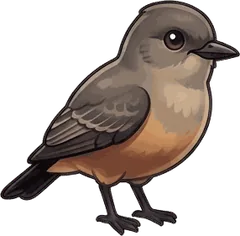 Say's Phoebe
 shares the same dry, open country and also wags its tail, but its song is a mellow, plaintive, whistled pee-ur that falls away. The flycatcher's peet rises instead, and only the flycatcher sings while fluttering high in the air.
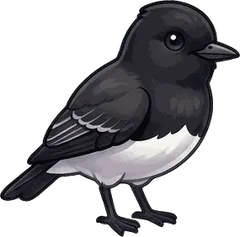 Black Phoebe
The Black Phoebe perches low over the same creeks and ponds and repeats a thin, buzzy pi-tsee that drops in pitch, plus a sharp, down-slurred chip. A rising peet-a-weet or a tinkling song from overhead points to the flycatcher.
Where the Vermilion Flycatcher card lives
In Warble the same bird can be an easy card in one state and a prized one in another, because each album ranks its birds by how often people really report them there. The Vermilion Flycatcher appears in 1 state albums:
 Heard one? Open Warble, tap the green button while it sings, and the Vermilion Flycatcher card flips into your album. Get the app free.
Questions people ask
Why does a Vermilion Flycatcher fly up in the air and sing?
It is a display. The male puffs out his red feathers, flutters up as high as 50 feet or more above his territory while singing a fast, tinkling song, then swoops back down. It advertises the territory and helps win a mate.
Do female Vermilion Flycatchers sing?
Rarely. The singing is almost all done by males. Females do call, including a tjee-tjee-tjee just before mating, and they join in the crouching, chattering display at nest sites.
Are Vermilion Flycatchers rare?
Not overall. The species ranges from the southwestern United States to Argentina and is listed as Least Concern. In the US it is fairly common in parts of the Southwest, though Texas and California have lost birds while Arizona has gained them.
Where do Vermilion Flycatchers go in winter?
Most go nowhere. North American birds are largely resident, and only some leave the northern and higher parts of the range. A few spend the winter along the Gulf Coast and the California coast, in open, brushy places near water.
Sources
- National Audubon Society, Guide to North American Birds: Vermilion Flycatcher. www.audubon.org/field-guide/bird/vermilion-flycatcher
- Wikipedia: Vermilion flycatcher (song structure, flight song, range trends, nesting). en.wikipedia.org/wiki/Vermilion_flycatcher
- Animal Diversity Web: Pyrocephalus rubinus (plumage, courtship, nesting). animaldiversity.org/accounts/Pyrocephalus_rubinus/
- National Audubon Society, Guide to North American Birds: Say's Phoebe. www.audubon.org/field-guide/bird/says-phoebe
- National Audubon Society, Guide to North American Birds: Black Phoebe. www.audubon.org/field-guide/bird/black-phoebe