 Warble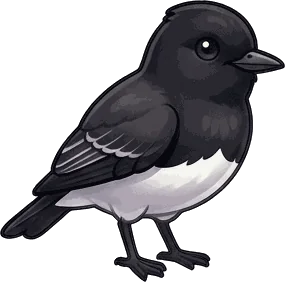
A Black Phoebe sounds thin and buzzy: a short two-part song, written tee-hee, tee-ho or pi-tsee, repeated over and over from a perch beside a pond, creek or swimming pool. The two phrases alternate, one rising and one falling, and the whole thing is quieter and higher than the Eastern Phoebe's raspy fee-bee. The everyday call is a sharp, down-slurred chip. The singer is a small black flycatcher with a white belly, dipping its tail on a railing anywhere in California and the Southwest where there is water and mud.
The birder's mnemonic
“tee-hee, tee-ho” The two phrases alternate, the first rising and the second falling, so the song sounds like a tiny question and answer.
What the song sounds like
Black Phoebes are not musical, but they are persistent. The song is a pair of thin, buzzy phrases that the bird alternates for minutes at a time: Wikipedia writes it as tee-hee, tee-ho or sisee, sitsew, Audubon as a thin, buzzy pi-tsee, usually repeated. The first phrase slides up, the second slides down, and the pattern repeats with a steady rhythm, like someone squeaking a hinge back and forth. It is high and slightly scratchy rather than whistled, and it does not carry far.
Both sexes sing, though males do most of it. The song runs through the year wherever the birds are resident, which is most of the range, so a January morning beside a California creek can sound like April. The bird sings from a low, open perch, often a rock in the stream, a railing or a branch over the water, usually in plain view.
If you cannot find the singer, look down, not up.
The call: a sharp chip
The call is a sharp, clear chip that drops in pitch, given from a perch, in flight and in bursts when the bird is disturbed near the nest. You hear it far more often than the song, and on a walk along a ditch or a park pond it tells you a phoebe is working the water ahead of you.
Watch what goes with it. Audubon notes that a perched Black Phoebe dips its tail down and then up, and the chip and the tail dip often come together, so the bird announces itself twice.
When and where you hear it
The one rule is water. Black Phoebes are rarely found far from a stream, pond, irrigation ditch, cattle trough or backyard pool, partly because that is where the insects are and partly because they need mud for the nest. Within that rule they use arroyos, farmyards, suburban parks, bridges and culverts. The range runs from southwestern Oregon and California through Arizona, New Mexico and west Texas, then south through Mexico and Central America to Argentina. In Texas the bird is pushing east.
This is mostly a year-round bird. Wikipedia calls it the most sedentary of the three North American phoebes, with only northern and high-elevation populations shifting south or downhill for winter. Audubon notes that males and females hold separate feeding territories in winter.
Breeding starts early. The Texas atlas gives a season from late February into early July, with two broods common. The nest is a mud cup mixed with grass, plastered to a sheltered vertical surface such as a bridge girder, a culvert wall, a cliff or the underside of an eave, and the same site is reused year after year. The female lays three or four white eggs and incubates for 15 to 17 days; the young leave about three weeks after hatching. The birds eat almost nothing but insects, taken in midair or off the water surface, and now and then a small fish from just below it. For Warble players in Los Angeles, Phoenix or the Bay Area, this is one of the most reliable catches of the year: find a pond, wait for the chip.
What it looks like
A small, neat flycatcher, 6 to 7 inches long. The whole bird is dark charcoal gray, blackest on the head and chest, with a clean white belly that meets the dark breast in an inverted V. Juveniles in summer show rusty edges on the wing feathers. Nothing else in the West is a black-and-white flycatcher that sits low over water and pumps its tail.
The population is roughly 5 million and stable or growing, helped by every artificial pond that adds water and mud to dry country.
Birds that sound similar
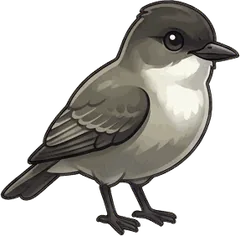 Eastern Phoebe
An Eastern Phoebe says a raspy, emphatic fee-bee, with the second note alternately higher or lower. The Black Phoebe's song is thinner, higher and buzzier.
- ?Say's Phoebe
A Say's Phoebe gives a mellow, plaintive, whistled pee-ur that falls at the end, nothing like the Black Phoebe's buzzy pairs, and it lives in dry open country, away from water.
- ?Western Wood-Pewee
A pewee's burry, descending peeer is a single rough note from higher in the trees. Black Phoebes sing in two alternating phrases from low perches.
Where the Black Phoebe card lives
In Warble the same bird can be an easy card in one state and a prized one in another, because each album ranks its birds by how often people really report them there. The Black Phoebe appears in 5 state albums:
 Heard one? Open Warble, tap the green button while it sings, and the Black Phoebe card flips into your album. Get the app free.
Questions people ask
What does a Black Phoebe say?
A thin, buzzy two-part song, usually written tee-hee, tee-ho or pi-tsee, repeated many times, plus a sharp down-slurred chip call. The song alternates a rising phrase and a falling one and is sung by both sexes, males most often.
Why do Black Phoebes always live near water?
Two reasons: insects are thickest over water, and the nest is built of mud. Audubon notes the birds are rarely found away from streams, ponds, ditches or troughs, which also supply the mud they plaster onto bridges, culverts and eaves.
Do Black Phoebes migrate?
Mostly no. The species is largely a permanent resident and the most sedentary of the North American phoebes. Birds at high elevations and at the northern edge of the range move south in fall.
How is a Black Phoebe different from an Eastern Phoebe?
By sight, the Black Phoebe is sooty black with a white belly, while the Eastern is gray-brown above and whitish below with a dark head. By ear, the Eastern's fee-bee is louder and raspier; the Black's tee-hee, tee-ho is thinner and buzzier.
Sources
- National Audubon Society, Guide to North American Birds: Black Phoebe. www.audubon.org/field-guide/bird/black-phoebe
- Wikipedia: Black phoebe (song, tail wagging, range, sedentary habits). en.wikipedia.org/wiki/Black_phoebe
- Texas Breeding Bird Atlas (Texas A&M): Black Phoebe. txtbba.tamu.edu/species-accounts/black-phoebe/
- National Audubon Society, Guide to North American Birds: Say's Phoebe (voice comparison). www.audubon.org/field-guide/bird/says-phoebe