 Warble


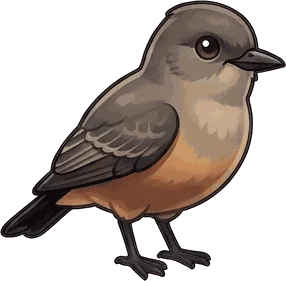
A Say's Phoebe sounds wistful. Its best-known note is a soft, plaintive whistle that falls in pitch, written pee-ur or pee-ee, given from a fence post, a boulder or the edge of a barn roof in dry, open country. The song is quicker and busier, a fast pit-tse-ar, often delivered while the bird flutters over a field. Listen in ranch country, canyons, badlands and desert edges across the West, where it is one of the early flycatchers back in spring.
What the song sounds like: a quick pit-tse-ar
The song is a fast pit-tse-ar, three quick pieces run together. It opens on a loud, high peak and then levels off to a steadier pitch, and that sharp start is what sets it apart from the songs of the other phoebes.
Almost every male sings, and a few females do too. Males use the song to answer rivals, to announce themselves while patrolling the territory, and during the early part of the breeding season. A singer usually picks an exposed perch, but Say's Phoebe also sings on the wing, fluttering or hovering over an open field as it delivers the phrase. If you see a gray bird hanging in the air above a pasture, the way an American Kestrel does, and hear a quick burst of notes, that is the display.
The call: a plaintive, falling whistle
The sound most people remember is the call: a mellow, whistled pee-ur that slides down at the end and has a lonely, plaintive tone. Other guides write it pee-ee and describe it as thin and slightly down-slurred. Either way it is one gentle note bending downhill, and it is often the first hint that a phoebe is sitting on a fence wire or the corner of a shed.
Audubon calls this a soft-voiced flycatcher, and the description fits. Nothing about the call is harsh or buzzy, which is useful when a wood-pewee or a Black Phoebe might be calling nearby.
When and where you hear it
Say's Phoebe has a huge breeding range, from Alaska through western Canada and south through North Dakota to New Mexico and the rest of the West, reaching dry upland tundra in the far north. It lives year-round from western Colorado southwest to southern California and east to the western Texas panhandle, and it winters from the desert Southwest to southern Texas and on into Mexico and northern Central America. Strays turn up far to the east, mostly in fall, in New England and Nova Scotia; one reached Bermuda.
This is a bird of dry, open country: prairie, badlands, canyons, scrub, farmland and ranches, avoiding forest. It perches low, on a bush, a boulder or a fence, and where tall perches are scarce it hovers just above the grass watching for insects. It heads north early in spring, males apparently ahead of females, and breeding runs from late March to late August. In the south a pair may raise two broods in a year, sometimes three.
It nests on rock ledges, in cliff crevices and caves, in wells and mine shafts, and very often under the eaves of a porch or barn or beneath a bridge, sometimes in an old swallow nest. The young leave the nest 14 to 16 days after hatching. Food is almost all insects, especially wild bees, wasps and winged ants, plus grasshoppers, crickets, beetles and dragonflies, and the bird coughs up the hard parts as pellets. On ranches across the West, a phoebe calling from the barn is a card Warble players should listen for.
What it looks like
About 6.7 to 7.5 inches long, a barrel-chested flycatcher with a squared-off head. It is soft dusty gray above and on the chest, with a pale orange-buff to cinnamon belly and a black tail that it wags and dips while perched. In flight the wings look pale, a little like a female Mountain Bluebird's. Young birds have buffy wing bars. The orange belly can fool you near red soil, where Eastern Phoebes sometimes pick up orange stains, but those show much more contrast on the face.
Birds that sound similar
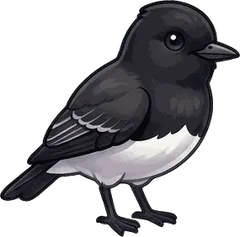 Black Phoebe
The Black Phoebe sings a thin, buzzy pi-tsee, usually repeated, and calls with a sharp, down-slurred chip. It is rarely far from water, so a buzzy phoebe by a creek is the black one; a soft, falling whistle over dry ground is Say's.
- ?Western Wood-Pewee
Its pee-eeer also drops in pitch, but it is harsh and nasal rather than mellow, and it comes from open woodland, pine-oak and streamside groves. Pewees arrive in late April or May, after the first Say's Phoebes are already calling.
Where the Say's Phoebe card lives
In Warble the same bird can be an easy card in one state and a prized one in another, because each album ranks its birds by how often people really report them there. The Say's Phoebe appears in 7 state albums:
 Heard one? Open Warble, tap the green button while it sings, and the Say's Phoebe card flips into your album. Get the app free.
Questions people ask
Do Say's Phoebes sing in flight?
Yes. Besides singing from exposed perches, males often deliver their quick pit-tse-ar while fluttering or hovering over an open field, as part of a flight-song display early in the breeding season.
Do Say's Phoebes nest on houses?
Often. They nest under porch and barn eaves, beneath bridges and in other sheltered spots, and they adapt well to residential areas. Unlike other phoebes, they usually build without mud, using grass, moss, spider silk and wool.
Is the Say's Phoebe a year-round bird?
In part of its range. It stays all year from western Colorado to southern California and the western Texas panhandle. Northern birds, some from as far as Alaska, migrate and winter from the desert Southwest into Mexico and Central America.
Who is the Say's Phoebe named after?
Thomas Say, an American naturalist. Charles Lucien Bonaparte formally described the species in 1825 from a specimen collected near Pueblo, Colorado.
Sources
- National Audubon Society, Guide to North American Birds: Say's Phoebe. www.audubon.org/field-guide/bird/says-phoebe
- Wikipedia: Say's phoebe (song, range, naming). en.wikipedia.org/wiki/Say%27s_phoebe
- UC Santa Barbara Sedgwick Reserve: Say's Phoebe species sheet. sedgwick.nrs.ucsb.edu/wp-content/uploads/2022/11/saysphoebe.pdf
- National Audubon Society, Guide to North American Birds: Black Phoebe. www.audubon.org/field-guide/bird/black-phoebe
- National Audubon Society, Guide to North American Birds: Western Wood-Pewee. www.audubon.org/field-guide/bird/western-wood-pewee