 Warble

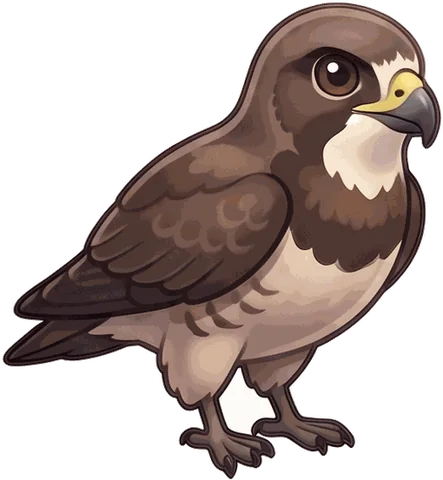
A Swainson's Hawk sounds like a long, plaintive, whistled kreee that falls in pitch: a hawk scream with much of the rasp taken out. HawkWatch International describes it as like a Red-tailed Hawk's call but less raspy and higher. You hear it in summer over the plains, ranches and farmland of the West, often from a slim hawk soaring with its wings raised and tipping from side to side. Young birds beg with a high, repeated whiw, whiw, whiw. In fall the species gathers in huge flocks bound for South America.
What the scream sounds like
Like other hawks, the Swainson's has no song. Its main call is a scream, but a gentle one as hawk screams go. Audubon describes it as a long, plaintive, whistled kreee, a single note that falls in pitch. The word that matters is whistled.
The most useful comparison to carry into the field comes from HawkWatch International, which says the call resembles a Red-tailed Hawk's but is less raspy and higher-pitched. Since the two hawks share a lot of open country and can look alike at a distance, a red-tail scream that sounds cleaner and higher than usual is worth a closer look.
Begging calls and nest defense
The other sound you are likely to hear is the begging of the young: a high-pitched, repeated whiw, whiw, whiw, whiw. Young Swainson's Hawks fly at about six weeks old and often stay with their parents until fall migration, so this call can carry on through late summer around a nest grove. Adults are territorial on their breeding grounds, and pairs court with display flights of circling and steep dives.
When and where you hear it
Swainson's Hawks breed in western North America, from Canada south to California, Arizona, Texas and northern Mexico, and are commonest on the northern Great Plains. They are rare in Alaska and uncommon on the eastern edge of the Plains, with a few pairs nesting as far east as Illinois. Look over prairie with scattered groves, dry grassland, sagebrush, ranch country and farmland. The nest is a stick platform hidden in the foliage of a tree or large shrub, sometimes on a power pole or a ledge, and the parents keep adding leafy green branches. Two or three eggs are typical, incubated for 34 to 35 days, mostly by the female. Pairs are faithful to each other and to their territory, unusual for a long-distance migrant.
The diet changes with the season. While raising young, the hawks hunt ground squirrels, pocket gophers, mice, snakes and lizards. The rest of the year they live largely on insects, grasshoppers above all, which is why the bird has been called the grasshopper hawk. They catch insects in the air, run them down on foot, gather at grass fires and follow tractors for whatever the plow turns up. In late summer flocks sit on the ground in fields full of grasshoppers or caterpillars. On the plains, a calling Swainson's is one of the summer raptor cards Warble players can hope to catch.
The long trip south
The Swainson's Hawk has the second-longest migration of any North American raptor, behind only Arctic-nesting Peregrine Falcons, with some journeys reaching about 7,100 miles. Fall migration runs from August to October. The hawks travel in large flocks, riding thermals and gliding between them, and Audubon notes they may go several days without eating. HawkWatch describes big kettles forming at migration sites in Texas, Mexico and Panama, and Wikipedia says nearly the whole population funnels through the Isthmus of Panama.
Most winter on the pampas of Argentina, Uruguay and southern Brazil, where they follow swarms of nomadic dragonflies. That winter range has carried risks: declines there were linked to DDT and monocrotophos sprayed against grasshoppers and locusts. Back north, the species has declined seriously in parts of its nesting range, especially California, where it has been listed as threatened since 1983.
What it looks like
A slim, graceful hawk about the size of a crow, only slightly smaller than a red-tail, with a small head, long tail and long, pointed wings that reach the tail tip when it perches. More than 90 percent are light birds: white throat and belly, a dark reddish-brown bib across the chest, and from below bright white wing linings against dark flight feathers, a two-toned pattern unusual among North American raptors. Dark birds, rufous to dark brown, are most common in the far West. Females are larger, averaging about 2.5 pounds to the male's 1.8. The name honors the British naturalist William Swainson.
Birds that sound similar
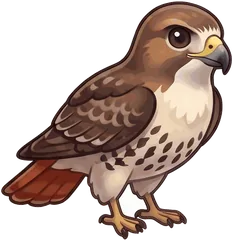 Red-tailed Hawk
A Red-tailed Hawk's scream is the closest match, but HawkWatch describes the Swainson's call as less raspy and higher-pitched. Look up, too: the Swainson's white linings against dark flight feathers are unusual among North American raptors.
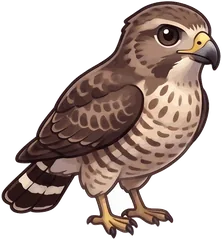 Broad-winged Hawk
A Broad-winged Hawk's call is also a whistle, but a thin, high pe-heeeeeeeee from eastern woodland rather than open western country. The broad-wing is smaller, with shorter wings and broad tail bands.
Where the Swainson's Hawk card lives
In Warble the same bird can be an easy card in one state and a prized one in another, because each album ranks its birds by how often people really report them there. The Swainson's Hawk appears in 6 state albums:
 Heard one? Open Warble, tap the green button while it sings, and the Swainson's Hawk card flips into your album. Get the app free.
Questions people ask
How do you tell a Swainson's hawk from a red-tailed hawk by sound?
Listen for the rasp. Both give a falling scream, but the Swainson's is a long, whistled kreee, cleaner and higher than the red-tail's raspier cry. Then check the underwing: a light Swainson's shows white linings against dark flight feathers.
How far do Swainson's hawks migrate?
Very far. Some journeys cover about 7,100 miles between western North America and the pampas of Argentina, Uruguay and southern Brazil, the second-longest migration of any North American raptor after Arctic-nesting Peregrine Falcons.
Why do hawks follow tractors?
To catch what the machine stirs up. Swainson's Hawks often follow tractors and plows, sometimes in large groups, snapping up insects and rodents exposed in the field. They gather at grass fires for the same reason.
Why is it called a Swainson's hawk?
It is named after William Swainson, a British naturalist. It has also been called the grasshopper hawk or locust hawk, for the insects that make up much of its diet outside the nesting season.
Sources
- National Audubon Society, Guide to North American Birds: Swainson's Hawk. www.audubon.org/field-guide/bird/swainsons-hawk
- Wikipedia: Swainson's hawk (migration, plumage, diet, breeding, conservation, name). en.wikipedia.org/wiki/Swainson%27s_hawk
- HawkWatch International, Raptor Identification: Swainson's Hawk (calls, flight, range). hawkwatch.org/learn/factsheets/item/376-swainsons-hawk
- National Audubon Society, Guide to North American Birds: Broad-winged Hawk (voice). www.audubon.org/field-guide/bird/broad-winged-hawk