 Warble


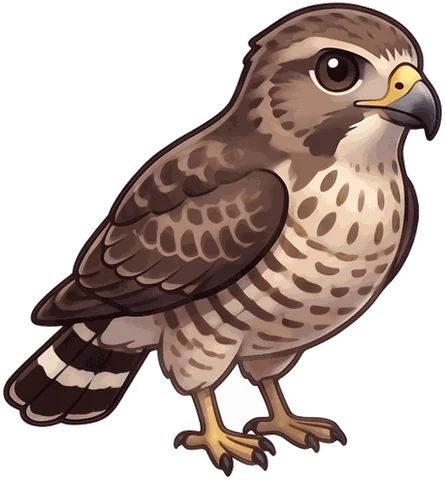
A Broad-winged Hawk sounds like a thin, high-pitched whistle: a short lead-in note and a long, drawn-out second one, written pe-heeeeeeeee by Audubon and kih-keee by the Missouri Department of Conservation. It is so high and thin that many people never suspect a hawk. You hear it in summer in eastern woodlands, where this crow-sized hawk nests out of sight, and Blue Jays copy it. In fall, look up instead: broad-wings migrate in swirling flocks called kettles, sometimes thousands at a time.
What the whistle sounds like
The broad-wing's call is a thin, high whistle, a quick first syllable followed by a long, drawn-out note. Audubon writes it pe-heeeeeeeee; Wikipedia calls it a very high-pitched kee-ee, almost like a whistle; and Missouri's guide gives a two-part kih-keee, high enough that it may not sound like a hawk at all.
According to Wikipedia, fledglings have learned the call by the time they are a month old, so in late summer you may hear the whistle from young birds as well as adults.
Courtship calls and copycats
In courtship, Audubon describes pairs circling high above the forest while calling, with one bird sometimes climbing and then diving steeply toward the ground. The other thing to know is that Blue Jays are known to mimic this whistle, as they mimic other hawks, so a broad-wing whistle near a crowd of jays deserves a second look.
When and where you hear it
Broad-winged Hawks breed across eastern North America, west to British Columbia and Texas. Audubon calls them common in eastern woodlands in summer, but easy to overlook, because they stay near forest edges. They nest in deciduous or mixed forest, often near water and clearings, and avoid people. In Missouri they arrive in April, breed mostly in the forested Ozarks, and leave in October.
The nest is a small stick platform lined with bark and moss, low in a large tree, usually 25 to 40 feet up, and the pair keeps adding fresh green twigs. Two or three eggs are typical. The female incubates for about a month, and the young fly at five to six weeks. A broad-wing hunts by sitting on a low branch, pole or fence post at a woodland edge and gliding down onto frogs, toads, small rodents, snakes and large insects.
For Warble players the whistle is the way in: in a leafy June woodland you will likely hear a broad-wing long before you see it.
The fall kettles
In fall almost every Broad-winged Hawk leaves North America, and they leave together. Migrants soar in flocks called kettles, a name Missouri's guide traces to the look of a big soup pot being stirred with a giant spoon. Wikipedia gives flock sizes from about 40 birds to several thousand, circling between roughly 1,800 and 4,300 feet up.
Missouri's guide describes the daily routine. The hawks spend the night together in a forest, take off between about 8 and 10 in the morning, and spiral up on thermals, the rising columns of warm air. Fall migration lasts about 70 days at around 60 miles a day, and the whole trip runs roughly 1,900 to 3,700 miles. Broad-wings avoid crossing salt water, so eastern birds swing south or southwest around the Gulf of Mexico. Most spend the winter in South America.
When the wind is right, you can see thousands at once along ridges, coastlines and lake shores. Famous watch sites include Hawk Mountain in Pennsylvania, Hawk Ridge in Minnesota, Hawk Cliff in Ontario and the River of Raptors in Veracruz, Mexico. In Missouri, kettles of up to 500, sometimes 1,000, pass around the third week of September and again in the last week of April. Early in the 20th century many were shot on migration; under legal protection their numbers now look healthy.
What it looks like
A chunky, compact hawk about the size of a crow. Adults have a dark brown back, a chest barred with rust, and a tail crossed by broad black and white bands; Audubon notes it is the only eastern buteo with tail bands that bold. From below, the wings are pale with dark tips and a dark trailing edge, and in a soar they are held flat and taper to a point. Young birds are streaked rather than barred below, with narrower tail bands. A rare dark-bodied form occurs mainly in the West.
Birds that sound similar
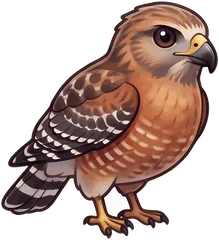 Red-shouldered Hawk
The Red-shouldered Hawk gives a shrill scream, kee-yeeear, that slides downward and is loudest in spring. The broad-wing gives a thin whistle instead. The red-shoulder is larger, with narrow tail bands and pale wingtip crescents.
 Blue Jay
s imitate the broad-wing's whistle, and in the East they give near-perfect copies of the Red-shouldered Hawk too. When a hawk call comes from a tree full of jays, find the caller before you trust your ears.
Where the Broad-winged Hawk card lives
In Warble the same bird can be an easy card in one state and a prized one in another, because each album ranks its birds by how often people really report them there. The Broad-winged Hawk appears in 4 state albums:
 Heard one? Open Warble, tap the green button while it sings, and the Broad-winged Hawk card flips into your album. Get the app free.
Questions people ask
What is a kettle of hawks?
A flock of migrating hawks circling together on a column of rising warm air. Broad-winged Hawks are famous for it: kettles range from a few dozen birds to several thousand, and the name comes from the look of a pot being stirred.
When do broad-winged hawks migrate?
In fall, when nearly the whole population heads south on a trip of about 70 days, and again in spring. In Missouri the big kettles pass around the third week of September and the last week of April.
What hawk sounds like a whistle?
Usually the Broad-winged Hawk. Its call is a thin, very high two-part whistle, pe-heeeeeeeee or kih-keee, high enough that many people take it for a songbird or a person whistling. Blue Jays imitate it, so check for jays nearby.
Where do broad-winged hawks go in winter?
Mostly to South America. The trip runs roughly 1,900 to 3,700 miles, and eastern birds go around the Gulf of Mexico rather than over it.
Sources
- National Audubon Society, Guide to North American Birds: Broad-winged Hawk. www.audubon.org/field-guide/bird/broad-winged-hawk
- Wikipedia: Broad-winged hawk (call, migration distances and flock sizes, diet, range). en.wikipedia.org/wiki/Broad-winged_hawk
- Missouri Department of Conservation, Field Guide: Broad-winged Hawk. mdc.mo.gov/discover-nature/field-guide/broad-winged-hawk
- National Audubon Society, Guide to North American Birds: Red-shouldered Hawk (voice, Blue Jay imitation). www.audubon.org/field-guide/bird/red-shouldered-hawk