 Warble
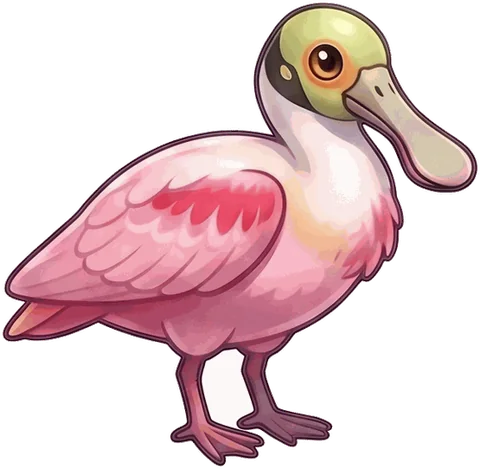
A Roseate Spoonbill sounds far plainer than it looks. It has no song at all, just low croaks and clucking sounds, flat in pitch with a rough, rattling quality, like a hen muttering to herself an octave down. Spoonbills feed in groups and nest in colonies, so that is where to listen. Next to the bird itself, the voice is easy to overlook. Listen in coastal marshes, lagoons and mangrove keys in Florida, Texas and southwest Louisiana.
What it sounds like: low croaks and clucks
For a bird dressed in pink, the spoonbill has a remarkably modest voice. Audubon's field guide describes it in five words: low croaks and clucking sounds. There is no song, no whistle and nothing pretty about it. The notes are short and low, and they stay on roughly one pitch.
Audubon's call tags fill in the texture: croaking or quacking, drumming, rattling and raucous. Put together, that is a rough, throaty muttering rather than clear notes, the kind of sound you might expect from a much plainer bird. Clucking is a good word to keep in mind. Picture a hen talking to herself, pitched lower and with more gravel, and you are close.
Spoonbills are sociable, feeding in groups and nesting in colonies, and those gatherings are where the croaking and clucking add up to something you notice.
At the colony
Spoonbills nest in colonies, mainly in winter in Florida and in spring in Texas. In Florida the nests go in red mangroves; farther west they sit in willows or in low scrub such as mesquite and salt cedar on coastal islands, usually 5 to 15 feet up. A clutch is typically two or three white eggs spotted with brown. Both parents incubate for 22 to 24 days and both feed the chicks, which leave the nest at five to six weeks and fly strongly at seven to eight weeks.
A colony is a risky place to be a chick. Turkey Vultures, Bald Eagles, raccoons and invasive fire ants all take nestlings, which is one more reason to watch and listen from a distance.
When and where you hear it
In the United States the spoonbill is locally common along the coasts of Florida, Texas and southwest Louisiana. On the Texas coast it is present all year but commoner in summer, with some birds heading to Mexico for winter, and some Florida birds seem to move back and forth to Cuba. The range is growing. Georgia recorded its first nesting in 2011, the bird has become much more common in South Carolina since the 1970s, and on the Atlantic side it now reaches at least Myrtle Beach. In Florida, birds are nesting farther north and inland as rising seas change their feeding grounds in Florida Bay.
After the breeding season a few birds, mostly young ones, wander far north and inland. Summer 2021 brought spoonbills to Washington, D.C., upstate New York and New Hampshire, and a flock at Huntley Meadows Park in Virginia drew crowds.
Look for them in shallow water with a muddy bottom, salt or fresh: coastal marshes, lagoons, tidal ponds, mudflats, mangrove keys and big inland marshes. A feeding spoonbill wades with its bill slightly open and swings it from side to side through the water, finding prey mostly by touch. It eats small fish such as minnows and killifish, shrimp, crayfish, crabs, water beetles and other insects, and mollusks, plus some sedge roots and stems. Egrets often trail a feeding spoonbill to grab whatever it stirs up. Because the voice is so low-key, a Warble recording works best near a busy feeding flock.
What it looks like
Unmistakable once seen: a tall wader, 28 to 34 inches long with a wingspan of about 4 feet, bright pink on the body and deeper carmine red on the shoulders of the wings, with a white neck, chest and upper back. The head is bare and greenish, the eyes are red, and the long gray bill ends in a flat, rounded spoon. Spoonbills fly with their necks stretched out, alternating stiff, shallow wingbeats with glides. Young birds are much paler, often mostly white with a pink wash, and have feathered white heads.
The pink comes from food. As in flamingos, a pigment called canthaxanthin from the diet colors the feathers, and birds range from pale pink to bright magenta depending on age, breeding condition and where they live. Plume hunting nearly finished the species. Spoonbills were common in parts of the Southeast until the 1860s and were virtually wiped out of the United States when plume hunters destroyed wading-bird colonies. They began returning to Texas and Florida early in the 20th century.
Birds that sound similar
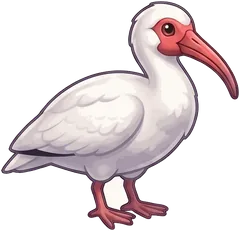 White Ibis
Both feed in flocks by sweeping their bills through the shallows, and both have rough voices: the ibis gives grunts and growls, the spoonbill croaks and clucks. Check the bill: red and curved on the ibis, flat and spoon-tipped on the spoonbill.
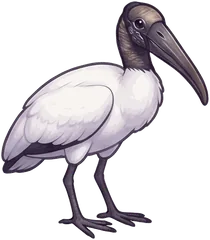 Wood Stork
The stork is usually silent away from the nest, apart from a dull croak, so two quiet waders feeling for fish in the same pool will not be settled by ear. The stork is bigger and white, with a bare gray head and heavy bill.
Where the Roseate Spoonbill card lives
In Warble the same bird can be an easy card in one state and a prized one in another, because each album ranks its birds by how often people really report them there. The Roseate Spoonbill appears in 3 state albums:
 Heard one? Open Warble, tap the green button while it sings, and the Roseate Spoonbill card flips into your album. Get the app free.
Questions people ask
What sound does a roseate spoonbill make?
Low croaks and clucking sounds, flat in pitch and rough in texture. It does not sing. Listen near feeding flocks and nesting colonies in coastal marshes and mangroves.
Why are roseate spoonbills pink?
Because of what they eat. Like flamingos, they get a pigment called canthaxanthin from their food, and it colors the feathers. The shade varies from pale pink to bright magenta with age, breeding condition and location.
Where can you see roseate spoonbills in the US?
Mostly along the coasts of Florida, Texas and southwest Louisiana, in shallow marshes, lagoons and mangroves. They are spreading north into Georgia and South Carolina, and young birds sometimes wander much farther in summer.
Sources
- National Audubon Society, Guide to North American Birds: Roseate Spoonbill. www.audubon.org/field-guide/bird/roseate-spoonbill
- Wikipedia: Roseate spoonbill (color, range expansion, feeding, breeding). en.wikipedia.org/wiki/Roseate_spoonbill
- National Audubon Society, Guide to North American Birds: White Ibis (voice and feeding). www.audubon.org/field-guide/bird/white-ibis
- National Audubon Society, Guide to North American Birds: Wood Stork (voice). www.audubon.org/field-guide/bird/wood-stork