 Warble
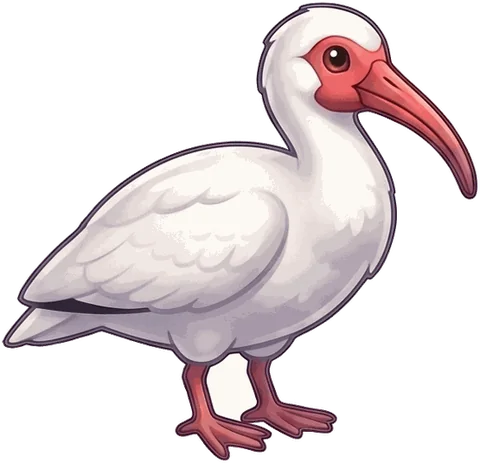
A White Ibis sounds like a small, hoarse goose. Its main call is a honking hunk, hunk, hunk or urnk, urnk, given in flight, during courtship and when the bird is disturbed. Feeding flocks murmur a soft, muffled huu-huu-huu as they probe the mud. Otherwise it is a fairly quiet bird. The noise peaks at the breeding colony in spring, where honking adults, courtship squeals, bill chattering and the high zziu of begging chicks mix together. Listen in marshes, mangroves, flooded fields and suburban ponds along the Southeast and Gulf coasts.
What it sounds like: honks, not songs
Ibises do not sing, and Animal Diversity Web calls the White Ibis relatively quiet. What you do hear is a honk: a short, rough hunk or urnk, run together in a series, a little like a goose with a head cold. It is the all-purpose call, used when a bird takes flight, when pairs court and when something alarms the flock. A flock passing overhead in a loose line, honking now and then, is the version you are likeliest to notice.
Up close, a feeding flock is quieter still. As the birds wade and sweep their bills through the water they give a muted huu-huu-huu, more conversation than call, audible only from close by.
At the colony: squeals, chatter and begging
The breeding colony is where the White Ibis turns up the volume. Colonies hold thousands of birds, often mixed with other waterbirds, and they are not loyal to one place: a big colony can form and break up within a season or two. Courtship adds a squealing call, and Animal Diversity Web notes that females greet males with a high-pitched squeal. Rival males warn each other with bill chattering and sharp horizontal jabs of the head.
Chicks have the most distinctive voice of all. Nestlings beg with a thin, high zziu, and their calls are individual enough that parents can pick out their own young among thousands of nests. Pairs usually lay two or three pale blue-green eggs with brown splotches in a nest over water, and both parents incubate for about three weeks, the male by day and the female by night. Fish Crows are the main nest raiders.
When and where you hear it
White Ibises breed from southern New Jersey down the Atlantic coast and around the Gulf of Mexico to Texas, and on south through the Caribbean and Central America to Colombia and Venezuela. Florida holds the largest numbers, and one colony there counted more than 30,000 birds. Outside the breeding season they spread farther inland, and in winter most move south of the Carolinas.
This is a bird that follows the water. Ibises feed by touch in shallows only a few inches deep, so they move as levels rise and fall: toward the coast in summer when inland marshes flood, back inland in fall as the water drops. Look for flocks in marshes, mangroves, ponds and flooded fields. Since the late 1990s they have also moved into Florida towns, working golf-course ponds, ditches and lawns. Feeding is busiest in early morning and late evening, which is also when you are likeliest to hear a flock honking overhead.
Ibises fly with neck and legs stretched out, usually in long lines or V formations, and young birds learn to join the formation over their first summer. A passing flock is often the easiest way to catch the honk for a Warble card.
What it looks like
An adult is all white with black wingtips that show mostly in flight, a bare pink face and a long, down-curved bill. The bill and legs are red-orange most of the year; early in the breeding season the bill turns deep pink and the legs a purplish red. It is 21 to 28 inches long with a wingspan of about 3 feet, and males are bigger, with longer bills. Young birds are brown above with a white rump and belly, and they take about two years to turn mostly white.
A feeding ibis walks slowly through shallow water or mud, sweeping its partly open bill and grabbing whatever it touches. Crayfish are the favorite, with crabs in the mangroves, plus insects and small fish. In Florida the ibis is a Species of Special Concern, and Everglades numbers fell by more than 95 percent between the 1930s and the 1970s, probably because water flows were changed.
Birds that sound similar
- ?Glossy Ibis
Its voice is a mix of low grunts and higher-pitched bleats, where the White Ibis sticks mostly to its honking hunk-hunk. In a mixed flock the Glossy is the dark one, chestnut with a green and purple sheen.
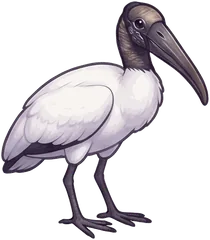 Wood Stork
s feed in the same pools but are usually silent away from the nest, apart from a dull croak, hissing and bill clattering. A big white wader with a bare gray head that says nothing is the stork.
Where the White Ibis card lives
In Warble the same bird can be an easy card in one state and a prized one in another, because each album ranks its birds by how often people really report them there. The White Ibis appears in 7 state albums:
 Heard one? Open Warble, tap the green button while it sings, and the White Ibis card flips into your album. Get the app free.
Questions people ask
What sound does a White Ibis make?
A honking hunk, hunk or urnk, urnk, like a small hoarse goose, given in flight, in courtship and when disturbed. Feeding flocks also make a soft huu-huu-huu, and chicks beg with a high zziu.
Why are there so many ibises in Florida neighborhoods?
Florida has the largest White Ibis population, and since the late 1990s the birds have increasingly used towns, feeding around golf-course ponds, ditches and wet lawns, where they probe for crayfish, insects and other small prey.
Do White Ibises migrate?
Some move with the seasons: in winter most gather south of the Carolinas, and after breeding they spread inland. They also shift with water levels, heading toward the coast when inland marshes flood and back inland as they dry.
Is the White Ibis the University of Miami mascot?
Yes. The university adopted the American White Ibis as its athletics mascot in 1926, and the mascot was named Sebastian in 1957. Native American folklore held that the ibis was the last bird to shelter before a hurricane and the first to come out after.
Sources
- Wikipedia: American white ibis (calls, range, breeding, foraging, culture). en.wikipedia.org/wiki/American_white_ibis
- Animal Diversity Web: Eudocimus albus, white ibis (communication, colonies, conservation). animaldiversity.org/accounts/Eudocimus_albus/
- National Audubon Society, Guide to North American Birds: Glossy Ibis (voice). www.audubon.org/field-guide/bird/glossy-ibis
- National Audubon Society, Guide to North American Birds: Wood Stork (voice). www.audubon.org/field-guide/bird/wood-stork