 Warble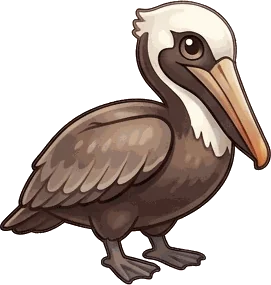
A Brown Pelican mostly sounds like nothing at all. Adults are silent away from the nest; Audubon notes only low grunts on the breeding grounds, and Wikipedia adds a low-pitched hrrraa-hrra given during displays and an occasional low croak. The noise at a pelican colony comes from the chicks, which squeal and give high, scratchy begging calls. What you actually hear from a pelican on the beach is the splash: the bird folds its wings and hits the water headfirst from as high as 60 feet.
Why the song section is nearly empty
Pelicans do not sing, and the Brown Pelican barely calls. Three field references say the same thing in different words: Audubon writes that it is usually silent and utters low grunts on nesting grounds; Wikipedia gives the adult sound as a low-pitched hrrraa-hrra during displays plus occasional low croaks; Animal Diversity Web describes a low raaa in courtship and a hrraa-hrraa that follows a bowing display when a bird is defending its nest. All of it is quiet, throaty and given at close range on a nesting island.
That makes the pelican one of the few birds on this site you will almost never identify by ear, and one that even a sound app will struggle with, because there is usually nothing to record. Instead the pelican talks with its body: head swaying, bowing, raising the bill, spreading the wings.
The sounds you do hear: squealing chicks and the dive
Visit a colony in spring and there is plenty of noise, all of it from the young. Nestlings squeal constantly and give a high-pitched, scratchy call to their parents when they want food, and the peeping starts inside the egg, audible up to two days before hatching. Around the adults the soundtrack belongs to the Laughing Gulls that follow pelicans to steal fish. On a fishing pier the sound of a Brown Pelican is the heavy splash of a dive, repeated every few seconds when a school of menhaden or anchovies is close to shore.
When and where you see and hear it
The Brown Pelican is strictly a bird of salt water, rarely more than 20 miles from the coast and almost never on fresh water. It lives along the Atlantic from New Jersey south, around the Gulf of Mexico, through the Caribbean, and on the Pacific from British Columbia to Peru. It nests in colonies on predator-free islands, on the ground, on heaps of debris or in mangroves, laying two or three chalky white eggs that both parents incubate for 28 to 30 days. The young fly at about nine to twelve weeks. After nesting, birds drift north along both coasts for the summer and back south for winter.
The story people search for is the crash and comeback. DDT in the 1950s and 1960s thinned pelican eggshells until they broke under the incubating birds, and the species was listed as endangered in 1970. DDT was banned in 1972, Louisiana restocked its coast with 767 young pelicans flown in from Florida between 1968 and 1976, and the bird recovered so well that it was delisted in the Southeast in 1985 and everywhere in 2009. Wikipedia puts the world population near 650,000. The 2010 Gulf oil spill hit pelicans harder than any other bird, and fishing line and hooks are the everyday hazard now.
Louisiana calls itself the Pelican State, puts the bird on its flag, and adopted the Brown Pelican as its state bird in 1966. Theodore Roosevelt created the first national wildlife refuge, Pelican Island in Florida, for this species in 1903. In Warble it is a card you will earn by luck at a colony rather than by design, since the adult almost never gives you anything to record.
What it looks like
Unmistakable: a huge, heavy waterbird 3.5 to 5 feet long with a wingspan around seven feet, weighing 4 to 11 pounds, with a foot-long bill and a stretchy throat pouch that can hold about three gallons of water. Adults are silver gray above and dark brown below with a white head washed yellow on the crown; in breeding season the back of the neck turns dark reddish brown and the pouch flushes red. Young birds are dull gray brown with a pale belly. It is the only pelican that hunts by diving, plunging headfirst from 20 to 70 feet, scooping fish and water into the pouch, then draining the water before swallowing.
The main food is fish, menhaden above all, along with anchovies, herring and sardines. Adults are far better at the dive than young birds, and Animal Diversity Web notes that only about 30 percent of pelicans live through their first year, while the oldest banded wild bird reached 43.
Birds that sound similar
- ?American White Pelican
Also nearly silent, with grunts and croaks only at the colony. It is white with black flight feathers, lives on inland lakes as well as coasts, and never dives; it swims and scoops, often in cooperating groups.
- ?Double-crested Cormorant
The dark diving bird that often shares pelican piers gives deep guttural grunts at close range, much like a pelican's, but it is a slim, long-necked bird that dives from the surface, not from the air.
Where the Brown Pelican card lives
In Warble the same bird can be an easy card in one state and a prized one in another, because each album ranks its birds by how often people really report them there. The Brown Pelican appears in 9 state albums:
 Heard one? Open Warble, tap the green button while it sings, and the Brown Pelican card flips into your album. Get the app free.
Questions people ask
Do Brown Pelicans make any sound?
Barely. Adults are silent except on the nesting grounds, where they give low grunts, croaks and a throaty hrraa-hrraa during courtship and nest defense. The chicks are the noisy ones, squealing and giving high, scratchy begging calls.
How high do Brown Pelicans dive from?
Usually from 20 feet or so up to about 60 or 70 feet. They fold back the wings and hit the water headfirst, and the lower bill splits and bows outward on impact so the pouch opens like a scoop. It is the only pelican that feeds mainly by diving.
Why did the Brown Pelican almost go extinct?
DDT. The pesticide built up in the fish pelicans ate and thinned their eggshells until the eggs broke during incubation. The species was listed as endangered in 1970, DDT was banned in 1972, and after restocking in Louisiana and decades of recovery it was delisted in 2009.
Why is Louisiana called the Pelican State?
The Brown Pelican has been on Louisiana's flag since 1912 and has been the official state bird since 1966. Pesticides devastated the bird along the Gulf, and Louisiana brought in 767 young pelicans from Florida between 1968 and 1976 to rebuild its colonies.
Sources
- National Audubon Society, Guide to North American Birds: Brown Pelican. www.audubon.org/field-guide/bird/brown-pelican
- Wikipedia: Brown pelican (sounds, measurements, range, diving height, DDT listing and delisting, Louisiana flag, Pelican Island). en.wikipedia.org/wiki/Brown_pelican
- Animal Diversity Web: Pelecanus occidentalis, brown pelican (calls, displays, pouch, survival, Louisiana restocking, oil spill). animaldiversity.org/accounts/Pelecanus_occidentalis/
- Wikipedia: List of U.S. state birds (Louisiana, brown pelican, 1966). en.wikipedia.org/wiki/List_of_U.S._state_birds