 Warble


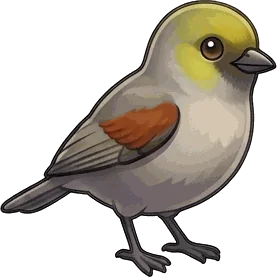
A Verdin sounds far bigger than it is: a loud, sharp, whistled seep! or tsilip!, or a rapid staccato tschep, repeated again and again from a mesquite or a thorny desert shrub. The bird making all that noise weighs about a quarter of an ounce. Now and then it sings a short three-note phrase, kleep-er-zee!, with the last note highest. Verdins live year-round in the deserts of the Southwest, usually alone or in pairs, moving busily through the brush and calling as they go.
What the song sounds like: three notes, rarely
The Verdin is not much of a singer. Audubon describes an infrequent song of three notes, written kleep-er-zee!, with the last note the highest, a bright little phrase that ends on an upswing. Males sing more in the breeding season, but even then the calls do most of the talking.
There are softer sounds too, mostly around the nest. Nestlings give faint, high peeps on the day they hatch, fledglings make soft warbling notes as they molt, and pairs trade a warbled tweedle that may help keep the pair together.
The call: loud whistles from a tiny bird
This is the sound that makes people look twice. The Verdin's calls are loud for its size: sharp, whistled notes, written seep! or tsilip!, given over and over, and a rapid, staccato tschep that it repeats constantly while foraging. In Texas, observers have noted runs of chip-chip-chip at one steady pitch and speed.
In early spring, unmated males repeat a tseet, probably to attract a female, and paired birds, lone foragers and older nestlings use the same note to keep in touch in thick brush. When a predator shows up, the call changes to a gee-gee-gee-gee alarm.
When and where you hear it
Verdins are permanent residents of the desert Southwest. One form lives mostly in the Sonoran Desert, from southern California, Nevada and Utah into Mexico; another belongs to the Chihuahuan Desert, from New Mexico and Oklahoma south, and they also breed in Texas. At Saguaro National Park in Arizona they are one of the resident desert birds. Look in brushy desert valleys, mesquite, acacia and paloverde stands, saltcedar thickets and low riverside woods, and in the suburbs of some southwestern towns.
They forage among small branches, picking tiny insects off leaves and sometimes hanging upside down to reach the undersides: aphids, caterpillars, scale insects, larvae and small spiders, plus berries and seeds. They drink nectar regularly and will visit hummingbird feeders. A loud seep from a bush with no bird in sight is a good moment to let Warble listen.
The nests: more than there are Verdins
For a tiny bird, the Verdin builds a big, obvious nest: a hollow ball of thorny twigs placed well out on a branch of a thorny shrub or low tree, or in a cholla, usually 4 to 12 feet up. The entrance, about an inch across, sits low on one side, and the inside is lined with feathers, grass, leaves and spider silk. Nests built late in spring tend to open into the prevailing wind, which may help keep them cool.
A male may build several nests before the female picks one for her eggs, and the birds also build roosting nests for winter nights. Young birds keep coming back to sleep in the nest after they fledge. In dry desert air the twig balls last for several seasons, so a stretch of mesquite can seem to hold more nests than birds.
What it looks like
At about 4.5 inches, the Verdin is nearly as small as the Bushtit, one of the smallest songbirds in North America. Adults are gray with a yellow head, a sharply pointed bill and a rusty-red shoulder patch that is often hidden. Young birds are plain gray and can pass for a Bushtit, except that they never travel in flocks.
It is also an outsider: the only North American member of the penduline tits, an Old World family whose other members live in Eurasia and Africa. The species is listed as Least Concern, but the Breeding Bird Survey shows a decline of about 1.9 percent a year from 1968 to 2015.
Birds that sound similar
- ?Black-tailed Gnatcatcher
Another tiny gray bird of the same mesquite and paloverde. Its usual call is a harsh, wren-like scold of two or three notes, and pairs use some calls that sound like imitations of the Verdin. A buzzy scold means gnatcatcher; a clean, sharp seep or tschep means Verdin.
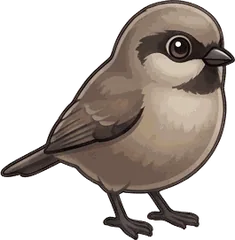 Bushtit
s give light tsip and pit notes constantly, but from a loose flock of twenty or thirty birds moving tree to tree. Verdins call alone or in pairs, with loud, sharp notes, and Bushtits mostly avoid hot desert.
Where the Verdin card lives
In Warble the same bird can be an easy card in one state and a prized one in another, because each album ranks its birds by how often people really report them there. The Verdin appears in 2 state albums:
 Heard one? Open Warble, tap the green button while it sings, and the Verdin card flips into your album. Get the app free.
Questions people ask
What tiny desert bird has such a loud call?
Very often a Verdin. Its sharp, whistled seep! and rapid tschep notes are loud for a bird that weighs about a quarter of an ounce. Look for a small gray bird with a yellow head working through mesquite or other thorny brush.
Why does a Verdin build so many nests?
Some are for eggs and some are for sleeping. A male may build several nests and let the female choose one, and Verdins also build roosting nests for cold winter nights. The twig balls last for seasons in the dry air, so old ones pile up.
Is the Verdin related to chickadees?
Not closely. It belongs to the penduline tits, an Old World family, and is the only member in North America. The National Park Service notes it is not a close relative of any other bird in the Western Hemisphere.
Do Verdins come to hummingbird feeders?
Yes. Verdins drink nectar regularly and will visit hummingbird feeders for sugar water, along with eating tiny insects, spiders, berries and seeds.
Sources
- National Audubon Society, Guide to North American Birds: Verdin. www.audubon.org/field-guide/bird/verdin
- Wikipedia: Verdin (calls, subspecies ranges, nests, taxonomy, conservation). en.wikipedia.org/wiki/Verdin
- National Park Service, Saguaro National Park: Birds. www.nps.gov/sagu/learn/nature/birds.htm
- National Audubon Society, Guide to North American Birds: Black-tailed Gnatcatcher. www.audubon.org/field-guide/bird/black-tailed-gnatcatcher
- National Audubon Society, Guide to North American Birds: Bushtit. www.audubon.org/field-guide/bird/bushtit