 Warble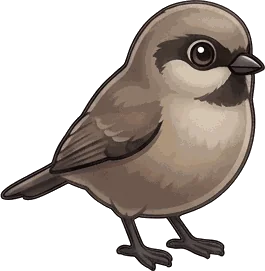
A Bushtit flock sounds like a hedge full of very small, very busy whispers: thin, high tsip and pit notes given constantly by twenty or thirty birds at once as they stream through the shrubs, hang upside down on twigs and move on to the next tree. There is no real song. The one call that stands out is the alarm, a high, sustained trill the whole flock takes up when a hawk appears, after which every bird freezes and the hedge goes silent.
What the song sounds like
Bushtits do not have a song in the way a sparrow or a thrush does. What they have is conversation. Audubon describes the contact calls as light tsip and pit notes, constantly uttered, and constant is the right word. A flock keeps up the chatter all day, because the calls are how twenty or thirty birds scattered through a thicket stay together. Each note is tiny, high and short, and the sound of the whole flock is a soft, spreading sizzle that moves through the shrubbery and fades as the birds pass.
The flock itself is the thing to recognize. Bushtits travel between feeding trees in a straggling single file, each bird flying weakly across the gap and diving into the next bush, so the chatter stretches out along the route like a string. Wikipedia gives flock sizes of 10 to 40 birds.
The birds forage as they talk, hanging upside down at the ends of twigs to pick off aphids, scale insects, caterpillars and spiders.
The call that means a hawk
The exception to the chatter is the alarm. When a hawk flies over, Bushtits give a high, thin trill, which Audubon lists as the alarm call, and the whole flock joins in. Then they stop moving. A hedge that was fizzing with tsips a second earlier goes still, and if you look up you will often find the hawk that caused it. Birders use the trill as a raptor detector.
Pay attention to the texture. Contact calls are separate, scattered notes. The alarm is a continuous trill with no gaps.
When and where you hear it
Bushtits live across the West in scrubby, brushy country: oak scrub and chaparral, pinyon and juniper, pine-oak woodland, streamside thickets and well-wooded suburbs. The range runs from southwestern British Columbia through Washington, Oregon and California, across the Great Basin and the Southwest to Texas, and south to Guatemala. They skip the high mountains and open desert.
They do not migrate. Audubon calls them mostly permanent residents, and BirdWeb notes the range has been pushing north and east as forest gives way to shrubby residential land. So the flock chatter is a year-round sound. The quiet period is nesting, when pairs split off from the flock.
The nest is a hanging woven pouch up to a foot long, made of spider webs, moss, lichens and grass and lined with plant down, hair and feathers, with an entrance near the top and a passage down to the chamber. Wikipedia says it can take up to a month to build, and that the whole family sleeps in it during the breeding season. Both parents incubate the 4 to 10 white eggs for about 12 days, often joined by helpers, usually extra adult males. On cold nights the flock roosts huddled together in a tight mass. If you play Warble on the West Coast, the flock chatter is an easy daily catch.
Common but slipping
The Breeding Bird Survey has recorded a significant decline in Bushtits since 1966, even though the range has grown. Crows raiding nests in cities and nests abandoned early in construction are among the suspected causes.
What it looks like
One of the smallest songbirds in North America: about 4 inches long, a fifth of an ounce, plain gray-brown with a long tail, a stubby bill and a round head on almost no neck. The field mark that matters is the eye. Adult females have pale yellow eyes; males and young birds have dark ones. Coastal birds wear brown caps, interior birds gray caps with brown cheeks, and in west Texas and Mexico some males show a black ear patch.
In practice you rarely study one. You hear the chatter, see the hedge quiver, and the flock is gone.
Birds that sound similar
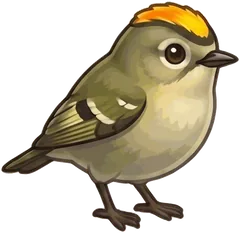 Golden-crowned Kinglet
Golden-crowned Kinglets also travel in flocks giving high, thin tsee notes, but theirs come in neat groups of three and the birds work conifers. Bushtit calls are more scattered and the flock stays in shrubs and broadleaf trees.
 Blue-gray Gnatcatcher
A Blue-gray Gnatcatcher's call is a nasal, wheezy spee from one or two birds, not a chorus. Bushtits are never alone outside the nest, and their notes are drier and shorter.
- ?Verdin
Verdins share desert scrub in the Southwest and give sharp single tsip notes, but they are solitary or in pairs and have a yellow head. A whole bush full of calling gray birds is Bushtits.
Where the Bushtit card lives
In Warble the same bird can be an easy card in one state and a prized one in another, because each album ranks its birds by how often people really report them there. The Bushtit appears in 6 state albums:
 Heard one? Open Warble, tap the green button while it sings, and the Bushtit card flips into your album. Get the app free.
Questions people ask
Why do Bushtits make so much noise?
Because they live in flocks of 10 to 40 birds spread through dense shrubs where they cannot see each other. The thin tsip and pit notes are contact calls that keep the flock together as it moves from tree to tree.
What does it mean when a Bushtit flock suddenly goes quiet?
Usually that a hawk is overhead. Bushtits give a high, shimmering trill when they spot a raptor, then freeze and fall silent. Look up and you will often find a Cooper's or Sharp-shinned Hawk passing through.
Do Bushtits sing?
No. They have no true song, just the contact calls, the alarm trill and some chatter, which is one reason most people never notice them until a flock passes through a hedge a few feet away.
Are Bushtits related to chickadees?
Not closely. Bushtits belong to the long-tailed tit family, Aegithalidae, and are its only members in the Americas. Chickadees are in the true tit family. The two do forage together in mixed winter flocks, which is where the confusion starts.
Sources
- National Audubon Society, Guide to North American Birds: Bushtit. www.audubon.org/field-guide/bird/bushtit
- Wikipedia: American bushtit (measurements, eye color, flock size, nest, helpers, family). en.wikipedia.org/wiki/American_bushtit
- Seattle Audubon, BirdWeb: Bushtit. birdweb.org/birdweb/bird/bushtit
- Animal Diversity Web: Psaltriparus minimus. animaldiversity.org/accounts/Psaltriparus_minimus/