 Warble


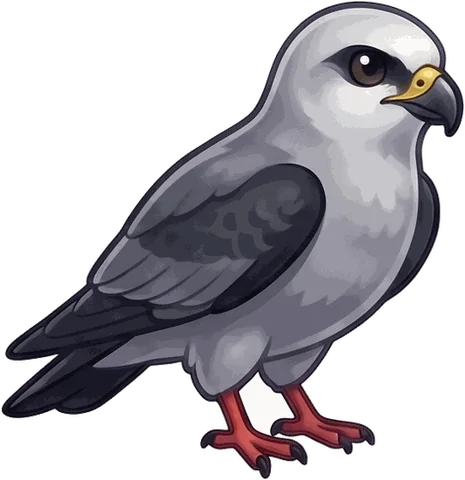
A Mississippi Kite sounds like a short, high, two-note whistle: a sharp first note and a long second one that slides downward, written CHIK-ewwww by the Missouri Department of Conservation, which compares it to a dog's squeaky toy. Audubon describes two or three high, clear whistles and says the call is seldom heard. Listen in summer on the southern Great Plains and in river-bottom woods of the South, where these gray, falcon-shaped kites nest in loose colonies, often right in town.
What the whistle sounds like
The kite's call comes in two parts. The first note is short and sharp, the second longer and falling away in pitch, so the whole phrase reads as CHIK-ewwww: a quick pick-up, then a long sigh. The Missouri Department of Conservation likens it to a dog's squeak toy, and that comparison works better than any bird. It is thin and high, not the scream people expect from something shaped like a hawk. Audubon describes two or three high, clear whistles with a falling pattern.
Raptors do not sing, and this one is not even especially talkative. That is the reason to learn the whistle: it is distinctive, and it often gives away a bird hunting high overhead.
Seldom heard, often seen
Much of what a kite does, you watch rather than hear. It glides, circles and swoops after large flying insects, catching them high in the air and eating them while it soars, the prey held in one foot. The Missouri Department of Conservation describes the flight as buoyant, like a swallow's. Cicadas, grasshoppers, katydids, beetles and dragonflies make up most of the diet.
Kites also skim low over grass, chase swallows, swifts and bats, and follow grazing cattle or grass fires to snatch the insects that fly up. Sometimes several forage together.
When and where you hear it
Despite the name, the Mississippi Kite is most common on the southern Great Plains. It needs tall trees next to open country: wooded streams, groves and shelterbelts on the prairie, and in the Southeast, groves along rivers and swamps. Planted windbreaks and town trees let it spread into places where it was once scarce, and since about 1950 the population has grown and pushed into parts of the Southwest. Many southern plains towns now have their own nesting colonies, and kites may roost on golf courses and school grounds. Pairs have nested as far north as Ohio and New Hampshire.
This is strictly a summer sound. In Missouri, where the kite is a local summer resident, mostly along the Mississippi River valley, birds arrive in late April, peak from late May through August and are gone by late September. They migrate in flocks, sometimes in very large concentrations over Texas and Mexico, to winter in the heart of South America, around the Gran Chaco and the Pantanal. In Warble the kite is a card in the Oklahoma album and a rare one in Arkansas and Louisiana.
Kites that dive at people
Kites nest in loose colonies, on a flimsy platform of dead twigs lined with green leaves, usually laying two eggs. Both parents incubate for about a month and both feed the young. Near the nest, some adults dive at anything they see as a threat, people included. According to Wikipedia this happens at fewer than 20 percent of nests, and the Missouri Department of Conservation says the dives are alarming but rarely cause injury.
The best advice is to stay about 50 yards away. If you cannot, a hat or waving your hands may keep the bird from making contact, though it will not stop the diving. The kites and their nests are protected under the Migratory Bird Treaty Act, so they cannot be moved without a permit. Town nests tend to do better than rural ones, because there are fewer tree-climbing predators.
What it looks like
A slim, falcon-like raptor a little larger than a pigeon, with long pointed wings spanning about three feet. Adults are mostly gray with a pale, almost white head, a black tail and red eyes. From above the wings show three shades of gray, and a whitish patch on the inner wing flashes when the bird turns. Juveniles are brown and heavily streaked with a banded tail. Audubon warns that any age can be mistaken for a Peregrine Falcon, but the kite's light, swooping, insect-chasing flight gives it away.
Birds that sound similar
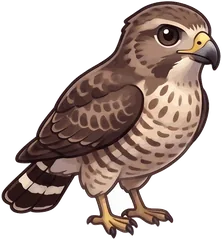 Broad-winged Hawk
The Missouri Department of Conservation says the two whistles are much alike, but the kite's phrase falls away at the end. Context helps: a kite usually calls from open summer sky over towns, pastures and river bottoms, often with other kites nearby.
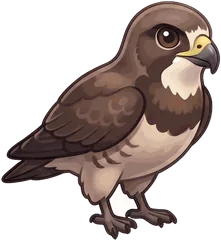 Swainson's Hawk
 also whistles over the plains in summer, but Audubon describes a single long, plaintive kreee. The kite's call is shorter and split in two: a sharp first note, then a falling second one.
Where the Mississippi Kite card lives
In Warble the same bird can be an easy card in one state and a prized one in another, because each album ranks its birds by how often people really report them there. The Mississippi Kite appears in 3 state albums:
 Heard one? Open Warble, tap the green button while it sings, and the Mississippi Kite card flips into your album. Get the app free.
Questions people ask
Why do Mississippi Kites dive at people?
They are defending a nest with young in it. Only a minority of pairs do it, and the dives rarely end in contact or injury. Give an active nest about 50 yards of space; a hat helps if you have to pass closer.
Why is it called the Mississippi Kite?
Because that is where it was first described. The Scottish ornithologist Alexander Wilson named it in 1811 after seeing it in the Mississippi Territory. Today the species is most common farther west, on the southern Great Plains.
Where do Mississippi Kites go in winter?
To South America. They travel in flocks through eastern Mexico and Central America and spend the winter mainly in Paraguay, Bolivia, Brazil and Argentina. Flocks of as many as 10,000 have been seen in Argentina.
What do Mississippi Kites eat?
Mostly large flying insects such as cicadas, grasshoppers and dragonflies, caught and eaten in midair. Small animals, from frogs to bats, are an occasional extra.
Sources
- National Audubon Society, Guide to North American Birds: Mississippi Kite. www.audubon.org/field-guide/bird/mississippi-kite
- Missouri Department of Conservation, Field Guide: Mississippi Kite (call, season, diving). mdc.mo.gov/discover-nature/field-guide/mississippi-kite
- Wikipedia: Mississippi kite (range expansion, migration, nesting, nest defense, name). en.wikipedia.org/wiki/Mississippi_kite
- National Audubon Society, Guide to North American Birds: Swainson's Hawk. www.audubon.org/field-guide/bird/swainsons-hawk