 Warble


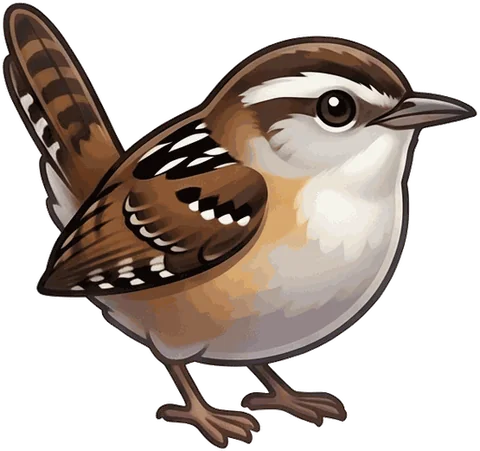
A Marsh Wren sounds like a short burst of bubbles that ends in the clatter of a sewing machine. The song lasts a second or two: a few quick lead-in notes, then a liquid, gurgling trill that finishes in a dry, rattling chatter. Males repeat it from deep in cattail and bulrush marshes, up to about twenty times a minute, through the early morning, much of the day and sometimes all night. Western birds sound harsher and more grating than eastern ones.
What the song sounds like: bubbles and a rattle
Each song has three parts. It opens with a few introductory notes, runs into a trill of rapidly repeated syllables, and closes with one or more ending notes. Audubon's field guide describes a sputtering, bubbling song that finishes in a mechanical chatter it likens to a sewing machine. The Sibley guide, as quoted by the Michigan Natural Features Inventory, calls it a gurgling, rattling trill that is musical and mechanical at once.
Only the males sing, and they sing a lot. A song lasts one to two seconds, and a busy male can deliver around twenty a minute. An unmated male keeps it up almost without a break all breeding season, and a mated male may sing just as hard if he is trying to attract a second female. Young males start copying adult songs at about fifteen days old and keep learning into adulthood.
Where you live changes what you hear. Western males sing harsh, broad, grating songs and know many more song types than eastern males, whose songs are simpler and more liquid. Western birds even devote more brain tissue to song control. When researchers raised nestlings from both regions under identical conditions, each still developed its own regional style, which points to a genetic difference rather than a local accent.
The calls: buzzes, chips and rattles
Between songs, Marsh Wrens give dry chips, buzzes, rattles and short trills. Two calls are tied to the nest: a nasal buzz given while the nest is being built, and a softer, rolling warble when a mated pair meets at the nest.
When and where you hear it
Marsh Wrens live in marshes with tall, fairly uniform stands of cattail, bulrush or cordgrass, fresh or brackish, and in winter they also use salt marshes and the brushy edges of ponds and ditches. They choose deeper water than the Sedge Wren, so the classic place to hear one is a cattail stand you cannot walk into. Many breed across the northern states and southern Canada. Others stay all year along the Atlantic, Pacific and Gulf coasts, in California's Central Valley and in much of Nevada, Utah and Colorado. Most migrants winter in the southern United States and Mexico.
In Michigan, a typical northern state, they arrive in late April or early May, breed from May through July, and leave between late September and early October. Males begin singing within a day or two of arriving and are especially loud in the early morning, but they also sing through the rest of the day and often well into the night.
Their home life is rough. Each male builds the outer shells of several nests in his territory, sometimes twenty or more, and the female picks one and lines it. Spare nests become shelters for fledglings and for wintering adults. Both sexes also puncture the eggs of neighboring birds, including blackbirds and other Marsh Wrens, and their own eggs are unusually strong and round, probably as a result.
What it looks like
A small, sparrow-sized wren, about 4 to 5 inches long, with the tail often cocked up over the back. It is warm brown above with a dark crown, a bold white eyebrow and a black triangle on the upper back streaked with white. The underparts are whitish with buff on the sides. It was once called the Long-billed Marsh Wren to separate it from the Sedge Wren, which is smaller, shorter-billed and has a streaked crown. Patient listeners sometimes see one slip through the reeds or bounce up to the top of a stem.
Birds that sound similar
- ?Sedge Wren
A Sedge Wren starts with three or four separate, deliberate chips before its trill, and the trill is fainter and less musical, with none of the Marsh Wren's bubbling. It sings from shallow sedge meadows and wet grass, not deep cattails.
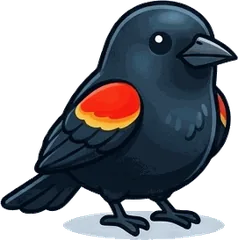 Red-winged Blackbird
A male redwing in the same cattails gives one rich, musical phrase, o-ka-leeee, with the last note drawn out. The Marsh Wren's song is a fast sputter that ends in a mechanical rattle.
Where the Marsh Wren card lives
In Warble the same bird can be an easy card in one state and a prized one in another, because each album ranks its birds by how often people really report them there. The Marsh Wren appears in 7 state albums:
 Heard one? Open Warble, tap the green button while it sings, and the Marsh Wren card flips into your album. Get the app free.
Questions people ask
What bird makes a gurgling rattle in the cattails?
Usually a Marsh Wren. Males sing a quick, bubbling song that ends in a mechanical rattle, over and over, from deep in cattail and bulrush marshes. A Sedge Wren in nearby sedge meadow has a fainter, drier rattle that begins with a few separate chips.
Do Marsh Wrens sing at night?
Yes. Males are loudest in the early morning but often keep singing through the day and into or throughout the night during the breeding season. Unmated males are the most persistent singers of all.
Why does a Marsh Wren build so many nests?
The male builds the shells of several nests, sometimes twenty or more, and the female chooses one to line and use. The extras are not wasted: fledglings and wintering adults use them for shelter.
Do western Marsh Wrens sound different from eastern ones?
Yes. Western males sing harsher, more grating songs and have far more song types, while eastern songs are simpler and more liquid. Birds raised in identical conditions still sang their region's style, so the difference appears to be inherited.
Sources
- National Audubon Society, Guide to North American Birds: Marsh Wren. www.audubon.org/field-guide/bird/marsh-wren
- Animal Diversity Web: Cistothorus palustris, marsh wren (song structure, singing schedule, eastern and western songs). animaldiversity.org/accounts/Cistothorus_palustris/
- Michigan Natural Features Inventory, Michigan State University: Special animal abstract for Cistothorus palustris (marsh wren). mnfi.anr.msu.edu/abstracts/zoology/Cistothorus_palustris.pdf
- Wikipedia: Sedge wren (song and classification). en.wikipedia.org/wiki/Sedge_wren
- National Audubon Society, Guide to North American Birds: Red-winged Blackbird. www.audubon.org/field-guide/bird/red-winged-blackbird