 Warble
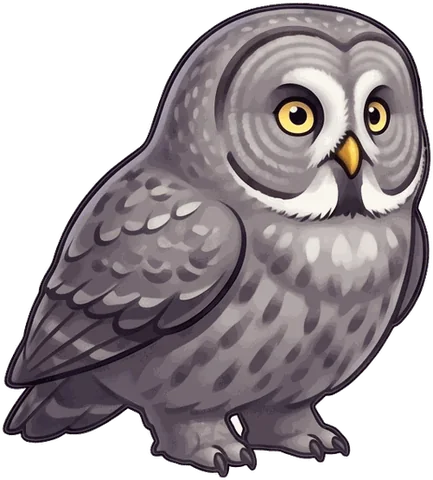
A Great Gray Owl sounds like a slow, very deep whoo, whoo, whoo: ten or more low hoots in an even series that lasts six to eight seconds and steps gradually down the scale, then a long pause, often around half a minute, before the next series. There is no rhythm or phrase to it, just steady, resonant notes. The owls call mainly around their territories and young, in spring at the edges of mountain meadows and northern bogs, and are usually silent the rest of the year.
What the hoot sounds like
The territorial call is a string of very deep, booming hoots, whoo, whoo, whoo, whoo, ten or more of them, each a little lower than the last, so the whole series seems to sink as it goes. Glacier National Park describes the call as deep and resonating, low-pitched notes lasting six to eight seconds with gaps of about thirty seconds between series. Other observers call it reverberating. It is a steady, almost mechanical sound, with none of the stutter of a Great Horned Owl or the conversational phrasing of a Barred Owl.
For a bird this large, it is not much of a talker. Adults hoot mainly to hold a territory or when dealing with their young, and otherwise keep quiet. When researchers put acoustic recorders around Sierra Nevada meadows, the machines logged about 7,400 male calls, 13,000 female calls and 43,000 juvenile calls, and the owls were noisier when people were not around.
The other calls: young owls and screams
Young Great Gray Owls chatter, shriek and hiss, and juvenile calls made up by far the biggest share of what the Sierra recorders picked up. Audubon also lists screams among the species' calls. The recordings fooled software at first, which mixed up owl calls with coyotes, jets, bears, nuthatches and Douglas squirrels. Tame owls fed by people may give higher-pitched hoots than wild ones.
When and where you hear it
Nesting runs from March to May, and that is the season for hooting. Great Gray Owls hunt mainly at night and around dawn and dusk on their nesting grounds, sometimes by day, so the hour around sunset at a meadow's edge is the time to listen. They need dense conifer forest for nesting and roosting next to open ground for hunting: bogs, clearings and old burns in the far north, mountain meadows in the West. In the Sierra Nevada they hunt wet meadows from tree islands, small clumps of trees jutting into the grass, listening for voles and pocket gophers.
In the United States they breed in Alaska and in the northern Rockies of Idaho, Montana and Wyoming, south to Grand Teton and Yellowstone, with small, scattered populations that stay year-round in Washington, Oregon and California. The Yosemite birds, the first breeding Great Gray Owls found south of Canada, have been isolated from Canadian owls for about 27,000 years, and California lists the species as endangered. In some winters, when northern rodents crash, many move into the extreme northeastern states. A spring dusk at a mountain meadow is the realistic time to hear one, and to give Warble a chance to name it.
What it looks like
North America's longest owl, 24 to 33 inches from head to tail with a wingspan of about five feet, but much of that bulk is thick, fluffy feathers, and several owls outweigh it. It is gray all over, with the largest facial disk of any bird of prey, marked with dark concentric rings around yellow eyes, no ear tufts, a white bow-tie mark below the bill and a long tail. Great Gray Owls are not aggressive and often sit still when people approach, though females defend their nests fiercely.
The hunting is the show. An owl listens and watches from a low perch, then drops onto its prey, and in winter it can find a rodent by sound under the snow and plunge in to catch it more than a foot below the surface. It builds no nest, using an old hawk, raven or Osprey nest or the broken top of a dead tree; in the Sierra Nevada it nests only in such snags. The female incubates two to five eggs for about a month, and the young climb onto branches at three to four weeks, a week or two before they can fly.
Birds that sound similar
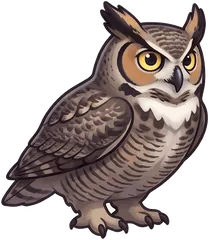 Great Horned Owl
Glacier National Park writes the Great Horned Owl's call as ho hoo hoo hoododo hooooo hoo, deep but stuttering and uneven. The Great Gray Owl's hoots are evenly spaced, longer in series and sink steadily in pitch.
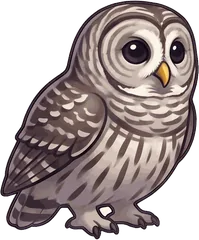 Barred Owl
The Barred Owl's staccato who cooks for you has a speakable rhythm. Its close relative the Great Gray Owl gives no phrase at all, only a slow line of very deep hoots followed by a long silence.
Where the Great Gray Owl card lives
The Great Gray Owl is not in the top 100 of any single state album, so it lives in the national album of all 800 birds, where it counts as legendary. Catching one anywhere in the country adds it there.
 Heard one? Open Warble, tap the green button while it sings, and the Great Gray Owl card flips into your album. Get the app free.
Questions people ask
What does a Great Gray Owl sound like?
A slow series of ten or more very deep, booming whoo hoots, evenly spaced and gradually descending, lasting six to eight seconds, then a pause of about half a minute. Adults call mostly around their territory and young in spring and are usually silent otherwise.
Is the Great Gray Owl the biggest owl in North America?
By length, yes: it reaches up to 33 inches with a five-foot wingspan. But much of that is feathers, and several owls, including the Eurasian eagle-owl, weigh more.
Where can you see Great Gray Owls in the US?
Mainly Alaska, the northern Rockies of Idaho, Montana and Wyoming including Grand Teton and Yellowstone, and small populations in Washington, Oregon and California's Sierra Nevada around Yosemite. In some winters they also move into the far northeastern states.
How do Great Gray Owls hunt under snow?
By ear. The huge facial disk and lopsided ears let the owl pinpoint a rodent moving under the snow. It then plunges into the snow and can catch prey more than a foot below the surface.
Sources
- National Audubon Society, Guide to North American Birds: Great Gray Owl. www.audubon.org/field-guide/bird/great-gray-owl
- Wikipedia: Great grey owl (vocalizations, range, breeding, hunting). en.wikipedia.org/wiki/Great_grey_owl
- National Park Service, Glacier National Park: Owls. www.nps.gov/thingstodo/owls.htm
- Audubon Magazine: After 100 Years, Scientists Are Finally Starting to Understand the Mysterious Great Gray Owl. www.audubon.org/magazine/after-100-years-scientists-are-finally-starting-understand-mysterious-great-gray-owl