 Warble


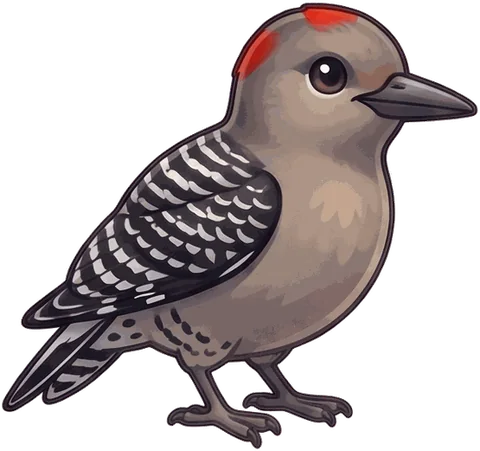
A Gila Woodpecker sounds like a loud, rolling churrr, a burry, level note that rings out of saguaro stands, palm-lined streets and desert washes, often again and again. Between churrs it gives a run of yip yip yip notes and a repeated kee-u, kee-u, kee-u, and it drums in long, steady rolls. Brash and noisy, it is one of the signature sounds of the Sonoran Desert, heard year-round in southern Arizona and nearby parts of California, Nevada and New Mexico, in towns as much as in the wild.
What it sounds like: the rolling churr
Audubon lists the rolling churrr as this bird's song. It is a single vibrating note with a rough, rolled edge, held at one level pitch with no rise or fall, more of a loud purr than a tune.
Gila Woodpeckers are not discreet about any of it. Audubon calls the species brash and noisy, and in saguaro stands it is common and often conspicuous, so on a desert walk the churr is hard to miss even before you spot the bird.
The calls: yips, kee-u and a squabble
The other two sounds worth learning are a run of yip yip yip notes and a repeated kee-u, kee-u, kee-u. Audubon also files screams and trills under this bird's calls. Territorial disputes come with a show: exaggerated bowing and head-swinging, with loud calling, so a racket from a saguaro is often two birds squaring off rather than one announcing itself.
When and where you hear it
This is a bird of the low Sonoran Desert. In the United States it lives in Arizona, southeastern California, southern Nevada and New Mexico, and its range continues into western Mexico. Look in desert washes, saguaro stands, riverside cottonwood groves and towns. What it really needs is somewhere to dig a nest: a giant cactus such as the saguaro, a big cottonwood, willow or mesquite, or a palm. Suburbs of southwestern cities suit it fine.
It does not migrate, so the churr is a year-round sound, though some birds shift a short way north or uphill for winter. The diet is wide: insects, cactus fruit, berries, nectar and seeds, and now and then a small lizard or the eggs of a smaller bird. It forages on trunks, cacti, outer branches and the ground, and it readily drinks from hummingbird feeders.
If a rolling churr keeps coming from a saguaro and you cannot find the bird, Warble can listen and tell you whether it is this woodpecker.
Drumming, and the saguaro boot
Gila Woodpeckers drum in long, steady rolls, and they dig as well as they drum. Both members of a pair excavate the nest, usually 8 to 30 feet up. In a saguaro the hole goes in between the skin and the inner woody ribs. A fresh cavity cannot be used right away: the pulp around it takes several months to dry into a hard lining, so a hole may be dug one year and used the next. The finished pocket, known as a boot, insulates the nest and shelters it from predators and extreme temperatures.
Old holes do not stay empty. Elf Owls, American Kestrels and Purple Martins all move into abandoned Gila Woodpecker cavities, which makes this noisy bird one of the saguaro forest's main landlords.
A clutch is usually three or four white eggs. Both parents incubate for about two weeks and feed the young, which probably leave the nest at around four weeks and stay with the adults for a while after. Pairs raise two or three broods a year.
What it looks like
About the size of a robin, 8 to 10 inches long. The back, wings and tail are barred black and white in a zebra pattern, while the head, neck and underparts are plain grayish tan. The male wears a small red cap; the female and young birds lack it. In flight, look for a white patch on each wing.
The species is listed as Least Concern, with about 1.5 million birds, and Arizona's population is strong. California's declined seriously during the 20th century, and the state lists the Gila Woodpecker as endangered.
Birds that sound similar
- ?Gilded Flicker
The other saguaro woodpecker gives a loud, repeated woika and a loud series of kee notes that can recall the Gila's kee-u. Wait for the rolling churrr: that is the Gila. In flight the flicker flashes bright yellow under the wings and tail.
- ?Ladder-backed Woodpecker
Smaller and also barred black and white, it shares the same washes and mesquite. Its call is a sharp pik, much like a Downy Woodpecker's, plus a descending whinny. A rolling churr points to the Gila instead.
Where the Gila Woodpecker card lives
In Warble the same bird can be an easy card in one state and a prized one in another, because each album ranks its birds by how often people really report them there. The Gila Woodpecker appears in 1 state albums:
 Heard one? Open Warble, tap the green button while it sings, and the Gila Woodpecker card flips into your album. Get the app free.
Questions people ask
What bird makes a rolling churr in the desert?
In the Sonoran Desert it is most likely a Gila Woodpecker. Its signature sound is a loud, rolling churrr on one level pitch, heard year-round in saguaro stands, washes and towns across southern Arizona and nearby states.
Why do Gila Woodpeckers drill holes in saguaros?
To nest. The pair digs a cavity between the cactus skin and its woody ribs, then waits several months for the pulp to dry into a hard lining. The finished boot is insulated and protected, and elf owls, kestrels and martins move in after.
Do Gila Woodpeckers come to hummingbird feeders?
Yes, often. They drink sugar water from hummingbird feeders and eat flower nectar along with insects, cactus fruit and berries, so a desert yard with a feeder is a good place to hear one.
Sources
- National Audubon Society, Guide to North American Birds: Gila Woodpecker. www.audubon.org/field-guide/bird/gila-woodpecker
- Wikipedia: Gila woodpecker (calls, drumming, range, conservation). en.wikipedia.org/wiki/Gila_woodpecker
- National Park Service, Saguaro National Park: Birds. www.nps.gov/sagu/learn/nature/birds.htm
- National Audubon Society, Guide to North American Birds: Gilded Flicker. www.audubon.org/field-guide/bird/gilded-flicker
- National Audubon Society, Guide to North American Birds: Ladder-backed Woodpecker. www.audubon.org/field-guide/bird/ladder-backed-woodpecker