 Warble


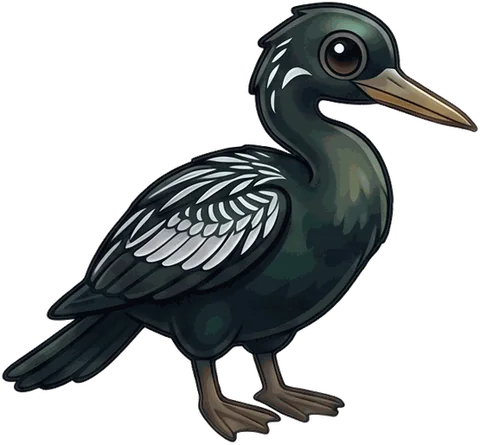
An Anhinga is usually silent. Most of the time the bird perched on a snag with its wings spread, or swimming with only its snaky neck above water, makes no sound at all. When it does call, almost always on or near the nest, it gives low grunts much like a cormorant's, plus dry clicks, rattles and croaks. A nesting colony in a southern swamp is the place to hear that clicking and croaking; out on a quiet pond, expect silence.
What it sounds like: mostly silence
Anhingas do not sing, and for long stretches they do not call either. Audubon describes them as silent at most times, and Animal Diversity Web calls them normally quiet. A bird hunting a canal or drying its wings on a cypress knee will usually stay silent the whole time you watch it. To hear one, you need to be near a nest.
The sounds themselves are low and dry. Audubon compares the grunts to those of cormorants and tags the voice as a chatter and a rattle. Animal Diversity Web lists clicks, rattles, croaks and grunts. Think of a short, rough rattle or a few dry clicks coming from a dark bird with a dagger bill.
Anhingas are quietest of all when molting leaves them unable to fly. Then they become especially silent and hard to find.
At the nest: clicks, croaks and rattles
Nearly all anhinga calling happens on or near the nest, with only occasional calls in flight or from a perch. Pairs talk to each other when they swap places on the eggs, and around a busy colony the various croaking and clicking sounds become part of the background.
Anhingas sometimes nest alone, but usually in groups inside mixed colonies of herons, ibises and cormorants. The male picks a site and shows it off by waving his wings, raising his tail over his back, pointing his bill at the sky and bowing deeply. The female builds a stick platform, often lined with green leaves, from material he brings, and pairs often reuse a nest from year to year. Usually four eggs are laid, and both parents incubate for about four weeks. After about two weeks, chicks that are disturbed may jump into the water and later climb back up to the nest.
When and where you hear it
In North America the Anhinga breeds from North Carolina to Texas. Birds in the northern part of the range arrive around March and April and leave around October; many head around the Gulf of Mexico to Mexico, and migrant flocks pass along the Texas coast in spring and fall. Some stay all winter in the South, especially peninsular Florida. Lone strays sometimes wander north in warm months, as far as Pennsylvania, Wisconsin and New York.
Look for anhingas on quiet, sheltered water: cypress swamps, slow rivers, wooded ponds, freshwater marshes, mangrove-lined lagoons and lakes with standing dead trees. They often feed alone but roost in groups. They soar high on outstretched wings with the long tail fanned, and migrating flocks sometimes travel with other species. Since the bird is silent away from the nest, a Warble player's best chance is a nesting colony, where the clicking and croaking actually happen.
Snakebird and water turkey
The Anhinga hunts underwater, kicking with its webbed feet and spearing fish by shooting out its kinked neck, thanks to a hinge-like joint in the neck bones. It then surfaces, tosses the fish and swallows it headfirst. To do this it needs to sink. Its feathers lack the oils that waterproof a duck, so they soak through, and with dense bones the bird floats so low that often only the head and neck show. That snake-like look gave it the name snakebird, and the name anhinga itself comes from a Tupi word meaning devil bird or snake bird.
The price is a wet, cold bird. Soaked anhingas fly poorly and lose body heat quickly, so they perch with wings spread and tail fanned, usually facing away from the sun, to dry off and warm up. The spread wings and broad tail reminded people of a male turkey, hence water turkey.
What it looks like
A long, slim waterbird about 35 inches long with a wingspan near 3.7 feet, weighing about 2.7 pounds. The neck is thin and snaky, the bill long, straight, yellow and sharply pointed, and the tail long and fan-shaped. Males are glossy greenish black with white spots and streaks on the back and upper wings. Females have the same white wing markings but a pale buff head, neck and chest. Young birds are browner. Anhingas eat mostly fish, from catfish and mullet to pickerel and shad, plus crayfish, shrimp and the odd small snake or turtle.
Birds that sound similar
- ?Double-crested Cormorant
Audubon says the anhinga's low grunts sound like a cormorant's, so ears will not split them. Look instead: the cormorant's bill has a hooked tip, its tail is shorter, and only the anhinga soars and glides on outstretched wings.
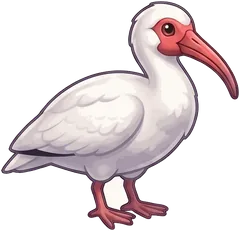 White Ibis
In mixed colonies White Ibises add their own grunts and growls to the anhingas' croaks and clicks. A white bird with a red curved bill is the ibis; a dark one with a straight dagger bill is the anhinga.
Where the Anhinga card lives
In Warble the same bird can be an easy card in one state and a prized one in another, because each album ranks its birds by how often people really report them there. The Anhinga appears in 4 state albums:
 Heard one? Open Warble, tap the green button while it sings, and the Anhinga card flips into your album. Get the app free.
Questions people ask
What sound does an anhinga make?
Usually none. Anhingas are silent most of the time, and when they call, mostly at the nest, they give low cormorant-like grunts along with clicks, rattles and croaks.
Why is the anhinga called a snakebird?
Because it often swims with its body underwater and only its long, thin head and neck showing, which looks like a snake gliding across the surface. Its feathers soak through and its bones are dense, so it floats very low.
Why do anhingas sit with their wings spread out?
To dry off and warm up. Their feathers are not waterproof, they lose body heat quickly, and wet birds fly poorly, so they perch with wings and tail spread, usually with their backs to the sun.
Sources
- National Audubon Society, Guide to North American Birds: Anhinga. www.audubon.org/field-guide/bird/anhinga
- Animal Diversity Web: Anhinga anhinga, anhinga (communication, breeding, range). animaldiversity.org/accounts/Anhinga_anhinga/
- Wikipedia: Anhinga (names, size, plumage, buoyancy and wing drying). en.wikipedia.org/wiki/Anhinga
- National Audubon Society, Guide to North American Birds: White Ibis (voice). www.audubon.org/field-guide/bird/white-ibis