 Warble

A Limpkin sounds like someone screaming in a swamp: a loud, wailing krrr-eeeow with a rough rattle in it, rising to a shriek and falling away at the end. It calls mostly at night and around dawn and dusk, from freshwater marshes, lake shores and river swamps in peninsular Florida and southern Georgia, and it is much easier to hear than to see. If something is shrieking from a Florida marsh in the dark, this is the first bird to suspect.
What the scream sounds like
The main call is one long, loud wail. Audubon writes it as krrr-eeeow; other renderings are kwEEEeeer and klAAAar, with the capitals marking the shriek in the middle. It starts with a rolling, gravelly edge, swells into a high scream and slides down as it ends. A rattle runs through the whole thing, which is why it sounds less like a bird singing and more like something in distress.
The names people have given the bird say a lot. In English it has been called the crying bird and the lamenting bird. Across Latin America many of its local names simply copy the call: carau in Argentina, carrao in Venezuela, carão in Brazil, guareáo in Cuba. Say one aloud with a rolled r and you have a fair sketch of the call.
The scream is usually a solo. Limpkins are mostly alone, keep close to cover and pick their way quietly through tall marsh plants, so a bird calling loudly from the reeds can still be hard to find. Let your ears lead.
The other calls: clicks, clucks and an alarm
Beyond the wail, Limpkins have a short list of quieter sounds: a dry, wooden clicking, soft clucks, and a sharp, piercing alarm note written bihk, bihk. The clicks and clucks are close-range talk you only catch when a bird is near and the marsh is still.
When and where you hear it
Limpkins call mostly at night and around dawn and dusk, and they also feed after dark, especially when the moon is bright, so the marsh stays busy after sunset. In the United States they are permanent residents and do not migrate, which means the wail is possible in any month of the year. Hunting pushed them close to disappearing from Florida by the start of the twentieth century; legal protection let them make a fair comeback.
The classic US range is peninsular Florida plus southern Georgia, where the bird lives locally in river swamps and the Okefenokee Swamp. In Florida, listen along open freshwater marshes, pond and lake shores, and wooded swamps along rivers and around springs. What ties these places together is food: Limpkins eat mostly large apple snails, and in Florida the spread of apple snails is the best predictor of where Limpkins turn up. One study of stomach contents found apple snails made up around 70 percent of the diet.
That map is changing. Reports from across the country have risen since 2014 and picked up speed after 2022, and new populations have taken hold outside Florida and southern Georgia. Strays have reached Wisconsin, Pennsylvania and southern Ontario. Audubon links the wanderers to spreading non-native snails; climate change has also been suggested. In Florida the wail is one of the swamp voices Warble can put a name to from a phone recording.
What it looks like
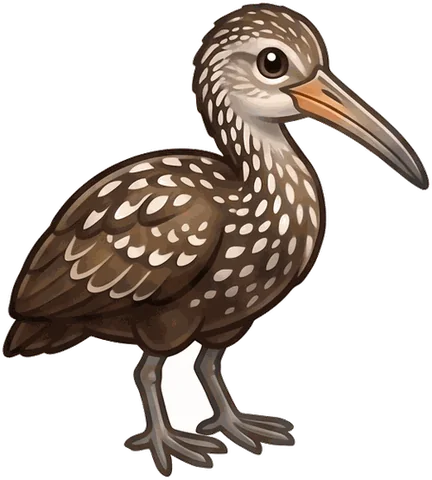
A tall wading bird about two feet long, with long dark legs, a long neck and a wingspan of around 40 inches. It is deep brown, heavily streaked and spotted with white on the head, neck and back, and the sexes look alike. The long, slightly downcurved bill is yellowish with a darker tip, and in many birds the tip bends a little to the right, with a small gap behind it that works like tweezers. It looks like a cross between a crane and a rail; it is the only living member of its family, and DNA places its closest relatives among the cranes. The name comes from its slightly bobbing walk, which looks like a limp.
Watch one feed and you will see its trick. It sets a snail in the mud with the opening up, pulls off the snail's trapdoor and draws the animal out in ten to twenty seconds, usually without breaking the shell. Piles of empty shells at a favorite spot mean a Limpkin is working that shoreline.
Birds that sound similar
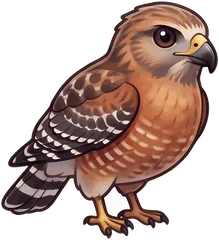 Red-shouldered Hawk
The hawk's shrill kee-yeeear also drops in pitch and rings out over southern swamps, but it is cleaner and more whistled, with none of the Limpkin's gravelly rattle. Blue Jays imitate the hawk almost perfectly, which adds a third suspect to the woods.
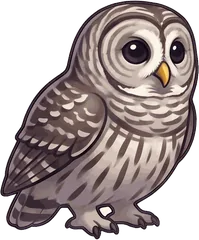 Barred Owl
s share the same Florida swamps and also scream at night, but their screams come mixed with loud barking hoots, hoo, hoo, hoo-hoo; hoo, hoo, hooo-aw, often from a pair answering each other. A Limpkin gives a long falling wail and no hoots.
Where the Limpkin card lives
In Warble the same bird can be an easy card in one state and a prized one in another, because each album ranks its birds by how often people really report them there. The Limpkin appears in 1 state albums:
 Heard one? Open Warble, tap the green button while it sings, and the Limpkin card flips into your album. Get the app free.
More about the Limpkin on this site
Questions people ask
What bird screams at night in Florida swamps?
Very often a Limpkin. Its main call is a loud, rattling, falling wail, krrr-eeeow, given mostly at night and around dawn and dusk. Barred Owls also scream in the same swamps, but they mix in barking hoots.
Why is it called a Limpkin?
Because of the way it walks. Its slightly bobbing gait looks like a limp. Its older nickname, the crying bird, comes from the call.
Are Limpkins spreading north?
Yes. Reports outside Florida and southern Georgia have climbed since 2014 and faster since 2022, new populations have become established, and strays have reached Wisconsin, Pennsylvania and southern Ontario. Spreading non-native snails and climate change have both been suggested.
Is a Limpkin a kind of crane?
Not quite. It is the only living species in its own family, but DNA studies show cranes are its closest relatives. It looks like a cross between a crane and a rail and flies with its neck stretched out.
Sources
- National Audubon Society, Guide to North American Birds: Limpkin. www.audubon.org/field-guide/bird/limpkin
- Wikipedia: Limpkin (vocalizations, diet, range expansion, relationships). en.wikipedia.org/wiki/Limpkin
- National Audubon Society, Guide to North American Birds: Red-shouldered Hawk. www.audubon.org/field-guide/bird/red-shouldered-hawk
- National Audubon Society, Guide to North American Birds: Barred Owl. www.audubon.org/field-guide/bird/barred-owl