 Warble


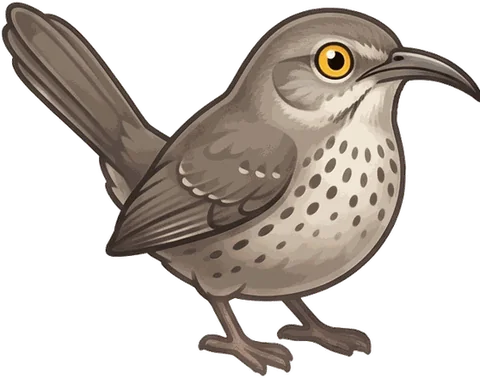
A Curve-billed Thrasher sounds like a sharp, two-part whistle meant to get your attention: whit-wheet!, abrupt and loud, usually thrown out from the top of a mesquite or another high perch. It is the classic call of desert backyards from Arizona to west Texas, and since the bird never migrates, it is a year-round sound. The song is a different animal: a rapid string of musical notes and phrases, a bit like a mockingbird's but sweeter, often repeated two or three times.
What the song sounds like
The song is a quick, tumbling series of musical notes and phrases. Wikipedia compares it to the Northern Mockingbird's and notes it is usually considered the more pleasant of the two. Each song runs about 2 to 15 seconds and is often given two or three times. The repertoire is big enough that in Mexico the bird is nicknamed cuicacoche, meaning songbird.
It borrows a little, too, imitating the Scissor-tailed Flycatcher, the Northern Cardinal and the Pyrrhuloxia, though far less than other members of the mockingbird family. Males sing to defend their territory, especially in spring, and a courting male may trail the female while singing softly.
The call: whit-wheet
This is the sound people remember. Audubon writes it as a sharp, whistled whit-wheet!; the Texas Breeding Bird Atlas calls it a characteristic double whistle, and Wikipedia an abrupt, brash one. It is over in a moment, and the bird usually gives it from a high perch, so look to the tops of the mesquites.
It is not a shy sound from a shy bird. Audubon calls this the most familiar thrasher of the southwestern deserts, a bird that darts around in plain view and calls from the tops of trees.
When and where you hear it
The Curve-billed Thrasher is a permanent resident of the desert Southwest and Mexico. In the United States it lives in the Sonoran Desert of Arizona, in New Mexico, west and south Texas (including the Panhandle), southeastern Colorado and southwestern Kansas, but not in the East Texas pineywoods or on the upper Texas coast. Look in desert scrub with cholla, saguaro, mesquite and paloverde, and in south Texas brush with prickly pear.
It takes readily to people. Suburbs suit it as long as some native plants remain, and it forages in gardens and visits feeders, where it bullies Inca Doves and ground squirrels. If you hear the whit-wheet but cannot find the bird, Warble can listen and confirm it.
Most food comes from the ground. It flips leaf litter and small stones with its heavy curved bill, and in hard dirt it braces its tail and hammers straight down. Beetles, ants, grasshoppers, spiders and snails are on the menu, plus berries and cactus fruit. It sips nectar from saguaro blossoms, pollinating them, and in dry months saguaro fruit is an important source of water.
Life in the cholla
The favorite nest site is the fork of a cholla, most often 3 to 5 feet up, though yucca, prickly pear and mesquite also work. Both parents build a bulky, loose cup of thorny twigs lined with grass, rootlets, feathers and hair. The eggs are pale blue-green with tiny brown dots, the chicks hatch after 12 to 15 days, and the young leave about two weeks later.
The neighbors are Cactus Wrens, which also favor cholla. A thrasher may build right on top of an old wren nest, the two fight hard over fledglings, and each may tear up the other's roosting nests. Snakes are the main threat to eggs and chicks, and only about one nest in five succeeds in a given year.
What it looks like
A big, long-tailed thrasher, about 11 inches, somewhere between a robin and a crow in size. It is a plain, dull gray-brown with faint spotting on the chest, more obvious in Texas birds. The giveaways are the long, curved black bill and the yellow-orange to golden eye.
The species is listed as Least Concern with an estimated 3.1 million birds and is still abundant in the West. Texas is the weak spot: Breeding Bird Survey routes there showed a significant decline of 3.4 percent a year from 1966 to 2005, and loss of south Texas brushland may be part of the reason.
Birds that sound similar
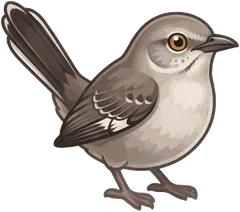 Northern Mockingbird
The mockingbird's song is a long run of musical and grating phrases, each repeated three or more times, full of imitations, and its call is a harsh chack. The thrasher sings shorter bursts with less mimicry, and its call is the whistled whit-wheet.
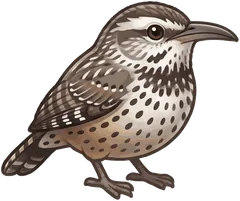 Cactus Wren
The Cactus Wren shares the same cholla yards, but its calls are rough and abrasive, with no whistle in them. A clean, rising whit-wheet from the same cactus is the thrasher.
Where the Curve-billed Thrasher card lives
In Warble the same bird can be an easy card in one state and a prized one in another, because each album ranks its birds by how often people really report them there. The Curve-billed Thrasher appears in 2 state albums:
 Heard one? Open Warble, tap the green button while it sings, and the Curve-billed Thrasher card flips into your album. Get the app free.
Questions people ask
What bird says whit-wheet?
The Curve-billed Thrasher. Its sharp, whistled whit-wheet! is one of the most familiar sounds of desert yards from Arizona to west Texas, usually given from a high perch and heard all year.
Why is a thrasher digging holes in my yard?
It is looking for food. The Curve-billed Thrasher forages mostly on the ground, flipping leaf litter and stones with its curved bill and bracing its tail to hammer into hard soil for insects and seeds.
Do Curve-billed Thrashers and Cactus Wrens fight?
Yes, sometimes. Both nest in cholla across much of the same range. Fights over food are rare, but squabbles over fledglings are intense, and each species may wreck the other's roosting nests. Breeding nests are rarely destroyed.
Do Curve-billed Thrashers mimic other birds?
A little. They have been heard copying the Scissor-tailed Flycatcher, Northern Cardinal and Pyrrhuloxia, but they mimic much less than mockingbirds and other relatives. Most of the song is their own.
Sources
- National Audubon Society, Guide to North American Birds: Curve-billed Thrasher. www.audubon.org/field-guide/bird/curve-billed-thrasher
- Wikipedia: Curve-billed thrasher (song, mimicry, range, cactus wren conflicts). en.wikipedia.org/wiki/Curve-billed_thrasher
- Texas Breeding Bird Atlas: Curve-billed Thrasher. txtbba.tamu.edu/species-accounts/curve-billed-thrasher/
- National Park Service, Saguaro National Park: Birds. www.nps.gov/sagu/learn/nature/birds.htm
- National Audubon Society, Guide to North American Birds: Northern Mockingbird. www.audubon.org/field-guide/bird/northern-mockingbird