 Warble


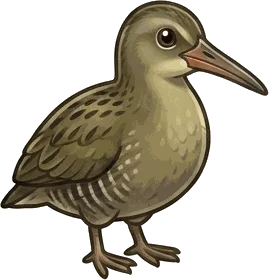
A Clapper Rail sounds like someone running a stick along a fence somewhere out in the salt marsh. Its main call is a loud, harsh clatter of 20 to 25 notes, often written kek-kek-kek or chock-chock-chock, that drops in pitch and speeds up as it goes. The bird itself is a chicken-sized rail that lives almost nowhere but salt marsh along the Atlantic and Gulf Coasts, and it usually stays hidden in the grass, so the clatter is often the only sign it is there.
What the clatter sounds like
The signature sound is a dry, wooden clatter. North Carolina's wildlife agency describes it as a loud series of 20 to 25 notes that falls in pitch while the tempo picks up, so it sounds like it is tumbling downhill and gaining speed. Audubon calls it harsh, and that is fair: there is nothing whistled or musical in it. People write it as kek-kek-kek or chock-chock-chock, depending on how they hear the attack of each note.
Audubon also points out that a clattering cackle from the grass is often the first clue a Clapper Rail is around at all. The bird is usually hidden in dense cover, so the call is often all you get. The University of Arizona's marsh bird survey team lists the clatter as a call mates use to keep in contact, so at least some of that racket is a pair talking to each other.
The scientific name fits. The species name crepitans is Latin, and Wikipedia gives two meanings for it: "resounding" and "breaking wind." Either meaning suits a bird this loud.
The other calls: kek, purr and squawk
The clatter is not the whole repertoire. North Carolina's guide notes that Clapper Rails make a wide variety of calls, and the Arizona survey lists several by name: a kek used to attract a mate, two-part versions written kek-burr and kek-hurrah, a hoo, a purr, and a squawk given in alarm and in disputes over territory. North Carolina adds that the purr is a call of the female.
When and where you hear it
Think salt. Along most of the Atlantic and Gulf Coasts the Clapper Rail is strictly a bird of salt marsh, sometimes spilling into the brackish marsh next door, and in Florida and other parts of the Southeast it also lives in shallow mangrove swamps. Wikipedia calls it a salt marsh specialist, with a range that runs from the eastern United States along the Gulf of Mexico to eastern Mexico and out to some Caribbean islands. Of its subspecies, crepitans ranges from Connecticut to northeastern North Carolina, and saturatus from the Gulf Coast to northeastern Mexico.
Over much of that range the bird stays all year, though some birds leave the northern end of the Atlantic Coast in winter. Tides matter. Clapper Rails forage by walking in shallow water or on mud, especially on a falling or low tide, picking up crabs above all, plus crayfish, aquatic insects, small fish, mollusks, worms and frogs. A muddy creek bank at low tide is the place to watch.
Nests are well-built cups of grass tucked into a clump of vegetation near the upper reach of high tide, often roofed over with woven stems and reached by a little ramp. Both parents incubate for about three weeks, and Wikipedia notes that the male takes the night shift. Audubon puts the population near 210,000 and says the bird, once abundant on the Atlantic Coast, is now more local because development has broken coastal marsh into pieces. In Warble it is a legendary card in the Delaware album and a rare one in South Carolina.
What it looks like
A chicken-sized rail with a long, slightly downcurved bill and long, unwebbed toes. In males the base of the bill is orange-yellow; in females it is duller. It is olive-brown to gray-brown above, with gray-and-white barred flanks and a buff to rusty breast. Atlantic Coast birds are paler and grayer; Gulf Coast birds run more cinnamon below. The short tail is often cocked up, showing white feathers underneath, and it twitches as the bird walks.
Clapper Rails rarely fly. When one does come into view, it is usually stalking boldly along the muddy edge of the marsh or swimming across a tidal creek, then slipping back into the grass. Young birds are darker and plainer than adults.
Birds that sound similar
- ?King Rail
The two share a vocabulary: the Arizona marsh bird survey lists the same clatter, kek and kek-burr calls for both. Habitat does the sorting. Clappers almost never leave salt marsh, so a clatter from a freshwater marsh inland is not a Clapper Rail.
- ?Virginia Rail
This rail's marsh sounds are grunts and a clipped, repeated tick-it, not a long, accelerating clatter. If the phrase falls and speeds up over twenty-odd notes, it is the Clapper.
Where the Clapper Rail card lives
In Warble the same bird can be an easy card in one state and a prized one in another, because each album ranks its birds by how often people really report them there. The Clapper Rail appears in 2 state albums:
 Heard one? Open Warble, tap the green button while it sings, and the Clapper Rail card flips into your album. Get the app free.
Questions people ask
What bird makes a clattering sound in a salt marsh?
On the Atlantic and Gulf Coasts it is usually a Clapper Rail. Its loud, harsh clatter of 20 to 25 notes falls in pitch and speeds up, and it usually comes from a bird hidden in the grass.
Do Clapper Rails fly?
Rarely. They walk through the marsh grass on long toes and swim across tidal creeks, and they are far more often heard than seen. You may catch one stalking along a muddy bank at low tide.
Is the Clapper Rail a game bird?
In North Carolina, yes. The state's wildlife agency classifies the Clapper Rail as a game species, and the bird lives along the North Carolina coast in salt marsh.
What do Clapper Rails eat?
Mostly crabs. They also take crayfish, aquatic insects, small fish, mollusks, worms and frogs, and the occasional seed, foraging on mud and in shallow water, especially as the tide falls.
Sources
- National Audubon Society, Guide to North American Birds: Clapper Rail. www.audubon.org/field-guide/bird/clapper-rail
- Wikipedia: Clapper rail (name, taxonomy, range, incubation). en.wikipedia.org/wiki/Clapper_rail
- North Carolina Wildlife Resources Commission: Clapper Rail. ncwildlife.gov/species/clapper-rail
- University of Arizona, National Marsh Bird Monitoring Program: call types of marsh birds. cales.arizona.edu/research/azfwru/NationalMarshBird/Call_Types.html