 Warble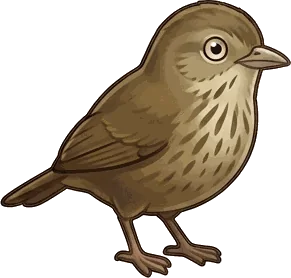
A Wrentit sounds like a ping-pong ball dropped on a table: a series of clear, even notes on one pitch that start slowly, speed up and run together into a trill, dropping slightly in pitch at the end. Males sing the full accelerating version; females give the same note repeated at a steady pace without the trill. The call is a long, dry, growling rattle. You hear all of it year round from deep inside chaparral and coastal scrub from Oregon to Baja California, usually without ever seeing the bird.
The birder's mnemonic
“a ping-pong ball bouncing to a stop” Picture the ball: the bounces start far apart, come faster and faster, and blur into a buzz at the end. That is the male's song in one image.
What the song sounds like
Audubon describes the song as an accelerating series of musical notes that run together into a trill and drop slightly in pitch toward the end, and Wikipedia reaches for the image everyone uses: a ping-pong ball falling on a table. The notes are clear and a little hollow, all on roughly the same pitch. The giveaway is the rhythm. Nothing else in western scrub starts slow and accelerates so smoothly into a trill.
The sexes sing differently, which is rare and useful. The male gives the full version, several separate notes leading into a fast trill. The female gives a repeated single note at an even pace that never speeds up, and the Oregon Department of Fish and Wildlife notes that her song is easy to tell from his. Since the sexes look identical, the song is one of the few reliable ways to tell them apart.
Both sexes sing in every month. Wrentits hold a territory as a pair all year and announce it with song in January as readily as in May.
The call: a dry growl
The call is a prolonged, dry, growling note, a low churring rattle given from inside the brush. It is soft and easy to overlook, but at the edge of a poison oak thicket that growl a few feet away is often your first sign that a Wrentit is watching you.
Audubon puts it plainly: this species is far more often heard than seen. ODFW calls it a mouse-like bird that only occasionally works up the courage to leave its shadowy domain.
When and where you hear it
The Wrentit lives in a narrow strip of the Pacific coast, from the Oregon coast and the Columbia River lowlands south through California to northern Baja California. The habitat is dense, low brush: chaparral, coastal sage scrub, poison oak and coyote bush thickets, blackberry tangles along streams, and shrubby corners of city parks. In Oregon it lives on the coastal slope and the west side of the Klamath Mountains, and it has never crossed the Columbia River into Washington.
That is the defining fact about the species: it does not go anywhere. Audubon calls it remarkably sedentary and notes that a bird may spend its entire adult life in a couple of acres. Pairs form within months of fledging, may stay together for life, and hold the same territory in every season.
Nesting runs through spring. Both birds build a compact cup of bark strips bound with spider web, lashed into a shrub one to four feet up, and share incubation of three or four pale greenish-blue eggs for about two weeks. The diet is insects in spring and summer and berries in fall and winter, with poison oak fruit a favorite. For Warble players in the Bay Area or Los Angeles, this is the classic catch from a hiking trail: you will have the sound long before you have the bird.
What it looks like
A small, plain, round-bodied bird, 5.5 to 6.5 inches long, gray-brown to reddish-brown above with faint blurry streaks on a paler, often pinkish breast, a short stubby bill and a long tail it often holds cocked. The one sharp feature is the eye, a staring pale iris that looks oddly intense on such a dull bird.
Taxonomists have struggled with it for 180 years. It has been filed as a tit, a babbler and an Old World warbler; a 2019 analysis places it with the parrotbills of Asia, in the family Paradoxornithidae, the only member of its group in the Americas.
Birds that sound similar
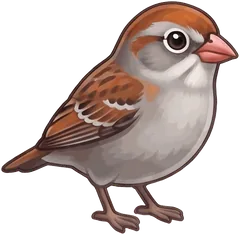 Field Sparrow
The eastern Field Sparrow also sings an accelerating bouncing-ball trill, but its notes are sweet, slurred whistles that rise, and the two birds never share a range.
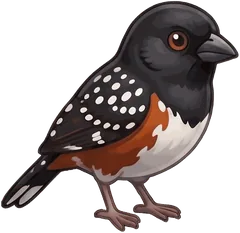 Spotted Towhee
A Spotted Towhee in the same chaparral gives a buzzy trill, often with one or two introductory notes, but the trill starts at full speed instead of accelerating. Its call is a rising, catlike mew, not a dry growl.
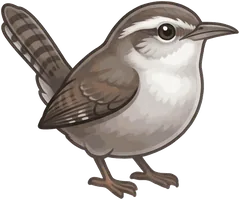 Bewick's Wren
Bewick's Wrens share the brush and end many songs with a trill, but the song is a varied, buzzy, several-part phrase rather than one steadily accelerating series of identical notes.
Where the Wrentit card lives
In Warble the same bird can be an easy card in one state and a prized one in another, because each album ranks its birds by how often people really report them there. The Wrentit appears in 1 state albums:
 Heard one? Open Warble, tap the green button while it sings, and the Wrentit card flips into your album. Get the app free.
Questions people ask
What bird sounds like a bouncing ping-pong ball in California?
The Wrentit. Its song is a series of clear notes on one pitch that start slow and speed up into a trill, like a ball bouncing to a stop. It sings from inside chaparral and coastal scrub all year.
Do female Wrentits sing?
Yes. The female sings a repeated single note at an even pace, while the male's song accelerates into a trill. Both sexes sing and defend the territory in every season, and the song is one of the only ways to tell them apart.
Why is a Wrentit so hard to see?
It lives inside dense, low brush, moves slowly, rarely crosses open ground and never leaves a territory of a few acres. A quiet wait after the growl call is the usual way to get a look.
Is a Wrentit a wren or a tit?
Neither. The name comes from its wren-like cocked tail and tit-like habits, but recent genetic work places it with the parrotbills, a mostly Asian family, as the only American member of that group.
Sources
- National Audubon Society, Guide to North American Birds: Wrentit. www.audubon.org/field-guide/bird/wrentit
- Wikipedia: Wrentit (song, range, pair bonds, taxonomy). en.wikipedia.org/wiki/Wrentit
- Oregon Department of Fish and Wildlife: Wrentit. myodfw.com/wildlife-viewing/species/wrentit