 Warble


A Sora sounds like a whinny coming out of the cattails: a loud, squeaky run of piping notes that drops down the scale and slows as it goes. It also gives a rising, whistled ker-wee and a sharp keek when alarmed. Soras live hidden in freshwater marshes across much of North America, so most people know the bird only as a voice, with no bird in sight.
What the whinny sounds like
The whinny is the Sora's song, and it is loud for a bird this size. It starts high with a burst of bright, piping notes, then tumbles down the scale, each note a little lower and a little slower than the last. Audubon calls it a musical series; Missouri's field guide calls it nasal. Both are right, which is part of why it sounds so odd from a marsh.
Soras use the whinny to claim a territory and to keep in touch with a mate. The University of Arizona's marsh bird survey team lists it under both jobs.
The trouble is seeing the singer. Soras are far more often heard than seen, and they move through dense cattails, sedges and bulrushes on long toes, with a narrow, flattened body that slips between the stems. Wikipedia notes that playing a recorded call greatly raises the odds of hearing one, and that a curious Sora will often come over to check out the source.
The other calls: ker-wee, keek and wheep
The second sound to learn is a softer, two-part whistle that rises at the end: ker-wee, also written sor-ee or sor-ah. Wikipedia suggests this call may be where the bird's name came from, and adds that the word Sora probably comes from a Native American language.
Near the nest, Soras give an explosive, single keek!, and the Arizona survey lists a similar keep as the alarm call. Missouri's guide adds a short wheep and a repeated quink-quink-quink.
When and where you hear it
Soras breed across much of North America, roughly north of a line through Arizona, Missouri and Pennsylvania, and they turn up in every state except Hawaii. The classic place is a marsh with big stands of cattails, sedges and bulrushes over shallow water, usually less than a foot deep. They keep to the edges of that cover and avoid open water. Spring migration north peaks in April and May, and nesting runs from late April into early August, which is the stretch when territories are being claimed and the whinny is in use.
In late summer and early fall, Soras pile into certain marshes to feed before leaving, sometimes in large numbers, eating seeds of smartweeds, sedges and grasses and, where it grows, a lot of wild rice. They also eat snails, insects and spiders. Migration happens mostly at night, and for a bird that seems to flutter weakly over the reeds, the trip is long: many cross the Gulf of Mexico and the Caribbean to winter in South America. Others spend the winter along the Atlantic Coast south of Virginia, the Gulf Coast and parts of the Southwest, where they also use salt marshes.
In Missouri the Sora is a common migrant but a very rare and local summer resident, and the state lists it as a species of conservation concern, though it is legal to hunt there. Across the continent Audubon puts the population at about 4.4 million and notes declines where freshwater marshes have been drained. A bird you hear far more than you see is a natural catch for Warble, which works from sound alone.
What it looks like
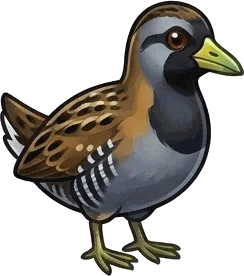
A chunky little rail about 8 to 10 inches long, with a short tail, short rounded wings and a short, thick, yellow bill. Adults have a black face and throat, a gray chest and cheeks, a brown back marked with white, and black-and-white bars along the flanks. Males and females look alike. Young birds lack the black face and are buffier below, which can make them look like the rare Yellow Rail.
Both parents build a cup of dead plants a few inches above the water, often roofed over with stems and sometimes with a little ramp of plants leading up to it. Clutches are big, usually 10 to 12 eggs and sometimes laid in two layers. Incubation lasts 18 to 20 days, and because it starts before the last egg is laid, the chicks hatch over several days. They can walk and swim on their first day. Missouri's guide notes that some people think the phrase "thin as a rail" first described birds like this one.
Birds that sound similar
- ?Virginia Rail
Its marsh sounds are grunts and a clipped, repeated tick-it, with no falling whinny. A whistled run of notes dropping down the scale is a Sora; grunting from the reeds is not. If you get a look, its long red bill settles it.
- ?King Rail
A much larger rail whose main sounds are a hard clatter and a sharp kek. Those are hard, percussive sounds, nothing like the Sora's piping whistles.
Where the Sora card lives
In Warble the same bird can be an easy card in one state and a prized one in another, because each album ranks its birds by how often people really report them there. The Sora appears in 1 state albums:
 Heard one? Open Warble, tap the green button while it sings, and the Sora card flips into your album. Get the app free.
More about the Sora on this site
Questions people ask
What bird whinnies like a horse in a marsh?
Most likely a Sora. Its song is a loud, squeaky whinny that runs down the scale and slows at the end, given from dense cattails and sedges, mostly during the spring and summer nesting season.
Why is it called a Sora?
The name probably comes from a Native American language. Some suggest it echoes the bird's softer rising whistle, often written sor-ah or ker-wee.
Where do Soras go in winter?
South, mostly at night. Some winter along the Atlantic Coast south of Virginia, the Gulf Coast and the Southwest, sometimes in salt marshes; many cross the Gulf of Mexico and the Caribbean to reach South America.
Why are Soras so hard to see?
They are built to disappear. A narrow, flattened body slides between cattail stems, and long toes let the bird walk on floating plants and soft mud. That is why you hear far more Soras than you ever see.
Sources
- National Audubon Society, Guide to North American Birds: Sora. www.audubon.org/field-guide/bird/sora
- Wikipedia: Sora (whinny and ker-wee calls, name, range, habitat depth, migration timing, nesting). en.wikipedia.org/wiki/Sora_(bird)
- Missouri Department of Conservation, Field Guide: Sora. mdc.mo.gov/discover-nature/field-guide/sora
- University of Arizona, National Marsh Bird Monitoring Program: call types of marsh birds. cales.arizona.edu/research/azfwru/NationalMarshBird/Call_Types.html