 Warble

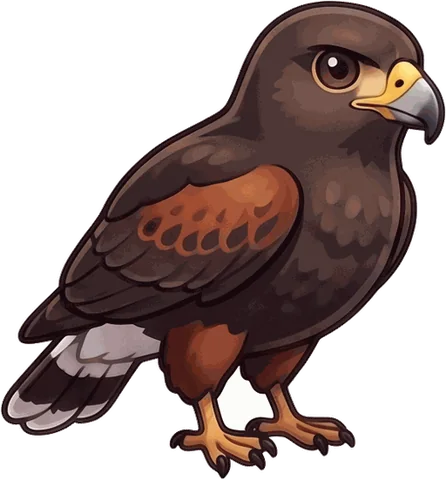
A Harris's Hawk sounds harsh and grating rather than whistled. Audubon describes a low, harsh, hissing sound and classes it with the raucous screams, and Wikipedia sums up the species' calls as very harsh. Because this hawk is far more social than most birds of prey, the calls often come from a family group: several dark, rust-shouldered hawks sitting close together on a saguaro, a pole or a mesquite. You hear them all year in the deserts and brushlands of southern Arizona, New Mexico and Texas, and now in some suburbs there.
What the calls sound like
A Harris's Hawk's voice is rough and low, more like a loud, raspy hiss than a whistle. Audubon describes it as a low, harsh, hissing sound, and Wikipedia simply calls the species' calls very harsh.
Published descriptions say little more than that, and this is a bird more often watched than heard. When perched, Harris's Hawks can seem sleepy and tame and let people walk quite close. Animal Diversity Web adds hissing noises and alarm calls to the repertoire.
Calls in the family group
Most hawks live and hunt alone. Harris's Hawks live in groups of two to seven birds, often a breeding pair plus young from earlier years, and the groups are fairly stable. The mature female sits at the top of the pecking order, followed by the adult male and then the younger birds. Many nests have three adults in attendance, sometimes two males and a female, sometimes the reverse, and all of them help raise the chicks.
Harris's Hawks give alarm calls, and every member of the group helps defend the territory, guard the nest and share food. So if a hawk starts calling harshly as you near a nest tree, look around for the rest of the group. Young hawks can stay with their parents for up to three years and help feed later broods, and a pair may raise two or three broods in a season.
When and where you hear it
Harris's Hawks do not migrate, so you can hear them in any month. In the United States they live in the Southwest: most commonly in saguaro desert in Arizona and in mesquite brushland in Texas and New Mexico, plus trees along rivers. Recently they have settled into some southwestern suburbs, where they hunt washes and open lots and nest in cottonwoods, palms and even electrical towers. Groups and single birds may wander widely when prey is scarce.
In Arizona they are often seen at Picacho Peak, Alamo Lake and Lost Dutchman state parks, and a breeding pair raises young at Oracle State Park. Look for a cluster of dark hawks perched near one another on a saguaro or a utility pole, the kind of scene few other raptors ever produce.
Hunting as a team
No other raptor hunts in groups as routinely. Hunting parties usually number two to six birds. Sometimes members scout in turn until one finds prey; sometimes they surround a bush while one bird flushes the animal out, and if it escapes the first hawk, the next one catches it. They chase prey on foot too, on long yellow legs. In groups of up to four, each extra hunter raises the success rate, and together they can take an adult black-tailed jackrabbit weighing more than four pounds. Cottontails, ground squirrels, woodrats, quail and lizards are regular prey.
Wikipedia also describes backstanding, in which one hawk stands on the back of another. The same sociability makes them easy to train, which is why the Harris's Hawk has become the most popular falconry hawk in the West and has been used to clear pigeons from London's Trafalgar Square and the Wimbledon tennis courts.
What it looks like
A medium-large hawk, 18 inches to 2 feet long, between a Peregrine Falcon and a Red-tailed Hawk in size, with females noticeably bigger than males. Adults are dark chocolate brown with rich chestnut shoulders, wing linings and thighs, long yellow legs and a long black tail with white at the base and a white band at the tip. Juveniles are brown and streaked below with narrow tail bands, but they already show some chestnut. Audubon notes that some dark Swainson's Hawks show a similar pattern.
Birds that sound similar
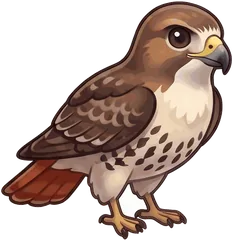 Red-tailed Hawk
Arizona State Parks writes the Red-tailed Hawk's call as a raspy, drawn-out kee-eeeee-arr scream. A Harris's Hawk gives a low, harsh hiss instead, often with other hawks of its group perched close by.
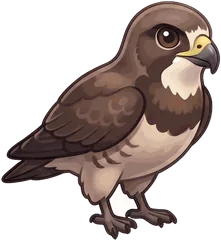 Swainson's Hawk
Dark Swainson's Hawks can share the Harris's color pattern, but their voice is a high-pitched whistle. A low, harsh, hissing call is the Harris's Hawk.
Where the Harris's Hawk card lives
The Harris's Hawk is not in the top 100 of any single state album, so it lives in the national album of all 800 birds, where it counts as uncommon. Catching one anywhere in the country adds it there.
 Heard one? Open Warble, tap the green button while it sings, and the Harris's Hawk card flips into your album. Get the app free.
Questions people ask
Do Harris's hawks hunt in packs?
Yes. No other raptor hunts in groups as routinely, usually two to six birds at a time. They take turns flushing and chasing prey, so an animal that dodges one hawk often runs straight into another, and the group shares the kill.
Who is the Harris in Harris's hawk?
Edward Harris, a friend, traveling companion and financial backer of John James Audubon. Audubon named the hawk in his honor.
Why are Harris's hawks used in falconry?
Because they are social and easy to train. Since about 1980 they have become the most popular falconry hawk in the West, and trained birds are used to keep pest birds away from airports, landfills and city squares.
Where can I see Harris's hawks?
In the deserts and brushlands of southern Arizona, New Mexico and Texas, all year round. In Arizona, Picacho Peak, Lost Dutchman, Alamo Lake and Oracle state parks are places where they are often seen, and some groups live in suburbs.
Sources
- National Audubon Society, Guide to North American Birds: Harris's Hawk. www.audubon.org/field-guide/bird/harriss-hawk
- Wikipedia: Harris's hawk (calls, group hunting, social structure, falconry, name). en.wikipedia.org/wiki/Harris%27s_hawk
- Animal Diversity Web, University of Michigan: Parabuteo unicinctus (alarm calls, group defense, urban nesting). animaldiversity.org/accounts/Parabuteo_unicinctus/
- Arizona State Parks: Hawks in Arizona (where to see them, other hawks' calls). azstateparks.com/hawks-in-arizona