 Warble


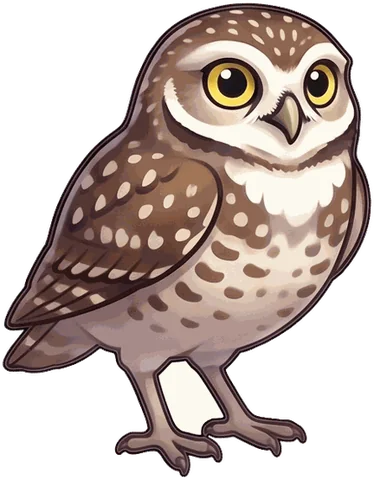
A Burrowing Owl sounds like a small dove with something to hide. The male's song is a soft, mellow, two-note coo-coooo, higher than a Mourning Dove's coo. Around the nest the owls cackle, cluck, chatter and scream. And when one is cornered in its burrow, it produces a rattling hiss so much like a rattlesnake's that it likely works as a disguise. Listen at dawn and dusk in open country in the West and in Florida.
What the song sounds like
The song is short and gentle: two notes, the second drawn out, written coo-coooo or, at night, co-hoo. Audubon calls it mellow and notes it is often repeated twice. It is pitched higher than a Mourning Dove's coo and is far quieter than the hoot of a big owl, so it can pass unnoticed across a field. Males use it to attract a mate, defend their territory and court.
Watch while you listen. A Burrowing Owl that is excited or agitated bobs its head up and down and flashes the white patch on its chin. Cowboys in prairie-dog country called these owls howdy birds, because they seemed to nod a greeting from the burrow entrances.
The other calls: the rattlesnake hiss, clucks and screams
The famous one first. When a Burrowing Owl is threatened, it retreats into its burrow and produces a rattling, hissing sound very much like a rattlesnake's warning. Researchers consider it likely acoustic mimicry, a harmless animal borrowing a dangerous one's signal, and it appears to work best on animals that already know to fear rattlesnakes. For a predator poking its nose into a dark hole, that is a persuasive reason to back out.
Above ground the owls are chattier than most. Adults have been credited with thirteen different calls and young owls with three of their own, for defense, begging and distress. Audubon describes a liquid cackling, and owls defending a nest scream, cluck and chatter at intruders. They also snap their bills and flap their wings when distressed.
When and where you hear it
Unlike most owls, Burrowing Owls are often out in daylight, standing at the burrow entrance, though they avoid the midday heat. They hunt mostly around sunrise and sunset, which makes dawn and dusk the best times to listen. In summer they eat mostly big insects such as grasshoppers, beetles and crickets; the rest of the year they turn more to voles, mice and ground squirrels, plus frogs, lizards, snakes and even cactus fruit.
These are birds of flat, open ground with short grass or bare soil: prairies, grasslands, farmland, deserts and, increasingly, airports, golf courses, vacant lots and industrial parks. In the United States they are most common in the western states, with resident populations in California, Arizona, New Mexico, Texas and Colorado, and a separate population across Florida. Birds that breed in Canada and the northern US migrate south for the winter, while Florida and Southwest birds may stay all year. Nesting usually starts in late March or April.
The burrow is the center of everything. Western owls mostly move into holes dug by prairie dogs, ground squirrels, badgers or other animals, while Florida birds usually dig their own. They line the burrow and entrance with cattle dung, which seems to steady the temperature underground and draws dung beetles to eat. The owls have declined for years from habitat loss, prairie dog and ground squirrel control, and traffic. If you hear a soft two-note coo at dusk over a Florida vacant lot, a recording with Warble can help sort owl from dove.
What it looks like
A small, robin-sized owl on stilts: long grayish legs, a round head with no ear tufts, bright yellow eyes, bold white eyebrows and a white chin. Adults are brown with white spots above and white below with brown bars or spots; young birds are plainer, with buff on the breast. Males often look paler than females because they spend more daylight time outside the burrow and their feathers fade in the sun. The female sits on the eggs for about four weeks while the male brings food, and western clutches tend to be larger than Florida ones.
The species is listed as endangered in Canada, threatened in Mexico, and state-threatened in Colorado and Florida. In Florida, invasive pythons and boas add to the threats.
Birds that sound similar
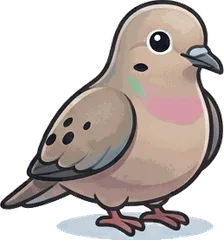 Mourning Dove
The owl's soft two-note coo-coooo can pass for a dove, but it is pitched higher than a Mourning Dove's coo and is often heard at night, when it sounds more like co-hoo.
- ?Short-eared Owl
Another owl that sits on open ground. Listen for its high, scratchy, bark-like call and, in courtship, the wing-clapping of displaying males. The Burrowing Owl's signature sounds are the gentle two-note coo and the rattling hiss from a burrow.
Where the Burrowing Owl card lives
The Burrowing Owl is not in the top 100 of any single state album, so it lives in the national album of all 800 birds, where it counts as uncommon. Catching one anywhere in the country adds it there.
 Heard one? Open Warble, tap the green button while it sings, and the Burrowing Owl card flips into your album. Get the app free.
Questions people ask
Why does a Burrowing Owl sound like a rattlesnake?
Because sounding like one probably keeps it safe. When threatened, the owl ducks into its burrow and makes a rattling hiss much like a rattlesnake's warning. Researchers consider it likely acoustic mimicry, and it seems to work best on animals that already fear rattlesnakes.
What does a Burrowing Owl's call sound like?
The male's song is a soft, mellow, two-note coo-coooo, higher than a Mourning Dove's. Around the nest the owls also cackle, cluck, chatter and scream, and they bob their heads when excited.
Are Burrowing Owls active during the day?
Yes, often. They stand outside their burrows in daylight, avoiding only the midday heat, and do most of their hunting around sunrise and sunset.
Do Burrowing Owls dig their own burrows?
In Florida, usually yes. In the West they mostly take over burrows dug by prairie dogs, ground squirrels, badgers and other animals, though owls in towns and cities have taken up digging where the soil is soft.
Sources
- National Audubon Society, Guide to North American Birds: Burrowing Owl. www.audubon.org/field-guide/bird/burrowing-owl
- Wikipedia: Burrowing owl (rattlesnake mimicry, range, burrows, conservation). en.wikipedia.org/wiki/Burrowing_owl
- Animal Diversity Web, University of Michigan: Athene cunicularia. animaldiversity.org/accounts/Athene_cunicularia/
- Buffalo Bill Center of the West, Draper Natural History Museum: Owl sounds, not just hooters. centerofthewest.org/2022/02/09/owl-sounds-not-just-hooters/