 Warble



An Olive-sided Flycatcher sounds like someone at the far end of a bar placing an order. The song is a loud, emphatic three-note phrase, written quick, three beers!, with the first note shorter and softer than the other two. Males repeat it in summer from the highest dead branch of a tall tree in northern conifer forests and high western mountains, usually beside a bog, pond, burn or clearing. The call is a loud, falling pip-pip-pip.
The birder's mnemonic
“quick, three beers!” The first syllable is shorter and quieter than the rest, so from a distance you may catch only the three beers.
What the song sounds like: quick, three beers
Few bird songs have a mnemonic that fits as well as this one. Both Audubon and Wikipedia give it as quick, three beers!, and once you hear the real thing it is hard to hear anything else. There are three notes: a short, quiet pickup, then two louder ones. It is emphatic more than pretty. For the full story of the phrase, see what bird says quick, three beers.
In spring the males sing almost constantly to claim and defend a nesting territory and to attract a mate. They usually sing from the same kind of place they hunt from: the very top of a tall tree, often a dead spike or a snag that sticks up above the forest. When a rival male turns up, the clean song gives way to growls and squeaks.
That habit makes a singing bird fairly easy to find. Follow the song up to the tallest dead tip in sight and look for a dark, big-headed silhouette sitting bolt upright.
The call: pip-pip-pip
The call you hear most often is a loud pip-pip-pip, three quick notes that fall slightly in pitch. The bird gives it at intervals from its high perch, so it is worth learning along with the song.
When and where you hear it
Olive-sided Flycatchers breed from California and New Mexico north to central Alaska, across most of Canada and in part of the northeastern United States. They want open edges in conifer country: the margins of bogs, ponds and clearings, burns and logged areas, up to about 10,000 feet in the Rockies, and almost always near water. In California some also nest near the coast in tall trees, including eucalyptus, in foothill canyons.
They are long-distance travelers. The species has the longest migration of any flycatcher that breeds in the United States, and some birds fly about 7,000 miles between central Alaska and Bolivia. Most winter in northern South America, with a few in Central America. They tend to migrate late in spring and early in fall, although the passage is spread over a long period.
This is a bird in trouble. It is listed as Near Threatened worldwide and as Threatened in Canada, and its numbers are estimated to have fallen by 79 percent over fifty years. Suspected causes include the loss of wintering forest in South America, falling numbers of flying insects, fire suppression and salvage logging after fires, which reduce the burned, open ground it hunts over.
What it looks like
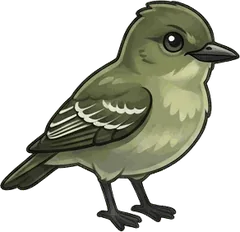
A stocky, big-headed, short-tailed flycatcher about 7 to 8 inches long, larger than a sparrow and smaller than a robin, and about twice the weight of a wood-pewee. It is dark olive-gray above, with dark mottled sides that frame a white stripe down the center of the chest like an unbuttoned vest. A white tuft sometimes peeks out above the wing, and it can raise a small crest. It hunts by watching from a high, exposed perch, flying out to snatch bees, honeybees included, wasps, winged ants and other flying insects in midair and returning to the same perch to eat. Nests sit on horizontal branches, usually in conifers, well out from the trunk. They have been found anywhere from 5 to nearly 200 feet up, and western birds tend to nest higher than eastern ones.
Birds that sound similar
- ?Alder Flycatcher
An Alder Flycatcher gives a burry, three-part fee-bee-o from low thickets of willows and alders near water. The Olive-sided's emphatic song comes from the very top of a tall tree.
 Eastern Wood-Pewee
Its smaller cousin sings a plaintive pee-ah-weee that falls on the last note, from the edges of clearings and woods. The Olive-sided's song is short and punchy, with the stress on the end.
Where the Olive-sided Flycatcher card lives
The Olive-sided Flycatcher is not in the top 100 of any single state album, so it lives in the national album of all 800 birds, where it counts as uncommon. Catching one anywhere in the country adds it there.
 Heard one? Open Warble, tap the green button while it sings, and the Olive-sided Flycatcher card flips into your album. Get the app free.
More about the Olive-sided Flycatcher on this site
Questions people ask
What bird says quick, three beers?
The Olive-sided Flycatcher. Its loud three-note song, quick, three beers!, comes from the top of a tall dead tree at the edge of a bog, pond, burn or clearing in northern conifer forests and western mountains in summer.
Why does the Olive-sided Flycatcher always sit on a dead treetop?
That is its hunting perch. It watches from the highest exposed branch, flies out to catch bees, wasps and other flying insects in the air, and returns to the same spot. It sings and calls from the same lookout.
How far does the Olive-sided Flycatcher migrate?
Farther than any other flycatcher that breeds in the United States. Some travel about 7,000 miles between central Alaska and Bolivia, and most spend the winter in northern South America.
Is the Olive-sided Flycatcher endangered?
It is not listed as endangered, but it is rated Near Threatened worldwide and Threatened in Canada. Its population is estimated to have dropped 79 percent over fifty years, possibly driven by the loss of wintering habitat.
Sources
- National Audubon Society, Guide to North American Birds: Olive-sided Flycatcher. www.audubon.org/field-guide/bird/olive-sided-flycatcher
- Wikipedia: Olive-sided flycatcher (song, migration, range, conservation status). en.wikipedia.org/wiki/Olive-sided_flycatcher
- National Audubon Society, Guide to North American Birds: Alder Flycatcher. www.audubon.org/field-guide/bird/alder-flycatcher
- National Audubon Society, Guide to North American Birds: Eastern Wood-Pewee. www.audubon.org/field-guide/bird/eastern-wood-pewee