 Warble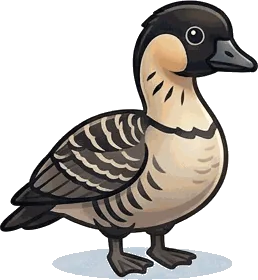
A Nene sounds like a goose talking quietly to itself. Its everyday call is a low, soft, murmuring nay-nay, which is where the Hawaiian name comes from. Families keep up this murmur while they graze, and it gets louder and shriller when a bird is alarmed, threatening a rival or calling to its mate during courtship. It is a smaller, gentler voice than the Canada Goose it descends from, and you hear it on Hawaii Island, Maui, Kauai and Molokai, from sea-level golf courses to volcanic slopes.
What the call sounds like
Start with the name. Wikipedia says the Hawaiian word nene comes from the bird's soft call, and the British Waterfowl Association, which has kept the species for decades, confirms that the calls really do sometimes sound like nay nay. It is a low, nasal, murmuring sound, closer to a mutter than to the brassy honk most people associate with geese.
Animal Diversity Web explains what the murmur is for. Nene forage in tight family groups, and the birds murmur as they walk and graze, which keeps each member a comfortable distance from the next. The sound from a flock on a lawn or a lava field is a running conversation, quiet and constant.
The loud calls: alarm, threat and courtship
The volume goes up when something is happening. Animal Diversity Web lists calls for family contact, for holding a territory, for alarm and for threatening predators, and describes a forward threat in which a goose raises its neck feathers, opens its bill and calls loudly before it charges. When a hawk or an owl passes over, the alarm call sends the family huddling together with wings spread, or into the air.
Courtship is loud too. Hawaii's Division of Forestry and Wildlife describes a male that threatens rivals, runs back to his mate and calls loudly. Goslings have their own small repertoire: pleasure calls, distress calls, sleepy calls and greeting calls.
When and where you hear it
The Nene lives only in Hawaii, today on Hawaii Island, Maui, Kauai and Molokai, with a single pair reported on Oahu in 2014. It once lived on all the main islands. Wikipedia traces it to Canada Geese that reached the islands roughly 500,000 years ago. Over that time it became a walking goose: longer legs, reduced webbing between the toes for crossing hardened lava, and wings about 16 percent smaller than a Canada Goose's, though it still flies well and can move between islands.
You can meet one from sea level to about 2,400 meters, on coastal dunes, pastures, golf courses, lava flows, native shrubland and alpine slopes. Nene are strict herbivores and eat the leaves, seeds, flowers and fruit of at least 50 kinds of plants, favoring the tender base of grass stems. The breeding season is unusual: it runs from August to April, longer than any other goose, with most nesting between October and March. The female lays one to five eggs, usually three, in a scrape under a bush, and sits for 29 to 32 days while the male stands guard. Pairs mate for life and the young stay with their parents for up to a year.
The Nene is famous as a comeback. About 25,000 lived in the islands when Captain Cook arrived in 1778. Hunting and introduced mongooses, cats, dogs and pigs cut that to around 30 wild birds by 1952. Hawaii made it the state bird in 1957, and a captive flock at Slimbridge in England, under Peter Scott, bred the species back from the edge. A 2022 count found 3,862 birds, which still makes it the world's rarest goose. In 2019 it was moved from endangered to threatened on the federal list, though the state still lists it as endangered. The main threats now are mongoose predation on eggs, toxoplasmosis carried by cats, vehicle strikes and people feeding them, which teaches the geese to walk up to cars. For Warble players the Nene is the one card in the Hawaii album that lives nowhere else on Earth.
What it looks like
A medium-sized goose, about 16 inches tall and 21 to 26 inches long, with males weighing roughly 3.7 to 6.7 pounds and females a little less. The face, crown and back of the neck are black, the cheeks are buff, and the front of the neck is pale with deep furrows that show as diagonal black-and-white stripes. The body is dark brown, the feet and bill are black, and the sexes look alike. A Nene can live up to 28 years in the wild and 42 in captivity.
Birds that sound similar
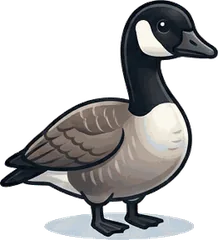 Canada Goose
The ancestor, and the bird most visitors expect a Nene to sound like. A Canada Goose gives a loud, two-part a-honk; the Nene's murmur is softer and lower, and it has buff cheeks instead of a white chin strap.
- ?Cackling Goose
A small relative with a Canada Goose's white chin strap and a high, yelping voice. The Nene has a striped, furrowed neck and a quiet nasal nay-nay rather than a cackle.
Where the Nene card lives
In Warble the same bird can be an easy card in one state and a prized one in another, because each album ranks its birds by how often people really report them there. The Nene appears in 1 state albums:
 Heard one? Open Warble, tap the green button while it sings, and the Nene card flips into your album. Get the app free.
Questions people ask
Why is it called a nene?
Because of the call. The Hawaiian name comes from the bird's soft, low, murmuring note, which really can sound like nay nay. The scientific name, Branta sandvicensis, refers to the Sandwich Islands, the old English name for Hawaii.
Is the nene the state bird of Hawaii?
Yes. Hawaii adopted the Nene as its state bird in 1957, when fewer than 50 birds were left in the wild. It is the only goose native to the islands and lives nowhere else.
How many nene are left?
A 2022 count found 3,862 birds, up from about 30 in the wild in 1952. That still makes it the world's rarest goose. In 2019 the federal government downlisted it from endangered to threatened, while the state of Hawaii still lists it as endangered.
Can nene fly?
Yes. Their wings are about 16 percent smaller than a Canada Goose's and they spend most of their time walking, with long legs and partly webbed feet suited to lava, but they fly well and can cross between islands.
Sources
- Wikipedia: Nene (bird) (name, ancestry, size, population history, state bird, breeding season). en.wikipedia.org/wiki/Nene_(bird)
- Animal Diversity Web: Branta sandvicensis (calls, threat displays, behavior, lifespan). animaldiversity.org/accounts/Branta_sandvicensis/
- Hawaii DLNR Division of Forestry and Wildlife: Nene. dlnr.hawaii.gov/wildlife/birds/nene/
- British Waterfowl Association: Nene (Hawaiian Goose). www.waterfowl.org.uk/wildfowl/swans-geese-allies/hawaiian-goose/